Customizing trading algorithms: step-by-step guide for crypto

TL;DR:
- Customizing trading algorithms in crypto requires careful tool selection, strategy definition, and robust testing.
- Separating signal generation from risk management enhances strategy flexibility and maintainability.
- Proper deployment and live monitoring are essential to adapt to market volatility and ensure sustained profitability.
Customizing trading algorithms: step-by-step guide for crypto
Most traders want more control over their automated strategies, but the moment someone mentions customizing algorithms, the room goes quiet. It sounds technical, time-consuming, and risky. The reality is that a well-customized trading algorithm is one of the most powerful advantages you can build in crypto markets that shift by the minute. This guide walks you through every practical step: from choosing the right tools and defining your strategy, to backtesting rigorously, deploying with confidence, and monitoring performance over time. Whether you are new to automation or refining a live strategy, what follows gives you a concrete roadmap.
Key Takeaways
| Point | Details |
|---|---|
| Choose the right platform | Select tools and frameworks that match your coding skill and trading goals. |
| Separate strategy and risk | Design your trading logic independently from risk controls for agility and better performance. |
| Test rigorously before going live | Always validate algorithms with backtesting, optimization, and dry-run phases to minimize unexpected losses. |
| Monitor real-time performance | Keep track of live results and adjust your strategy to handle volatility, slippage, and API issues. |
Essential tools and requirements for customizing trading algorithms
Now that you know why customizing algorithms matters, let’s identify the essential tools needed to get started. The good news is that the ecosystem has matured significantly. Platforms exist for every skill level, from experienced Python developers to traders who have never written a single line of code.

Code-based frameworks offer the most flexibility. Freqtrade is the leading open-source option, built entirely in Python. It supports custom indicator creation, complex entry and exit logic, hyperparameter optimization, and live trading across dozens of exchanges. If you understand Python at a basic level, Freqtrade gives you nearly unlimited control. CCXT is a complementary library that standardizes API connections to exchanges like Binance, making it easier to pull market data and execute orders without rewriting exchange-specific code for each platform.
No-code platforms are a legitimate entry point if Python is not your strength. Platforms like Zignaly and Tradetron let you configure crypto trading bot frameworks using visual rule builders, preset conditions, and drag-and-drop logic. They sacrifice some depth but dramatically reduce setup time. 3Commas sits in the middle, offering DCA (dollar-cost averaging) and grid bots with straightforward configuration panels and robust exchange integrations.
For data feeds, you need reliable real-time and historical price data. Binance’s REST and WebSocket APIs are the industry standard for live tick data. CoinGecko provides solid historical OHLCV (open, high, low, close, volume) data for backtesting across thousands of assets. Combining both gives you the breadth and depth to build and test strategies properly.
Here is a quick comparison of the major platforms:
| Platform | Skill level | Bot type | Exchange support | Open source |
|---|---|---|---|---|
| Freqtrade | Intermediate | Custom Python | 30+ via CCXT | Yes |
| 3Commas | Beginner | DCA, Grid | 23+ | No |
| Zignaly | Beginner | Signal-based | 10+ | No |
| Tradetron | Beginner/Mid | Visual rules | Multiple | No |
| CCXT library | Advanced | API bridge | 100+ | Yes |
Before you write a single line of logic, make sure you have:
- A funded exchange account with API key access enabled
- Read/write API permissions scoped only to trading (never withdrawal)
- Python 3.9 or higher installed locally if using Freqtrade
- At least 90 days of historical OHLCV data for your target pairs
- A paper trading or sandbox environment for initial testing
Exploring the broader landscape of algorithmic trading platforms before committing to one tool helps you avoid costly switching later. Match the platform to your real skill level, not the skill level you plan to have in six months.
Defining your trading strategy: Indicators, signals, and risk layers
With the right tools in place, the next step is to define your strategy components and risk controls. This is where most traders either get it right or set themselves up for failure. A strategy is not just a collection of indicators. It is a structured set of rules that tells your bot when to enter, when to exit, and how much risk to take on each trade.
Step 1: Choose your indicators. Indicators translate raw price and volume data into signals. The most commonly used ones in crypto strategies include:
- Moving averages (MA/EMA): Track trend direction. A 50-period EMA crossing above a 200-period EMA (the golden cross) is a classic bullish entry signal.
- RSI (Relative Strength Index): Measures momentum on a 0 to 100 scale. Below 30 typically signals oversold conditions; above 70 suggests overbought.
- Bollinger Bands: Show volatility by plotting standard deviation bands around a moving average. Price touching the lower band can signal a mean-reversion entry.
- MACD: Combines trend and momentum. Crossovers of the MACD line over the signal line are often used as entry triggers.
Step 2: Code entry and exit signals. In Freqtrade, these go into two dedicated functions: "populate_entry_trendandpopulate_exit_trend`. Your entry function scans each candle and applies your indicator conditions to generate buy signals. Your exit function does the reverse, flagging when to close positions. Strategy customization basics explains how to structure these functions cleanly for maintainability.
Step 3: Set risk parameters separately. This is critical. According to strategy callbacks guidance, you should separate concerns: your main strategy logic handles signals, while risk controls like stoploss, trailing stop, and minimal ROI live in their own configuration or callback functions. Mixing the two creates brittle code that is hard to debug and even harder to optimize.
Here are the core risk parameters you need to set from day one:
| Parameter | Purpose | Example value |
|---|---|---|
| stoploss | Max loss before exit | -0.05 (5%) |
| minimal_roi | Target profit at time intervals | {“0”: 0.10, “30”: 0.05} |
| trailing_stop | Dynamic stop that follows price up | True |
| max_open_trades | Limits simultaneous exposure | 3 |
Pro Tip: Use Freqtrade’s custom_stoploss callback to build dynamic stops that adjust based on volatility or trade duration. A fixed 5% stoploss that works in a low-volatility period will get triggered constantly during a high-volatility event like a major Fed announcement or exchange hack.
Layering risk management automation separately from your signal logic makes it far easier to swap one without breaking the other. This architectural discipline is what separates a strategy you can actually maintain from one that becomes a tangled mess after a few updates. Solid crypto trading bot risk layers protect your capital when signals fail, and they always do occasionally.
Backtesting and optimizing algorithms: Validating performance before going live
Once your strategy is designed, rigorous testing and optimization are essential to ensure reliability and profitability. Skipping this step is the single most expensive mistake a trader can make. A strategy that looks brilliant on paper can bleed capital in live markets if it has never been stress-tested properly.
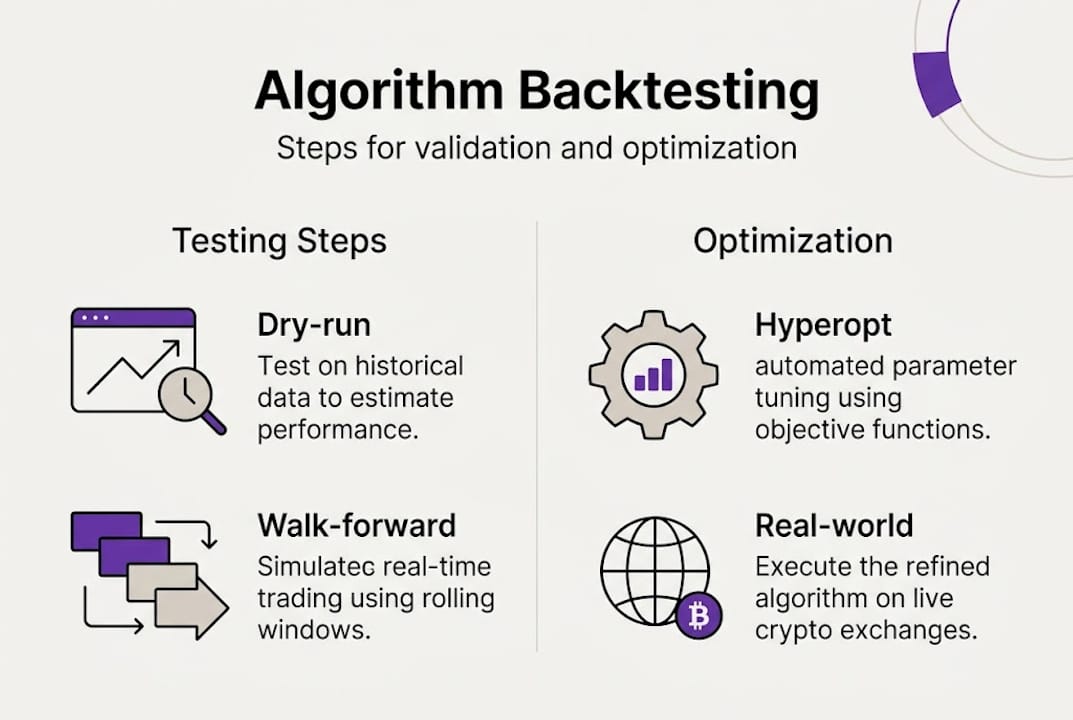
The validation process follows four stages:
- Historical backtesting: Feed your strategy months or years of OHLCV data and simulate how it would have performed. Freqtrade’s
backtestingcommand makes this straightforward. Backtesting methodology requires using the same data format and timeframe you plan to trade live. - Hyperparameter optimization (Hyperopt): Once your baseline backtest looks promising, use Freqtrade’s Hyperopt module to systematically search for better indicator settings, RSI thresholds, MA periods, or stoploss levels. This automates what would otherwise be hours of manual tweaking.
- Out-of-sample and walk-forward testing: Split your historical data into training and testing sets. Optimize on the training set, then validate on data the algorithm has never seen. Walk-forward testing repeats this across rolling windows to check consistency.
- Dry-run (paper trading): Deploy your strategy in a simulated environment using real-time market data but no real capital. This catches issues that historical data simply cannot reveal: API timeouts, unexpected order fills, and logic errors under live conditions.
The most common errors to avoid:
- Lookahead bias: Using future data to make past decisions. This inflates backtest results dramatically. Always use recursive (not vectorized) analysis to confirm your indicators do not peek ahead.
- Overfitting: Over-optimizing parameters to historical data until the strategy works perfectly on that data and nowhere else. If your strategy has 40 parameters and was optimized on 60 days of data, it is almost certainly overfit.
- Ignoring costs: A strategy that generates 0.3% average profit per trade looks great until you factor in a 0.1% maker fee and 0.1% taker fee. Realistic backtesting requires including fees, slippage, and latency in every simulation.
Pro Tip: Run at least two weeks of dry-run testing before going live, not two days. Most edge cases, including exchange outages, thin order books, and sudden volatility spikes, only appear after sustained operation.
Proper testing can meaningfully improve real-world results. Strategies that go through full hyperopt plus walk-forward validation consistently outperform those deployed straight from a basic backtest. Explore more about optimizing crypto trading bots and mastering algorithmic trading to build your optimization skills systematically.
Deploying and monitoring your custom trading algorithm
After validation, you are ready to deploy and monitor your algorithm in the real market environment. This phase is where theory meets reality, and the gap between the two is often wider than traders expect.
Launching your algorithm depends on your platform. In Freqtrade, the freqtrade new-strategy command creates a clean strategy template, and the freqtrade trade command launches it in live mode with your exchange API credentials. For 3Commas users, deployment means activating your configured bot through their dashboard and connecting it to your exchange via API keys.
Key things to monitor once you go live:
- Log output: Freqtrade generates detailed logs for every trade decision. Review them daily, especially in the first two weeks, to catch logic errors and unexpected behavior.
- Slippage: The difference between your expected fill price and the actual fill price. In illiquid markets or during news events, slippage can erode profits significantly. Adjust your profit targets to account for it.
- API rate limits: Exchanges cap how many API requests you can make per minute. If your strategy polls the exchange too frequently, you will hit limits and miss trade opportunities or trigger errors.
- Order fill confirmation: Always verify that orders are actually filled and not sitting as open orders indefinitely. Partial fills on large orders can skew your position sizing.
Critical note: Never modify OHLCV (open, high, low, close, volume) columns in your strategy’s dataframe during live deployment. Freqtrade and similar frameworks rely on these columns being immutable. Altering them can introduce silent bugs that cause incorrect signals, wrong position sizes, or missed exits.
Handling volatility correctly is an art. High volatility edge cases require different stop strategies: swing traders should use wider stops to avoid being shaken out of valid positions, while scalpers need tighter stops because each trade targets a smaller margin. A one-size-fits-all stoploss will hurt you in at least one of these scenarios.
For a deeper look at safe crypto trading automation, reviewing documented case studies of what goes wrong in live deployment is far more instructive than any theoretical guide.
A smarter way to customize trading algorithms: Lessons learned
Here is something most step-by-step guides will not tell you: the traders who consistently profit from custom algorithms are not the ones with the most indicators or the most optimized parameters. They are the ones who invest in architecture. The way your code is organized matters as much as the logic inside it.
The biggest trap we see is over-optimization. Traders spend weeks tuning RSI thresholds down to decimal points while their live monitoring setup is a single Telegram alert. Then the algorithm runs off-script during an unexpected market event, and no one notices for hours. Real profit comes from robust live monitoring and rapid response, not from squeezing another 0.2% out of a backtest.
The strategy callbacks approach that separates risk logic from signal logic is the single most important architectural decision you can make. When your risk layer is independent, you can adjust stops, position sizing, or exposure limits without touching your core strategy. That kind of modularity is what lets you adapt quickly when market conditions shift.
Another overlooked insight: adaptive data streams beat static historical optimization every time. A strategy built on robust, real-time data feeds that adjusts its behavior based on current volatility regimes will consistently outperform a beautifully optimized static strategy in the long run. Build in real-world risk layering from the start, not as an afterthought. Your future self will thank you.
Next steps: Portfolio management and optimization tools
If you are ready to leverage advanced tools for portfolio management, here is where to start. Building a strong custom algorithm is just one piece of the puzzle. Sustained success in crypto trading requires continuous performance monitoring, automated rebalancing, and real-time analytics that respond to market shifts as they happen.
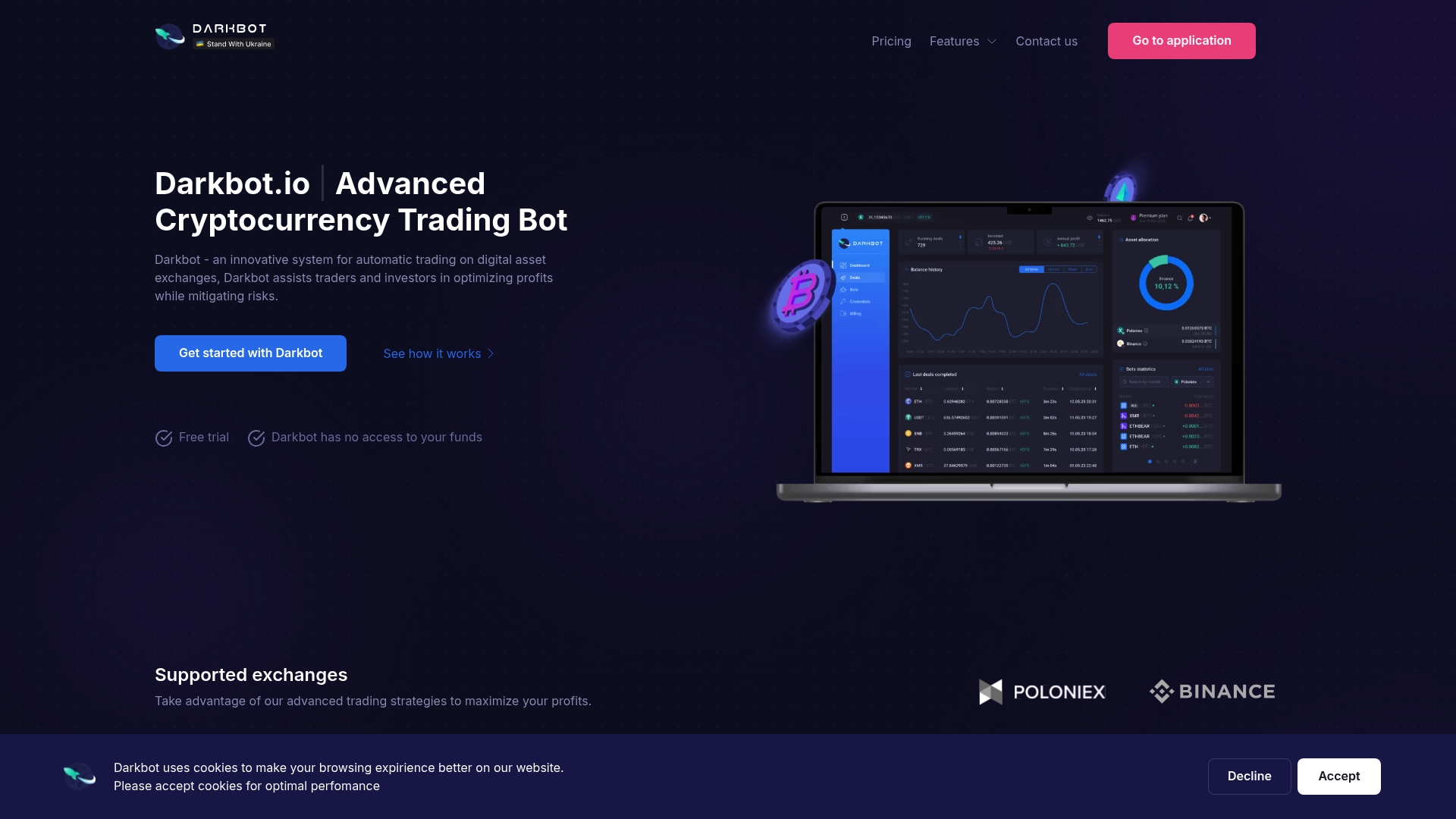
Darkbot.io brings together everything covered in this guide under one platform. From portfolio management tools that give you live oversight of all your positions, to AI-driven strategy optimization and multi-exchange support, the Darkbot platform is built for traders who want automation without sacrificing control. Whether you are running your first bot or managing a diversified crypto portfolio across five exchanges, Darkbot’s flexible pricing tiers and personalized support make it straightforward to scale your trading operations confidently and securely.
Frequently asked questions
What is the best platform for customizing trading algorithms in crypto?
Freqtrade is one of the most flexible open-source frameworks for Python users, while platforms like 3Commas and Zignaly offer intuitive interfaces for no-code customization. Your best choice depends on your technical skill level and how much control you need.
How can traders avoid overfitting their algorithms?
By using out-of-sample testing and walk-forward validation, including realistic fees and slippage in every backtest, traders significantly reduce the risk of building strategies that only work on historical data.
What are common mistakes when deploying trading algorithms?
The most frequent errors include ignoring API rate limits, applying the wrong stoploss width for your trading style, and modifying OHLCV columns during live deployment, which introduces silent bugs that corrupt signal logic.
Which risk parameters are most important in crypto trading bots?
Stoploss and minimal ROI are the two foundational parameters, as confirmed by Freqtrade’s strategy guide. Together they define your maximum acceptable loss and your target profit thresholds, forming the backbone of any automated risk framework.
Recommended

Start trading on Darkbot with ease
Come and explore our crypto trading platform by connecting your free account!
Free plan available • No credit card required