Why automate your Binance strategy for peak efficiency
TL;DR:
- Automated trading bots on Binance can outperform manual strategies by over 100%.
- Automation enhances speed, consistency, and enables complex strategies impossible manually.
- Active monitoring and risk management are crucial to prevent technical, security, and volatility-related losses.
Automated trading bots on Binance can outperform manual strategies by over 100%, and that single fact forces every serious trader to reconsider their approach. Most traders experience the same frustration: they miss a breakout while sleeping, sell too early because panic sets in, or hold too long because hope overrides logic. These are not skill failures. They are human failures, and no amount of screen time fixes them. Automation addresses exactly those gaps. This article walks through how automated trading works on Binance, why speed and strategy diversity matter, which risks you must manage, and how AI tools are quietly reshaping what is possible for retail traders.
Key Takeaways
| Point | Details |
|---|---|
| Eliminates emotional bias | Automation on Binance reduces impulsive trading decisions and improves discipline. |
| Faster trade execution | API-driven bots execute trades instantly and minimize losses from market volatility. |
| Diverse strategies enabled | Automation supports a wide range of trading methods, including advanced AI and traditional approaches. |
| Risks require vigilance | Automation comes with technical and security risks that demand constant monitoring and smart risk management. |
Understanding automated trading on Binance
Automated trading means letting software execute buy and sell orders on your behalf, based on rules you define in advance. Instead of watching charts for hours and reacting in real time, you program a strategy and the bot carries it out systematically. On Binance, this is possible through several routes: Binance’s own built-in bot tools, third-party platforms that connect via API, or custom scripts written by developers. Each option has its trade-offs in flexibility, cost, and complexity.
What makes automation genuinely valuable is not just convenience. It is the elimination of the cognitive distortions that damage manual trading performance. Fear of missing out drives traders to chase pumps. Loss aversion causes them to hold losers too long. Overconfidence leads to oversized positions. A bot has none of those problems. It executes the rules, every time, without hesitation.
Automated trading on Binance generally works through the following core components:
- Strategy logic: The set of conditions that trigger a buy or sell, such as moving average crossovers, RSI thresholds, or price band boundaries.
- Order execution layer: The mechanism that sends orders to Binance through the API at the right moment.
- Portfolio and position tracking: Real-time monitoring of open trades, available capital, and cumulative performance.
- Risk controls: Hard-coded limits such as maximum drawdown, stop-loss levels, and position sizing rules that cap potential losses.
The result is a system that can trade 24 hours a day, seven days a week, without fatigue or distraction. Crypto markets never close, and manual traders are always fighting that structural disadvantage.
“Eliminates emotional decision-making, reducing impulsive trades driven by fear or greed.” Automated trading on Binance captures exactly why systematic execution outperforms gut-feel trading over any extended period.
The automation benefits for Binance users go beyond just saving time. The deeper gain is consistency: a bot that executes your edge every single time it appears in the market, without exception. For a thorough walkthrough of setup options, the guide to using Binance trading bots covers the practical steps from API key configuration to live deployment.
How automation boosts efficiency and speed
Now that we understand what automation means, let’s look at its most practical advantage: speed and efficiency. In cryptocurrency markets, prices move fast. Very fast. A Bitcoin price move of 2% can happen in under 60 seconds during high-volatility windows. Manual traders simply cannot react at machine speed, and that gap creates real financial cost through slippage, missed entries, and delayed exits.
Trading APIs, like the one Binance provides, allow bots to send and receive order information in milliseconds. That matters enormously when you are trading in markets where price impact accumulates with every second of delay. Faster execution via API directly minimizes delays and reduces slippage in volatile markets, and that alone can be the difference between a profitable trade and a marginal one.
Here is how automated and manual execution compare across key efficiency metrics:
| Metric | Manual trading | Automated trading |
|---|---|---|
| Order execution time | 3 to 10 seconds | Under 100 milliseconds |
| Average slippage (volatile market) | 0.3% to 1.5% | 0.05% to 0.2% |
| Available trading hours | Limited (8 to 12 hours typical) | 24 hours, 7 days a week |
| Simultaneous strategies managed | 1 to 2 | 10 or more |
| Reaction to news event | 15 to 60 seconds | Instant (if preconfigured) |
The table makes it clear that the gap is not marginal. It is structural. A trader running three simultaneous bots on Binance is effectively operating at a scale and speed no individual can match manually, without working extra hours or hiring a team.
The efficiency gains also compound over time. Lower slippage on every trade means more capital preserved. Consistent execution means your strategy’s actual performance matches its backtested results more closely. And around-the-clock operation means you capture opportunities in Asian and European market sessions that most US-based manual traders miss entirely.
Understanding how this connects to your exchange setup is worth the time. The article on API trading integration explains how API keys, permissions, and rate limits affect the practical performance of any Binance bot.
Pro Tip: Before going live with any bot, run a latency test on your API connection and simulate order routing under high-volume conditions. A bot that performs well in low-volatility backtests can behave unexpectedly when the market is moving fast and API rate limits kick in.
Diverse strategies enabled by automation
Beyond speed, automation opens up a range of strategies that simply are not feasible to run manually. Some require placing dozens of orders simultaneously. Others demand constant recalibration based on real-time data. A few require monitoring hundreds of trading pairs at once for pricing inefficiencies. None of these are realistic without software.
The range of supported strategies includes grid trading, arbitrage, market-making, trend following, and AI-based prediction models, each suited to different market conditions and risk tolerances. Here is a quick breakdown of the most popular ones:
- Grid trading: Places buy and sell orders at regular price intervals, profiting from the natural oscillation of price within a range. Works best in sideways markets.
- Arbitrage: Exploits price differences between exchanges or trading pairs. Requires speed that only automation can deliver.
- Market-making: Simultaneously places bids and asks around the current price to capture the spread. Requires constant order management.
- Trend following: Uses technical indicators to ride momentum in either direction. Can be adapted for both bull and bear conditions.
- AI-based prediction: Uses machine learning models trained on historical data to forecast price direction and adjust position sizing accordingly.
The performance data on AI-driven bots is worth pausing on. Reinforcement learning bots (a type of machine learning where the algorithm learns by trial and reward) have shown a +144% change in balance with a Sharpe ratio of 1.85 in empirical benchmarks. Deep reinforcement learning bots have recorded returns exceeding 258% under controlled conditions. These are not marketing numbers. They come from academic and industry performance studies.
Even more practically, AI-driven tools like Binance AI Pro automate analysis, execution, and monitoring, bringing institutional-grade capabilities to retail traders. When you combine AI analysis with automated execution, you remove two of the biggest manual trading weaknesses at once: slow analysis and slow reaction.
| Strategy type | Requires automation? | Typical win rate | Best market condition |
|---|---|---|---|
| Grid trading | Recommended | 55 to 65% | Sideways or low volatility |
| Arbitrage | Required | 70 to 80% | Any (fast execution needed) |
| Trend following | Optional | 45 to 55% | Trending markets |
| AI/ML prediction | Required | 60 to 65% | Mixed conditions |
| Market-making | Required | 65 to 75% | High-volume pairs |
The numbers on machine learning in trading continue to improve as models are trained on larger datasets and refined with better feature engineering. And for traders interested in the broader picture of how AI improves trading efficiency, the shift from rule-based bots to adaptive AI systems is one of the most significant developments in the space right now. In real 30-day backtests, AI bots have recorded 60 to 65% win rates and a return on investment of +21.4%, demonstrating that the performance edge is repeatable, not just theoretical.
Risk management and common pitfalls
While the upsides are clear, automation comes with real risks that every trader needs to manage deliberately. The risks are not small or rare. They include technical failures, security vulnerabilities, unexpected volatility, and API rate limit breaches, all of which can cause partial or total loss of trading capital if not addressed.
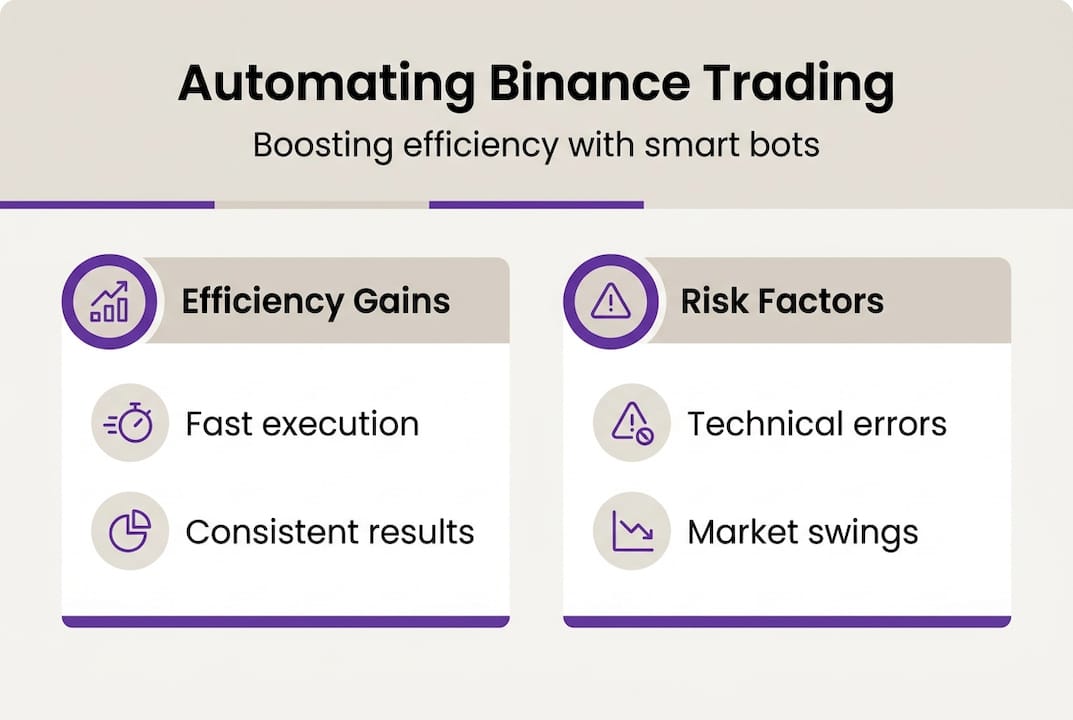
Technical failures, security issues, and volatility losses are among the most commonly cited risks of automated trading on Binance, and each requires its own mitigation approach. Unauthorized access to your API keys, for example, can give a malicious actor the ability to drain your account through rapid, unauthorized trades. This is not hypothetical. It has happened to traders who used API keys with overly broad permissions or stored them insecurely.
Here are five essential risk management steps every automated trader on Binance should follow:
- Restrict API key permissions. Never enable withdrawal permissions on API keys used by trading bots. Limit keys to trading only, and whitelist specific IP addresses wherever the exchange allows it.
- Set hard stop-loss rules in your bot logic. Do not rely on mental stops. Code the maximum drawdown you are willing to accept and make sure the bot halts or reduces exposure when that threshold is hit.
- Monitor bot activity in real time. Automation does not mean walking away. Check performance logs daily and set alerts for unusual behavior, such as a spike in trade volume or a string of consecutive losses.
- Run parallel paper trading alongside live bots. Test any strategy change in a simulated environment before deploying it live. Even small parameter tweaks can have large performance consequences.
- Diversify across bots and strategies. Running all your capital in one bot, using one strategy, on one trading pair, concentrates risk dangerously. Spread exposure across multiple configurations.
Understanding smart crypto risk management is not optional when you automate. It is the foundation that keeps automation working in your favor instead of against you. A structured crypto trading risk checklist can help you build the habit of reviewing your setup regularly rather than assuming it is running correctly. For traders who want a grounded explanation of what risk management means in this context, the resource on risk management definitions is a solid starting point. For those already running bots who want to optimize security and profit simultaneously, the deeper guide on robot trading risk management covers advanced configurations worth implementing.
Pro Tip: Set your bot’s maximum position size to no more than 5% of your total account per trade when starting out. It feels conservative until the day a flash crash hits and your controlled position sizes mean you are still trading the next morning.
A fresh perspective on automation: What experts miss
Most automation coverage focuses on the upside and lists the risks at the end as a disclaimer. That framing is backwards. The traders who fail with bots are not the ones who chose the wrong strategy. They are the ones who treated automation as a “set-and-forget” solution and stopped paying attention.
Bots amplify whatever you build into them. A well-designed bot amplifies a good edge. A poorly monitored bot amplifies risk, especially during extreme volatility events like exchange outages, liquidation cascades, or sudden regulatory announcements. No pre-set rule can fully anticipate those scenarios.
The most durable results in automated trading come from combining systematic execution with disciplined human review. That means checking your bots daily, reviewing performance weekly, and adjusting strategy parameters monthly based on changing market conditions. Automation removes the need for real-time human reaction. It does not remove the need for ongoing human judgment.
The automated trading advantages are real and measurable, but they belong to traders who stay engaged, not those who disengage entirely. The best traders using bots today think of themselves as operators, not passengers.
Take the next step: Automated trading tools for Binance
For traders ready to put these principles into practice, Darkbot.io brings together the tools needed to automate Binance trading with confidence.
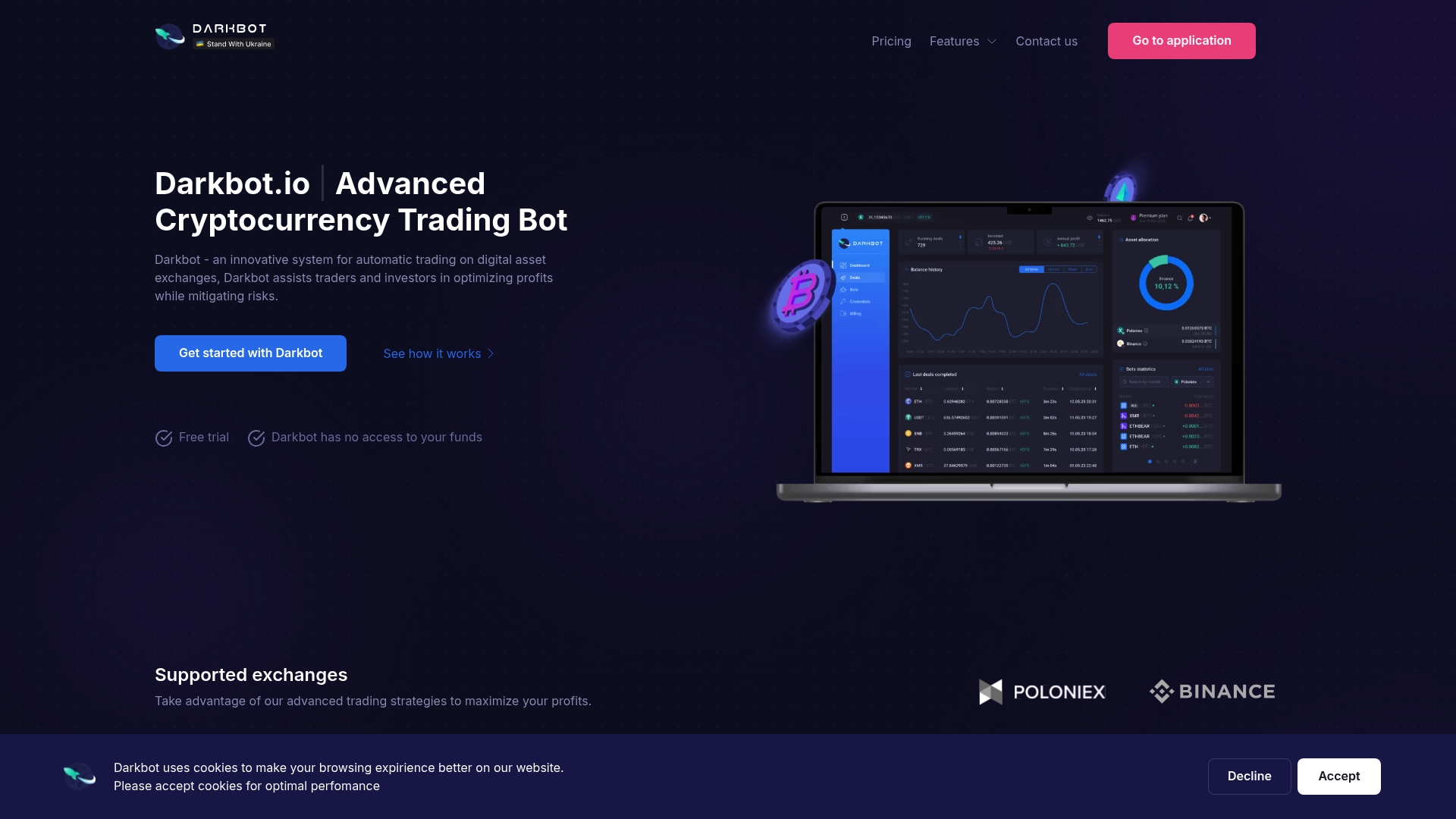
Darkbot’s AI crypto trading bot connects to Binance via secure API integration, supporting multiple simultaneous strategies with real-time performance analytics. Whether you are running a grid bot on stablecoin pairs or an AI-driven trend strategy on BTC, the platform gives you the controls to fine-tune risk parameters, monitor execution, and scale efficiently. The crypto portfolio management feature also handles automated rebalancing, so your capital allocation stays aligned with your strategy even as prices shift. From free-tier exploration to advanced premium configurations, Darkbot makes professional-grade automation accessible to traders at every level.
Frequently asked questions
What types of trading strategies can be automated on Binance?
On Binance, you can automate grid trading, arbitrage, market-making, trend following, and AI-based prediction strategies, covering everything from range-bound markets to momentum plays.
Are automated trading bots more profitable than manual trading?
Empirical benchmarks show that well-designed bots outperform manual trading significantly, with reinforcement learning bots posting +144% balance changes and Sharpe ratios above 1.85 in controlled studies.
What are the main risks involved in automating trading on Binance?
Technical failures, security gaps, unpredictable market volatility, and API rate limit breaches are the primary risks, all of which require active monitoring and conservative configuration to manage effectively.
How does AI improve automated trading on Binance?
AI-driven tools automate data analysis, trade execution, and market monitoring simultaneously, removing the speed and cognitive limitations that hold manual traders back.
Recommended

Start trading on Darkbot with ease
Come and explore our crypto trading platform by connecting your free account!
Free plan available • No credit card required