What is strategy customization for crypto trading bots

Most crypto traders assume automation equals hands-off profits. The reality? Even the most sophisticated trading bot fails without proper strategy customization. Generic algorithms can’t adapt to your risk tolerance, market conditions, or profit goals. This guide reveals how strategy customization transforms automated trading from a blunt instrument into a precision tool, covering core concepts, proven methodologies, expert validation techniques, and practical implementation steps that separate profitable automation from expensive mistakes.
Key Takeaways
| Point | Details |
|---|---|
| Tailored automation | Customizing bots to fit your risk tolerance, goals, and market conditions turns automation into a precision tool rather than a one size fits all solution. |
| Testing and validation | Backtesting, dry run, live trading with risk controls, and paper trading provide essential validation before risking real capital. |
| Range of techniques | Strategies span rule based logic to AI and reinforcement learning with each bringing tradeoffs in transparency, adaptability, and potential overfitting. |
| Adaptive ensemble approaches | Using multiple strategies with adaptive switching improves robustness in shifting markets. |
Understanding strategy customization in crypto trading
Strategy customization in cryptocurrency trading refers to tailoring automated bots or algorithms to implement user-defined logic for entry/exit signals, indicators, risk parameters, and position sizing. This process transforms generic automation into a personalized trading system aligned with your objectives and market view.
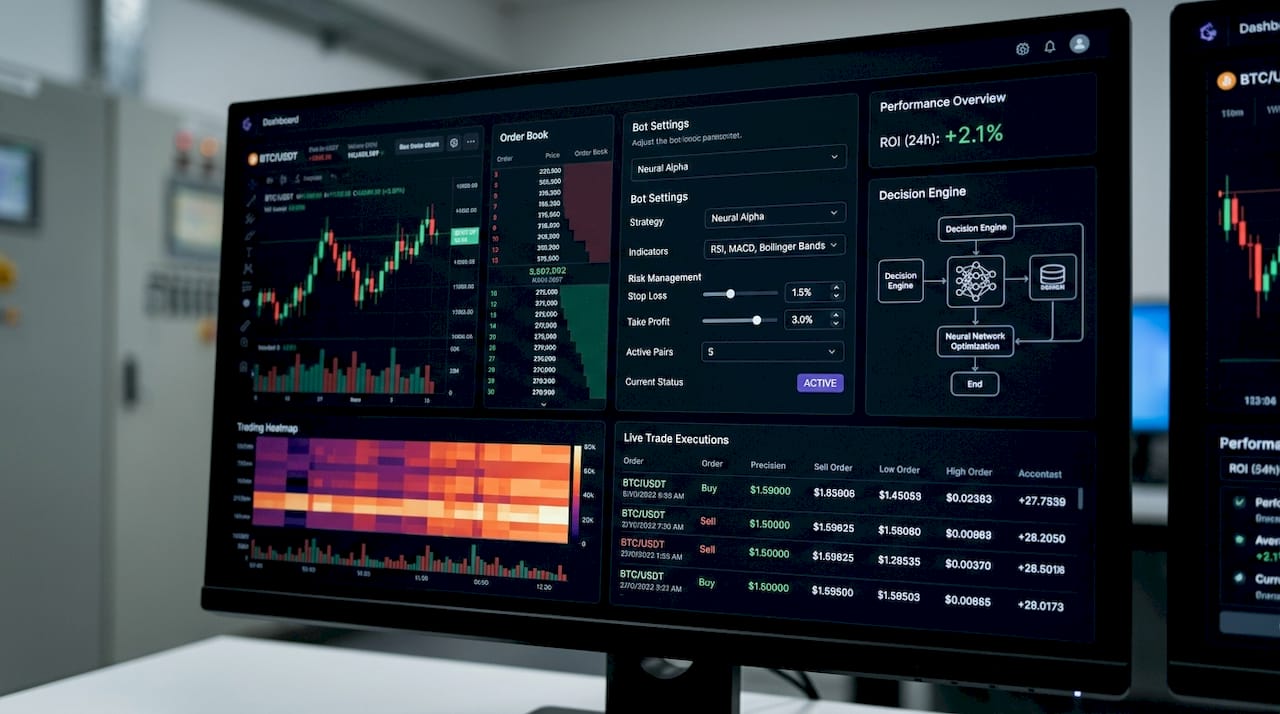
The foundation consists of three core building blocks. Technical indicators like RSI, MACD, and Bollinger Bands generate market signals. Entry and exit logic defines precise conditions for opening and closing positions. Risk management parameters control position sizing, stop losses, and profit targets. Together, these elements create a complete trading strategy.
Common customization parameters include ROI goals that specify profit targets at different time intervals, stop loss thresholds that limit downside exposure, and startup candle count that ensures sufficient data before trading begins. Platforms like Freqtrade, Gunbot, and 3Commas support extensive customization through code-based or GUI interfaces.
Successful implementation requires rigorous testing across multiple operational modes:
- Backtesting validates strategy performance against historical data
- Dry-run mode simulates live trading without real capital exposure
- Live trading executes actual orders with proper risk controls
- Paper trading provides additional validation in simulated environments
The customize trading bots process demands both technical understanding and practical market experience. You must balance complexity against robustness, ensuring your customized strategy performs reliably across different market conditions without excessive optimization that leads to fragility.
Techniques and methodologies for customizing crypto trading strategies
Rule-based systems form the foundation of strategy customization, relying on traditional technical indicators and fixed signal logic. These approaches use explicit conditions like “buy when RSI drops below 30 and MACD crosses bullish” to generate trades. The simplicity provides transparency and robustness, making rule-based systems easier to debug and validate. However, they struggle with regime changes and non-stationary market dynamics.
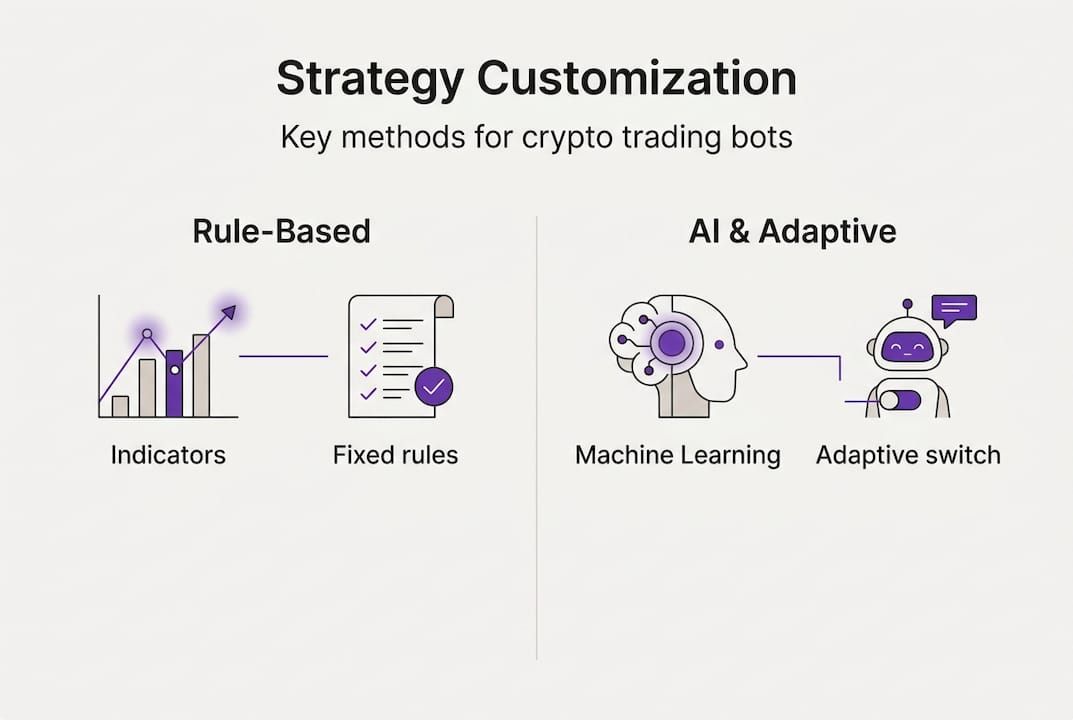
AI and machine learning methodologies include rule-based, AI/ML integration, reinforcement learning, and adaptive switching for portfolio optimization. These data-driven models identify complex patterns and relationships that traditional indicators miss. Neural networks, decision trees, and ensemble methods can dynamically adjust to evolving market conditions. The primary risk involves overfitting, where models perform brilliantly on historical data but fail in live trading.
Reinforcement learning represents the cutting edge of strategy customization. Application of reinforcement learning achieves excess returns of 152% with Sharpe ratios above 2.8 on ETH/USDT pairs. These models learn optimal trading policies through trial and error, continuously improving as they interact with market environments. Techniques like Soft Actor-Critic (SAC) and Proximal Policy Optimization (PPO) balance exploration and exploitation to maximize long-term rewards.
Adaptive switching enables selecting the best performing strategy based on recent backtests or validation metrics. This meta-strategy approach runs multiple customized strategies in parallel, allocating capital to whichever performs best under current conditions. You effectively hedge against individual strategy weaknesses while capturing diverse market opportunities.
Pro Tip: Combine multiple methodologies rather than relying on a single approach. A hybrid system using rule-based filters with machine learning in trading strategies for signal refinement often outperforms pure implementations. The rule layer prevents catastrophic ML errors while the adaptive layer captures subtle patterns.
No single methodology dominates across all market conditions. Understanding the tradeoffs between simplicity and sophistication, transparency and performance, robustness and adaptability guides effective customization decisions. The goal is not the most complex system but the most reliable one for your specific trading objectives and use ai in trading context.
Common pitfalls, expert nuances, and best practices in strategy customization
Overfitting represents the most dangerous trap in strategy customization. Excessive optimization on historical data creates strategies that perform brilliantly in backtests but fail catastrophically in live markets. This occurs when you test hundreds of parameter combinations, inadvertently fitting your strategy to random noise rather than genuine market patterns. The result looks impressive until real money enters the equation.
Backtest to live variance stems from multiple sources that simulations often ignore. Slippage between your order price and execution price erodes profits in volatile markets. Incomplete candle data during live trading creates signals that wouldn’t exist in clean historical datasets. Order book depth affects large positions differently than backtests assume. These factors compound to create significant performance gaps.
Edge cases like overfitting, incomplete data effects, regime shifts, and tail risks degrade performance significantly. Market regime shifts occur when fundamental dynamics change, rendering previously profitable strategies obsolete. A strategy optimized for trending markets suffers during ranging conditions. Tail risk events like flash crashes or regulatory announcements create losses that historical data rarely captures.
Expert practitioners implement robust validation frameworks:
- Reserve 20-30% of data for out-of-sample testing never used during optimization
- Apply walk-forward analysis that progressively tests strategy on unseen future periods
- Use Monte Carlo simulations to stress test against randomized market scenarios
- Implement CVaR (Conditional Value at Risk) metrics to quantify tail risk exposure
- Track live performance metrics that diverge from backtest expectations
Experts recommend using startup_candle_count, Kelly Criterion for sizing, OCO orders, multi-timeframe filters, and ensemble approaches. The startup candle count ensures sufficient data accumulates before trading begins, preventing premature signals. Kelly Criterion calculates optimal position sizes based on win rate and risk-reward ratios, maximizing long-term growth while controlling drawdowns.
Multi-timeframe analysis filters false signals by requiring confirmation across different time horizons. A buy signal on the 5-minute chart gains validation from bullish alignment on hourly and daily timeframes. This layered approach reduces whipsaws and improves signal quality.
Pro Tip: Implement circuit breakers that halt trading after consecutive losses or during extreme volatility spikes. Set a maximum daily loss threshold of 2-3% of capital and stop all bots when reached. This simple risk management in crypto trading rule prevents catastrophic drawdowns during black swan events.
Ensemble strategies combine multiple uncorrelated approaches to smooth returns and reduce individual strategy risk. Rather than betting everything on one customized strategy, allocate capital across momentum, mean reversion, and breakout systems. When one underperforms, others compensate, creating more consistent overall results. This diversification principle applies to strategy customization just as it does to asset allocation, making risk management in crypto 2026 more robust and reliable.
Applying strategy customization: tools, validation, and risk management for crypto traders
Selecting the right platform determines your customization capabilities and learning curve. Freqtrade offers maximum flexibility through Python-based strategy development, supporting advanced features like custom indicators, hyperparameter optimization, and edge positioning. Gunbot provides a middle ground with both GUI configuration and custom strategy scripting. 3Commas emphasizes ease of use with visual strategy builders suitable for traders without programming experience.
| Platform | Customization Depth | Ease of Use | Best For |
|---|---|---|---|
| Freqtrade | Very High (Python) | Moderate | Technical traders wanting full control |
| Gunbot | High (JavaScript) | Moderate | Balanced customization and usability |
| 3Commas | Moderate (GUI) | High | Beginners prioritizing simplicity |
| Darkbot | High (AI-enhanced) | High | Adaptive automation with ML |
Start with templates on platforms like Freqtrade or Gunbot, then modify incrementally rather than building from scratch. This approach provides working foundations while teaching customization mechanics through practical iteration. Test each modification thoroughly before adding complexity.
Rigorous backtesting must include realistic transaction costs and slippage assumptions. Exchange fees typically range from 0.1% to 0.25% per trade, while slippage adds another 0.05% to 0.2% depending on liquidity and order size. A strategy showing 50% annual returns with zero costs might barely break even with realistic friction. Always model worst-case scenarios.
Critical risk controls protect capital during strategy deployment:
- Limit position sizing to 1-2% of total capital per trade using Kelly Criterion calculations
- Restrict API keys to trade-only permissions, never allowing withdrawals
- Implement hard stop losses at 2-3% below entry prices to cap single-trade losses
- Use trailing stops to lock in profits as positions move favorably
- Set maximum daily loss limits that halt all trading when breached
Risk management essentials include API security with trade-only keys, position sizing using Kelly Criterion, stops, trailing stops, and circuit breakers. Never grant bots withdrawal permissions or store large balances on exchange accounts. Keep the majority of capital in cold storage, transferring only active trading amounts to exchange wallets.
Continuous validation prevents the “set and forget” mistake that destroys accounts. Monitor live performance daily against backtest expectations. Track metrics like win rate, average profit per trade, maximum drawdown, and Sharpe ratio. Significant deviations signal strategy degradation requiring immediate attention. Schedule monthly strategy reviews to assess whether market conditions still favor your approach.
Pro Tip: Maintain a trading journal documenting every strategy modification, the rationale behind changes, and resulting performance impacts. This record identifies what actually works versus what seems logical but fails in practice. Over time, you build institutional knowledge about effective risk management in crypto trading bots specific to your style and market focus.
Start small with minimal capital during initial live deployment, even after extensive backtesting. Real market conditions always reveal issues that simulations miss. Gradually scale position sizes as your customized strategy proves reliable over weeks and months. Patience during this validation phase prevents costly mistakes and builds confidence in your customize trading bots approach for long-term success.
Explore Darkbot for customizable crypto trading automation
Strategy customization reaches its full potential when paired with sophisticated infrastructure and adaptive intelligence. AI-powered cryptocurrency trading bot solutions from Darkbot combine advanced customization capabilities with machine learning optimization, creating systems that evolve with market conditions rather than remaining static.
The platform supports comprehensive strategy development while handling the complex infrastructure requirements that often overwhelm individual traders. Automated portfolio rebalancing, risk-adjusted position sizing, and real-time performance analytics work seamlessly with your customized trading logic.
Darkbot’s cryptocurrency portfolio management tools integrate directly with your custom strategies, enabling sophisticated multi-strategy deployments across different market conditions and asset pairs. The system monitors performance continuously, alerting you to degradation while suggesting optimization opportunities based on current market dynamics. This combination of human strategy insight and automated execution efficiency delivers the consistent results serious crypto traders demand.
Frequently asked questions about strategy customization
What is strategy customization in crypto trading bots?
Strategy customization means programming your trading bot with specific rules, indicators, and risk parameters that match your trading goals and risk tolerance. Instead of using generic pre-built strategies, you define exactly when the bot enters trades, sets profit targets, places stop losses, and sizes positions. This personalization transforms basic automation into a sophisticated system aligned with your market view and capital management approach.
How does customized strategy outperform standard bot configurations?
Standard configurations use one-size-fits-all logic that ignores your specific risk tolerance, capital size, and market focus. Customized strategies adapt to your constraints and objectives, implementing position sizing appropriate for your account, risk controls matching your drawdown tolerance, and indicator combinations suited to your preferred trading timeframes. This alignment between strategy and trader circumstances produces more consistent results than generic approaches designed for average users.
What are the main risks of strategy customization?
Overfitting represents the primary danger, where excessive optimization creates strategies that work perfectly on historical data but fail in live markets. You inadvertently fit random noise rather than genuine patterns. Complexity risk emerges when strategies become so intricate that debugging failures becomes impossible. Validation failures occur when backtesting doesn’t account for realistic trading costs, slippage, and execution delays. Proper walk-forward analysis and out-of-sample testing mitigate these risks.
What tools do beginners need to start customizing strategies?
Beginners should start with platforms offering both GUI builders and code-based customization like Gunbot or 3Commas. These provide pre-built strategy templates you can modify incrementally while learning. Basic Python or JavaScript knowledge helps but isn’t initially required. Focus on understanding technical indicators, risk management principles, and backtesting methodology before diving into complex coding. Many successful traders customize effectively using visual strategy builders without writing code.
How do rule-based strategies differ from AI-enhanced approaches?
Rule-based strategies use explicit conditions like “buy when RSI is below 30 and MACD crosses bullish” that execute identically every time conditions match. AI-enhanced strategies use machine learning models that identify complex patterns and adapt to changing market dynamics. Rule-based systems offer transparency and reliability but struggle with regime changes. AI approaches capture subtle patterns but risk overfitting and lack interpretability. Hybrid systems combining both often perform best.
How do I avoid overfitting my custom trading strategy?
Use walk-forward analysis and out-of-sample validation to prevent overfitting during optimization. Reserve 20-30% of your data for final testing, never touching it during strategy development. Limit the number of parameters you optimize simultaneously, focusing on the most impactful variables. Test your strategy across multiple market conditions and time periods rather than just recent bull markets. If performance degrades significantly on unseen data, you’ve likely overfit.
What risk management practices should I use with custom crypto bots?
Essential risk management includes trade-only API keys, position sizing via Kelly Criterion, stops, and circuit breakers. Never exceed 1-2% of capital per trade regardless of confidence level. Implement hard stop losses at 2-3% below entry and trailing stops to protect profits. Set maximum daily loss limits that halt trading when breached. Monitor live performance daily and maintain the majority of capital in cold storage separate from active trading accounts.
Which platforms support strategy customization for crypto trading?
Freqtrade leads in customization depth, offering Python-based strategy development with extensive documentation and community support. Gunbot provides JavaScript customization with a balance of power and usability. 3Commas emphasizes visual strategy builders suitable for non-programmers. TradingView enables Pine Script strategies that connect to exchanges via webhooks. Darkbot combines AI-enhanced customization with managed infrastructure, ideal for traders wanting sophistication without technical overhead. Choose based on your programming comfort and desired control level.
Recommended

Start trading on Darkbot with ease
Come and explore our crypto trading platform by connecting your free account!
Free plan available • No credit card required