How to Build a DCA Bot Strategy That Actually Works

A DCA bot strategy systematically places a base buy order, then fires additional “safety orders” as price drops, lowering your average entry cost and closing the deal automatically when price recovers to your take-profit target. Use it when you want systematic accumulation in mean-reverting assets like BTC or ETH, you have capital available to cover every safety order, and you want execution that runs without emotional interference.
Before launching any configuration, calculate the maximum capital required if every safety order fills. That single step separates bots that survive drawdowns from those that stall at the worst possible moment.
The six levers every trader must configure:
- Base order size — the initial buy that opens the deal
- Safety order count — how many averaging buys the bot can place
- Deviation — how far price must drop before the first safety order fires
- Step scale — the multiplier that widens spacing between consecutive safety orders
- Volume multiplier — how much each safety order grows relative to the previous one
- Take-profit % — the gain above average entry that closes the deal
Key Takeaways
A DCA bot strategy delivers its cost-averaging advantage only when the configuration is fully capitalized, backtested on realistic data, and governed by explicit risk controls before any live capital is deployed.
| Point | Details |
|---|---|
| Calculate capital first | Sum base order plus all scaled safety orders before launch; under-capitalization is the most common bot failure. |
| Match template to asset | Use conservative settings for BTC/ETH accumulation; reserve aggressive multipliers for assets you have backtested thoroughly. |
| Paper trade before going live | Run at least 14 days of paper trading and a 12-month backtest to surface capital and configuration errors. |
| Monitor and set pause rules | Configure low-balance alerts, API error notifications, and automated pause conditions before the bot runs live. |
| Darkbot for production DCA | Darkbot provides backtesting, paper trading, risk controls, and multi-exchange API integration for systematic DCA execution. |
What does a DCA bot actually do?
A DCA bot automates the full cycle: scheduled or signal-triggered base buys, safety orders on price drops, take-profit closes, and optional stop-loss exits. Most platforms expose these controls through a deal configuration panel, a capital calculator, and a paper-trade or backtest mode.
Common UI elements you will encounter on any serious platform:
- Base order settings — size, order type (market or limit), and trigger condition
- Safety order settings — count, initial deviation, step scale, and volume multiplier
- Max simultaneous deals — caps how many open positions the bot holds at once
- Capital calculator — projects total capital required if all safety orders fill
- Paper trading / backtest — lets you validate a config against historical data before risking real funds
Exchange connectivity runs through API keys. The bot sends signed requests to the exchange adapter, which translates strategy logic into exchange-native order calls. Webhook or Telegram alerts notify you when deals open, safety orders fill, or take-profit closes execute.
Risk controls sit at the platform level: per-deal capital caps, balance percentage limits, and minimum balance thresholds that pause the bot before it runs out of funds. These are not optional features. They are the boundary conditions that keep a bot solvent during extended drawdowns.
Pro Tip: Before touching live capital, run your full configuration through the platform’s capital calculator. If the number it returns exceeds what you have allocated, reduce safety order count or volume multiplier until it fits.
How does a DCA bot execute trades step by step?
The logic follows a fixed sequence. Understanding each step tells you exactly when capital is consumed and when it is released.
- Base order fires. The bot opens a deal by placing the base order, either on a schedule, on a signal trigger, or immediately on start.
- Price drops to deviation threshold. The first safety order fires at the configured deviation below the base order price.
- Average entry recalculates. After each filled safety order, the bot recomputes the volume-weighted average entry across all filled buys.
- Subsequent safety orders fire. Each additional safety order fires at a price calculated by applying the step scale to the previous deviation. A step scale above 1.0 widens spacing progressively.
- Take-profit evaluates continuously. The bot watches for price to reach the take-profit percentage above the current average entry. When it does, it closes the full position.
- Deal closes, capital releases. Funds return to the bot’s available balance and a new deal can open.
The volume multiplier controls how aggressively capital scales across safety orders. A multiplier of 1.5 means each safety order is 1.5× the size of the previous one. That concentrates buying power at lower prices but also accelerates capital consumption.
Exit options beyond a fixed take-profit include trailing take-profit, which locks in gains as price continues rising before reversing, and stop-loss placed relative to the last safety order price. Stop-loss is a hard exit that closes the deal at a loss to free capital when price keeps falling past all safety orders.
Health rules matter operationally. Set a minimum interval between trades to avoid over-trading on noise. Cap max simultaneous deals to prevent the bot from opening more positions than your balance can support. When capital runs out mid-deal, the bot cannot place remaining safety orders, which means it holds a losing position with no mechanism to average down.
Pro Tip: Run every new configuration in paper trading for at least 14 days before going live. Paper trading surfaces capital-sufficiency failures and misconfigured deviations without costing real funds.
Which DCA strategy variant fits your objective?
Not all automated dollar-cost averaging works the same way. Four distinct variants exist, each with different capital behavior and complexity.
Fixed DCA
Fixed dollar amount on a fixed schedule. The bot buys $X of BTC every Tuesday regardless of price. Simple, predictable capital usage, and well-suited for investors contributing from income. DCA reduces timing risk and is typically the practical choice for investors who invest from income, even though lump-sum often outperforms mathematically on long upward trends.
Value averaging
The bot targets a specific portfolio value growth rate and buys more when the portfolio underperforms the target, less when it overperforms. Capital usage varies significantly week to week. Mathematically, value averaging can improve cost basis on deep drawdowns, but it increases operational complexity and requires a larger capital reserve for periods of sustained decline.
Dip-buying (drawdown-multiplier DCA)
Safety order size scales with the magnitude of the drawdown. Aggressive on deep dips, which is exactly what you want for mean-reverting assets. The trade-off is that capital consumption during a sharp selloff can be substantial and fast.
Spot vs. futures
Spot DCA carries no liquidation risk. Futures DCA introduces leverage, which amplifies both the averaging benefit and the downside. A leveraged position can be liquidated before all safety orders fire, eliminating the averaging mechanism entirely. If you run DCA on futures, the stop-loss and margin management rules are structurally different from spot, and KYC requirements on US exchanges for futures access add a compliance layer.
For a windfall or large lump sum, a hybrid approach works well: deploy half immediately and DCA the remainder over weeks or months. This captures some of the lump-sum upside while reducing the risk of a poorly timed single entry.
How do you design smarter entry signals for DCA bots?
Always-on scheduled DCA works. Signal-filtered DCA can work better, particularly for dip-buying variants where entry quality matters more than entry frequency.
Indicators that pair well with DCA entry logic:
- RSI (Relative Strength Index) — filter base orders to fire only when RSI drops below 35–40, indicating oversold conditions
- MACD — use momentum crossovers to confirm that a dip is losing downward momentum before opening a deal
- SMA/EMA — restrict base orders to periods when price is above the 200-day SMA to avoid entering in structural downtrends
- Bollinger Bands — trigger safety orders when price touches or breaches the lower band, a volatility-adjusted dip signal
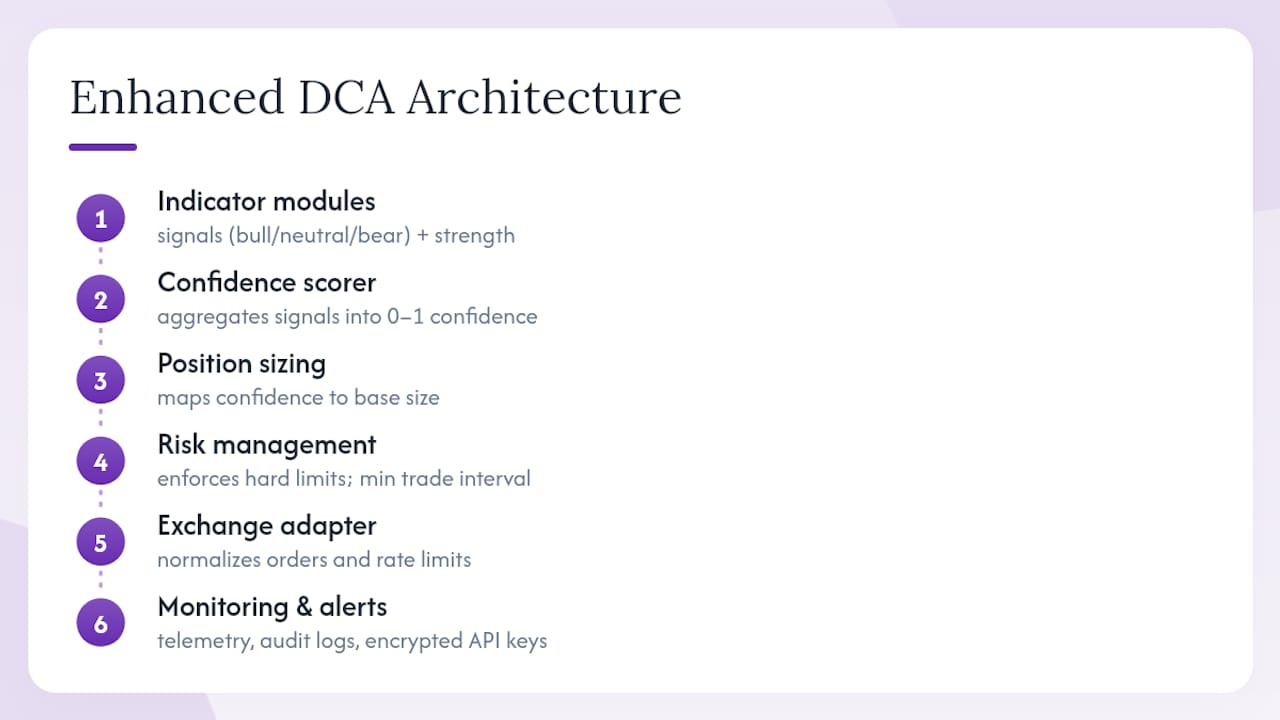
The enhanced DCA architecture combines multiple indicators into a confidence score, then uses that score to scale position size dynamically. A high-confidence signal (RSI oversold + MACD bullish crossover + price at lower Bollinger Band) justifies a larger base order. A low-confidence signal justifies a smaller one or no entry at all.
Signal logic patterns fall into two categories. Conditional activation requires all selected indicators to agree before a deal opens. Threshold-weighted activation assigns a score to each indicator signal and opens a deal only when the combined score clears a minimum threshold.
When to skip indicator filters entirely: pure dollar-schedule DCA for long-term accumulation does not benefit from indicator filtering. Adding filters to a weekly BTC buy introduces complexity without improving the cost basis meaningfully over a multi-year horizon.
Pro Tip: Choose signal filters that reduce false starts rather than attempt to time exact bottoms. A filter that prevents you from opening a deal into a structural downtrend is more valuable than one that tries to pinpoint the low.
What risk controls should every DCA bot have?
Under-capitalization is the most common DCA bot failure mode. The bot opens a deal, price drops past the last safety order, and the bot holds an unrealized loss with no capital left to average down or wait for recovery. Preventing this requires explicit capital planning before launch.
Core risk controls to configure:
- Maximum capital per deal — calculate total capital if every safety order fills: sum of (base order + all safety orders at their scaled sizes). This is your per-deal capital requirement.
- Max simultaneous deals — multiply per-deal capital by this number. That product must not exceed your total bot allocation.
- Balance percentage limits — cap each deal at a fixed percentage of total bot capital so one open position cannot consume the entire balance.
- Minimum balance threshold — set a floor below which the bot pauses new deal openings. This preserves a reserve for existing open deals.
- Stop trading conditions — configure the bot to halt if total unrealized loss exceeds a defined percentage, or if capital usage crosses a ceiling.
For asset selection, BTC and ETH’s mean-reversion characteristics and deep liquidity make them generally better fits for DCA bots than speculative altcoins. Thin-liquidity assets can gap through safety orders without filling, eliminating the averaging benefit.
The 1–2% rule for position sizing provides a useful anchor: no single deal should risk more than 1–2% of total portfolio capital on its stop-loss distance. Apply this to your DCA stop-loss placement relative to the last safety order.
A practical risk management checklist before going live should confirm: capital calculator run, max simultaneous deals set, minimum balance threshold active, and stop trading condition configured.
How do you backtest a DCA bot configuration?
A backtest is not a performance guarantee. It is a structured way to understand how a configuration would have behaved under historical conditions, and which parameters drive the most risk.
Essential backtest inputs:
- Historical OHLCV price data for the target asset and timeframe
- Realistic fee and slippage assumptions (exchange taker/maker fees, spread)
- Exact order execution model matching the exchange (market vs. limit fill behavior)
- The precise schedule or signal logic the live bot will use
Key metrics to record per backtest run:
| Metric | What it tells you |
|---|---|
| ROI | Total return over the backtest period |
| Max drawdown | Largest peak-to-trough decline in portfolio value |
| Average deal duration | How long capital is typically locked per deal |
| Cost advantage | Difference between average entry and final market price |
| Safety order fill distribution | How often each safety order level was reached |
| Trade frequency | Number of completed deals per month |
Cost advantage is the metric most specific to DCA. It measures how much lower your average entry was compared to simply buying at the base order price. A high cost advantage on a backtest means the safety order structure was doing real work.
Common backtest pitfalls: look-ahead bias (using future data to set parameters), data leakage (training and testing on the same period), and unrealistic fills (assuming every limit order fills at the exact limit price). Run backtests on out-of-sample data after setting parameters, not before.
The backtest procedure: set parameters on a training window, validate on a separate holdout period, then compare the two. If performance degrades sharply on the holdout, the configuration is overfit to the training data.
Practical checklist for deploying a DCA bot safely
Deployment is where configuration errors become real losses. Work through this checklist before any live capital touches the bot.
API key setup:
- Generate a dedicated API key for the bot with trading permissions only
- Disable withdrawal permissions on the API key entirely
- Enable IP whitelisting to restrict the key to your bot’s server IP
- Rotate keys every 90 days or immediately after any suspected exposure
Account security:
- Enable 2FA on the exchange account (hardware key preferred over SMS)
- Keep custody assets in a hardware wallet; only fund the exchange with active trading capital
- Set up account activity alerts for logins, withdrawals, and large order events
Pre-launch validation:
- Run the capital calculator and confirm total required capital fits your allocation
- Paper trade the configuration for at least 14 days
- Run a backtest on at least 12 months of historical data
- Confirm the exchange supports the asset pair and order types your config requires
US exchange notes: Futures and leveraged DCA on US-regulated exchanges require KYC verification and may have product restrictions depending on your state. Confirm your exchange’s current listing and regulatory status before configuring futures-based DCA. DCA frequency matters for fee efficiency; weekly or biweekly cadence often balances fee friction and averaging benefit better than daily schedules for most retail configurations.
Pro Tip: Always keep an emergency reserve outside the bot’s allocated capital. If the bot exhausts its balance during an extreme drawdown, that reserve lets you manually add funds or close positions without being forced to sell at the worst price.
Sample DCA strategy templates: conservative, moderate, and aggressive
These three templates give you a starting point. Adjust parameters based on your asset, capital, and risk tolerance. All figures assume spot trading on BTC or ETH.
The conservative template locks capital for longer but survives deeper drawdowns. Wide deviation means safety orders fire less frequently, so the bot is patient. It suits long-term BTC or ETH accumulation where you are not trying to trade every swing.
The moderate template is the most common starting point. Balanced safety order count and multipliers with a tighter deviation means it averages in faster during a dip. More deals run simultaneously, so capital requirements multiply accordingly.
The aggressive template runs tight deviations and high volume multipliers. Safety orders fill quickly during any meaningful dip, which can produce a strong cost advantage in volatile markets. The downside: capital locks up fast, and a sustained downtrend can exhaust all safety orders before price recovers.
For assets with wider volatility, widen deviation and reduce safety order count to keep total capital requirements manageable.
Pro Tip: Start with the conservative template on a new asset. Run it for 30 days in paper trading, review the safety order fill distribution from the backtest, then decide whether tighter deviations or higher multipliers are warranted.
How do you monitor and maintain running DCA bots?
A bot running without monitoring is a liability. Markets change, exchanges have outages, and API keys expire. Operational discipline here is what separates systematic trading from set-and-forget gambling.
Essential alerts to configure:
- Low balance warning — fires before the bot hits the minimum balance threshold
- API error alert — notifies immediately if the exchange connection fails
- Safety order fill percentage — tracks how many safety orders have filled on open deals
- Prolonged drawdown alert — flags deals that have been open longer than a defined threshold without closing
- Exchange maintenance window — pauses the bot automatically during scheduled downtime
Daily checks for live bots: confirm active deals count, review capital usage percentage, and check unrealized PnL on open positions. Weekly: review all open deals individually, assess whether any are in a structural downtrend that warrants manual intervention. Monthly: re-run backtests with updated data, review parameter performance, and adjust if market regime has shifted.
When to pause the bot: a sustained downtrend with no mean-reversion signal, an exchange custody or regulatory risk event, or capital usage approaching the minimum balance threshold. Pausing is not failure. It is a deliberate risk decision. The key risks in automated trading that traders most often miss are operational, not strategic: API failures, exchange outages, and balance exhaustion during drawdowns.
Pro Tip: *Set automated pause rules when your platform supports them.
How does enhanced DCA architecture work in production?
Production-grade DCA goes beyond a simple safety order ladder. The enhanced DCA design separates concerns into distinct modules: an exchange interface, a strategy engine, a risk management layer, a monitoring and telemetry subsystem, and a notification system.
The strategy engine handles indicator evaluation, confidence scoring, and position sizing decisions. The risk management module enforces hard limits independently of the strategy engine. This separation matters because it prevents a misconfigured strategy from bypassing risk controls.
Multi-indicator enhanced DCA works as follows: each indicator module produces a signal (bullish, neutral, bearish) and a strength score. The confidence scorer aggregates these into a single value between 0 and 1. The position sizing module maps that confidence score to a base order size within the bounds set by the risk policy. A minimum trade interval prevents the bot from re-entering immediately after a stop-loss close.
Darkbot implements this architecture across multiple exchanges via API key integration, with backtesting, paper trading, portfolio management, and automated rebalancing built into the platform. Exchange adapters normalize order types and rate limits across supported venues, so strategy logic does not need to account for exchange-specific quirks.
Security at the platform level includes encrypted API key storage, audit logs for all order events, and rate-limit shielding that prevents the bot from triggering exchange bans during high-frequency periods.
Pro Tip: Keep your strategy logic and risk policy in separate, version-controlled configurations. When you change a parameter, you can audit exactly what changed, when, and what the backtest result was before and after.
Tax implications of automated DCA trading
Every completed DCA deal is a taxable event in the United States. When the bot closes a position at take-profit, the IRS treats that as a sale of cryptocurrency, and the gain or loss is calculated against the cost basis of the position.
Because DCA bots accumulate multiple buy lots at different prices (base order plus each safety order), the cost basis calculation is lot-specific. The IRS permits specific identification, FIFO (first-in, first-out), and HIFO (highest-in, first-out) accounting methods. HIFO typically minimizes taxable gains by matching sales against the highest-cost lots first, but it requires detailed per-lot records.
Short-term vs. long-term treatment depends on holding period. DCA bots that close deals within days or weeks generate short-term capital gains, taxed at ordinary income rates. A bot that holds a deal for more than 12 months before closing qualifies for long-term capital gains rates, which are lower for most taxpayers.
Automated bots can generate dozens or hundreds of taxable events per year. Manual record-keeping becomes impractical quickly. Crypto tax software that integrates directly with exchange APIs (pulling trade history automatically) is the practical solution for most traders running multiple simultaneous bots.
Wash sale rules do not currently apply to cryptocurrency under US law, but proposed legislation has sought to change this. Confirm current IRS guidance before assuming wash sale treatment does not apply to your situation.
This is general information, not tax advice. Consult a qualified tax professional for guidance specific to your situation and confirm current IRS rules before filing.
Why disciplined automation outperforms ad-hoc manual DCA
The instinct to pause, reduce size, or skip the buy entirely is almost universal, and it is exactly the behavior that erodes the statistical advantage DCA is supposed to provide.
Automation removes that decision point. The bot executes the configured rule regardless of how the market feels that week. That consistency is not a minor convenience. It is the core mechanism through which DCA delivers its cost-averaging benefit over time.
The behavioral argument for automation is well-supported. Backtests comparing DCA to lump-sum consistently find that the deciding factor is not the math but investor behavior: DCA outperforms in worst-case scenarios primarily because investors who DCA are less likely to panic-sell during drawdowns. Automation enforces that discipline structurally.
Templates and backtests serve a related function. When you configure a moderate template, backtest it over 18 months of historical data, and see the safety order fill distribution and max drawdown, you understand what you are signing up for before the market tests you. That preparation makes it easier to hold the strategy when it is under stress.
The right time for manual intervention is narrow but real: a structural regime change (an asset losing its mean-reversion characteristics), an exchange custody risk event, or a capital emergency. Outside those conditions, the bot’s rules should run. Overriding the bot on a bad week because it “feels wrong” is the behavior the automation was designed to prevent.
Automate your DCA strategy with Darkbot
Traders who want to move from manual accumulation to a production-grade automated system need more than a simple scheduler. Darkbot is an AI-powered crypto trading automation platform built for exactly this: systematic DCA execution with multi-indicator signal logic, configurable safety order structures, backtesting, paper trading, and real-time portfolio analytics, all connected to major exchanges via encrypted API keys.
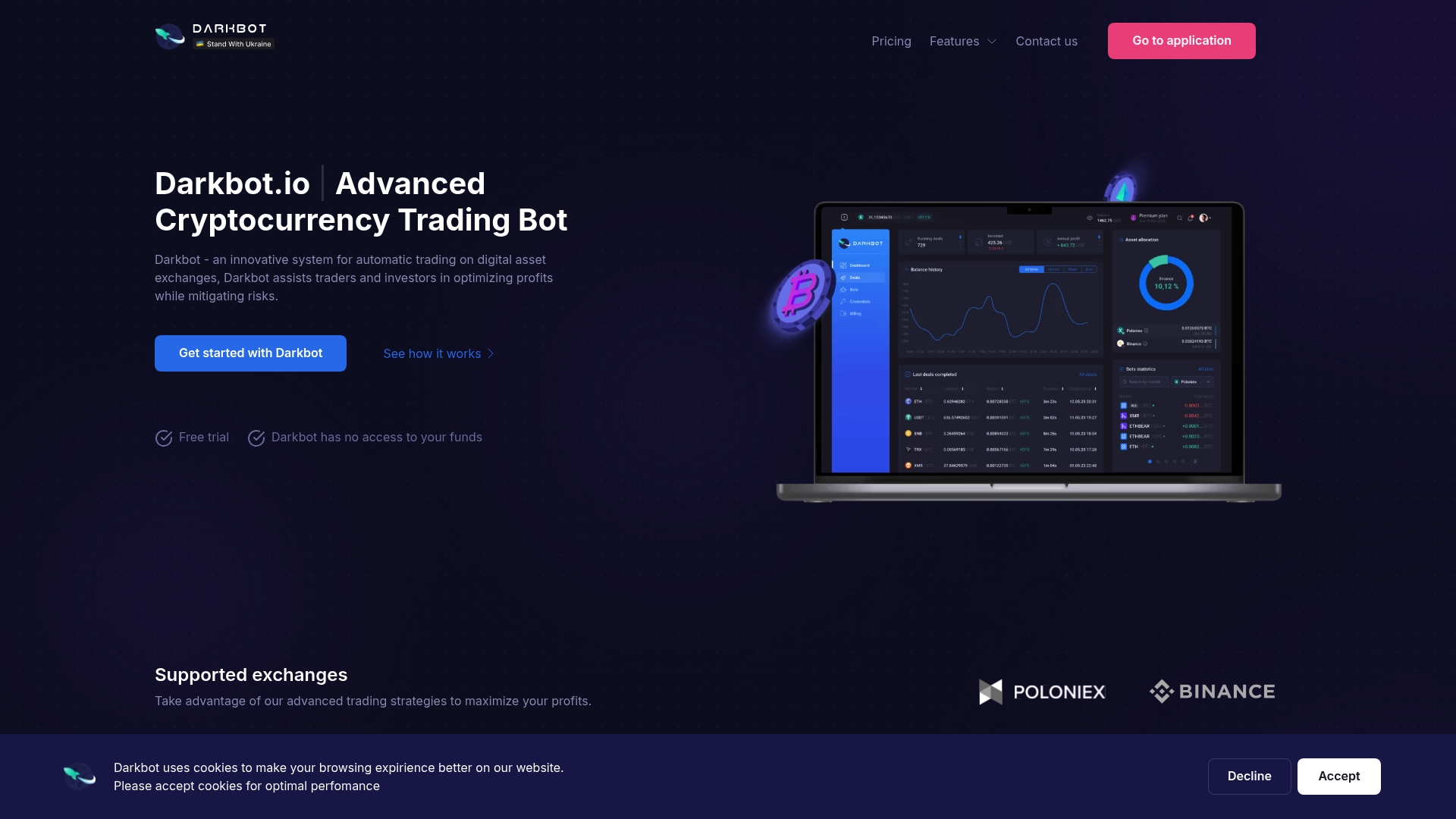
Where most manual DCA setups break down is capital management and consistency. Darkbot’s risk layer enforces per-deal capital caps, minimum balance thresholds, and stop trading conditions automatically, so the bot does not exhaust your balance during a drawdown. The portfolio management tools give you a consolidated view across multiple simultaneous bots and asset pairs.
Plans start with a free tier so you can validate configurations in paper trading before committing capital. If you are ready to run a disciplined, rules-based DCA strategy without managing it manually, start with Darkbot and configure your first bot today.
Useful sources and further reading
The sources below were used throughout this guide and are worth consulting directly for deeper technical detail.
- Zmey56/enhanced-dca-bot (GitHub) — Production-grade enhanced DCA implementation with multi-indicator confidence scoring and modular risk enforcement. Practical reference for architecture and signal design.
- Viprasol-Tech/dca-bot (GitHub) — Multi-strategy backtest runner covering fixed DCA, value averaging, and dip-buying. Useful for comparing strategy variants against the same historical dataset.
- RonOnCrypto: DCA Bot Configuration Guide — Detailed walkthrough of safety order configuration, capital calculation, and common failure modes. The most practical single reference for parameter setup.
- KuCoin: DCA vs. Lump Sum — Conceptual comparison of DCA and lump-sum with behavioral context and hybrid strategy guidance.
- CryptoCalcPro: 10-Year Bitcoin DCA vs. Lump Sum Backtest — Long-horizon backtest with methodology notes; useful for understanding how DCA performs across different market regimes.
- Dipprofit: DCA Frequency Analysis — Practical discussion of cadence trade-offs; weekly and biweekly schedules tend to balance fee friction and averaging benefit better than daily for most retail configurations.
Darkbot: automated DCA built for systematic traders
Running a DCA bot manually across multiple pairs, monitoring safety order fills, and rebalancing capital between deals is operationally intensive. Darkbot removes that overhead with a platform designed around systematic execution: AI-driven strategy logic, configurable DCA parameters, backtesting and paper trading, automated rebalancing, and encrypted API key management across supported exchanges.
The platform suits traders who want a deployable, auditable system rather than a manual process. Free, standard, and premium tiers let you start with paper trading and scale up as your configuration matures. Start with Darkbot to configure, backtest, and deploy your first automated DCA strategy.
This article is general information, not a substitute for advice from a qualified financial advisor. Consult a qualified financial professional about your own circumstances before acting on anything here.
Recommended

Start trading on Darkbot with ease
Come and explore our crypto trading platform by connecting your free account!
Free plan available • No credit card required