Leverage GitHub ML Tools for Smarter Crypto Trading
TL;DR:
- Open-source GitHub tools enable profitable crypto trading with minimal coding skills.
- Effective ML strategies emphasize risk management, realistic backtesting, and walk-forward validation.
- Connecting these tools to platforms like Darkbot facilitates reliable live automation and portfolio control.
Most traders assume machine learning tools for crypto are locked behind quant fund budgets or PhD-level coding skills. That assumption is wrong, and it’s costing you real money. Open-source repositories on GitHub have quietly shifted the playing field. A vectorbt SMA combination strategy produced a 1,504% total return versus an 866% benchmark across BTC, ETH, and XRP from 2017 to 2026. These aren’t theoretical numbers from a research paper. They come from tools you can download today, configure over a weekend, and connect to your existing exchange accounts. This guide breaks down the best repositories, how their ML engines actually work, what the benchmarks really mean, and how to deploy them without blowing up your portfolio.
Key Takeaways
| Point | Details |
|---|---|
| Open-source ML leads | Top GitHub repositories provide powerful machine learning frameworks tailored for crypto trading automation. |
| Realistic results matter | Backtest results often overstate live performance so prioritize robust validation. |
| Risk is critical | Effective risk management, using methods like volatility targeting and walk-forward tests, is essential for sustainable automation. |
| Integrate step by step | Careful hands-on integration, simulation, and phased deployment lead to best live outcomes. |
Top GitHub machine learning repositories for crypto trading
With the performance edge established, the next question is which open-source projects actually deliver. The ecosystem has matured fast, and a handful of repositories stand out for their methods, flexibility, and real-world adoption.
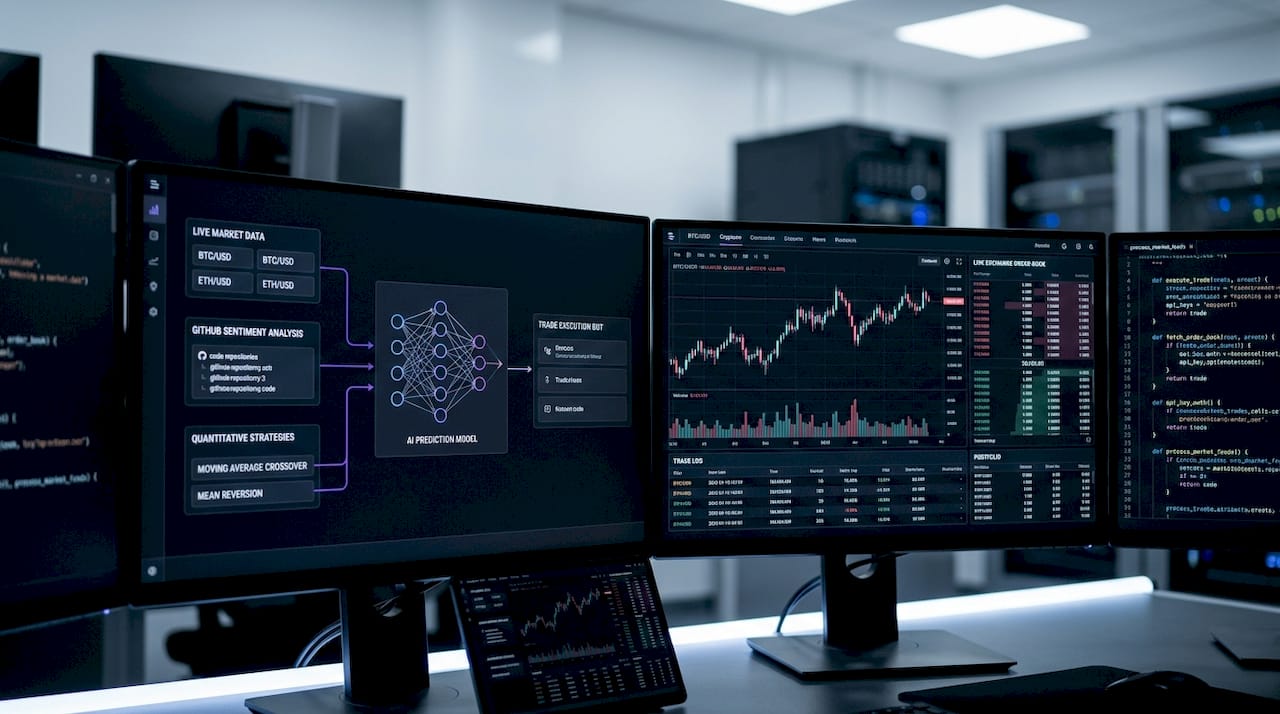
FreqAI within Freqtrade uses LightGBM, XGBoost, and ensemble models to generate predictions on custom-engineered features, making it one of the most practical options for live crypto trading. FinRL applies deep reinforcement learning algorithms including PPO and DDPG across stock and crypto environments using OHLCV data. Vectorbt takes a different approach, using vectorized NumPy and Numba operations for blazing-fast signal generation and portfolio simulation. LLM-TradeBot deploys multi-agent large language models including DeepSeek and GPT for real-time decisions on Binance futures. Each tool reflects a distinct philosophy about what drives alpha.
For traders focused on maximizing trading efficiency, understanding these differences matters. FinClaw uses genetic algorithms to evolve factor-based strategies, while MarketRegimeNet combines transformer models with LightGBM for regime detection. Speed is another axis worth considering. Rust-based raptorbt runs backtests over 5,000 times faster than vectorbt, though it’s still early in its development cycle.
Here’s a quick comparison of the leading repositories:
| Repository | Core method | Best for | Assets |
|---|---|---|---|
| FreqAI (Freqtrade) | LightGBM, XGBoost | Beginners to intermediate | Spot crypto |
| FinRL | PPO, DDPG (DRL) | Portfolio optimization | Stocks, crypto |
| Vectorbt | Vectorized NumPy | Fast backtesting | Multi-asset |
| LLM-TradeBot | Multi-LLM agents | Sentiment-driven futures | Binance futures |
| FinClaw | Genetic algorithms | Factor strategy evolution | Multi-asset |
| MarketRegimeNet | Transformer + LightGBM | Regime detection | Crypto, stocks |
When picking a repository, consider these factors:
- Strategy type: Rule-based signals suit FreqAI; pure DRL fits FinRL.
- Automation level: LLM-TradeBot handles live decisions; vectorbt excels at research.
- Programming skill: FreqAI has the gentlest learning curve; FinClaw demands more compute knowledge.
- Exchange compatibility: Confirm API support before committing to any repo.
- Community support: Freqtrade’s active Discord is a major advantage for troubleshooting.
For traders already working on optimizing automated crypto trading, these repositories offer a structured upgrade path from manual strategies.
How machine learning powers robust trading strategies
Now that you know the top projects, let’s unpack what makes their machine learning engines effective for real-world trading. The methods differ significantly, and knowing which one fits your strategy type is the difference between a working system and an expensive experiment.
Deep reinforcement learning, used in FinRL, trains an agent to maximize cumulative reward by interacting with a simulated market environment. The agent learns when to buy, hold, or sell based on OHLCV data, momentum indicators, and portfolio state. PPO (Proximal Policy Optimization) is particularly stable during training, which is why it dominates DRL-based crypto repos. DDPG (Deep Deterministic Policy Gradient) handles continuous action spaces, making it useful for position sizing.
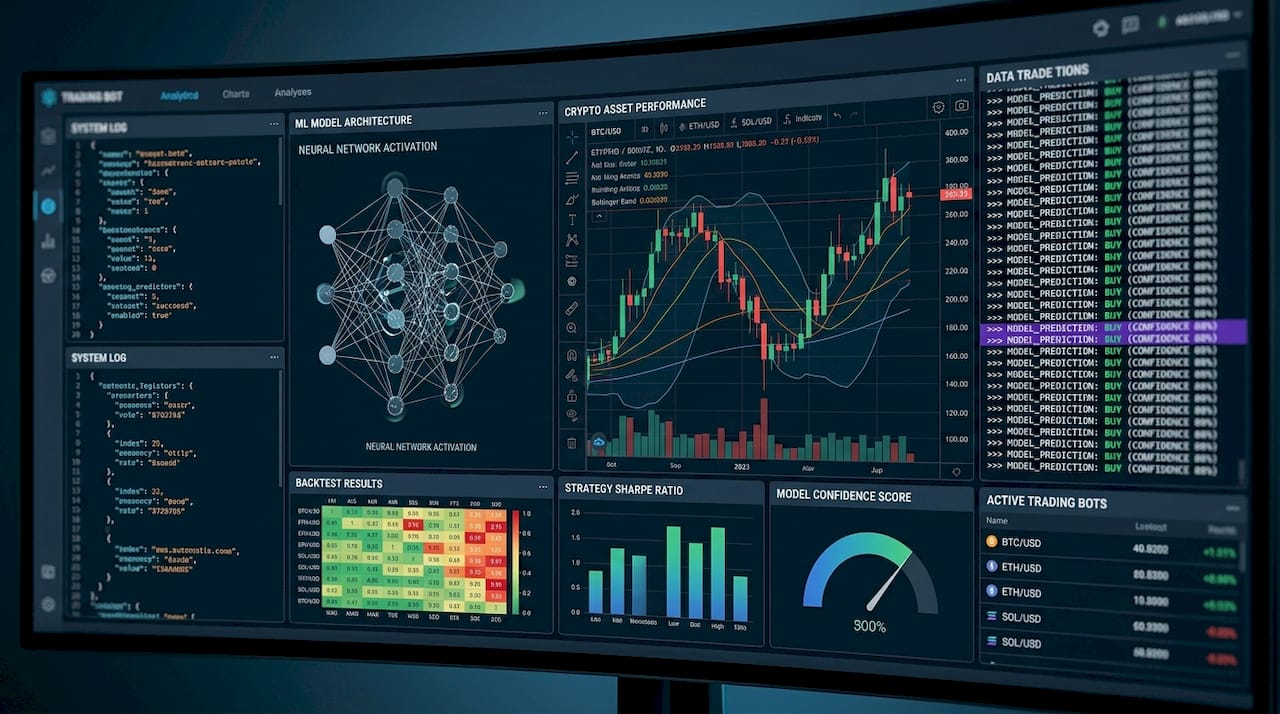
FinClaw’s genetic algorithms evolve strategies across 484 factors, selecting the combinations that survive rigorous fitness tests. DRL-MultiFactorTrading combines Double DQN with transformer architectures to capture both short-term momentum and longer-range pattern dependencies. MarketRegimeNet ensembles transformers with LightGBM specifically to detect regime shifts, a critical capability in volatile crypto markets.
Here’s how a typical ML trading pipeline flows:
- Data input: Pull OHLCV data from exchange APIs or historical datasets.
- Feature processing: Engineer indicators like RSI, ATR, volume momentum, and regime labels.
- Model training: Train on historical windows using your chosen algorithm.
- Validation: Run walk-forward tests and check Sharpe and Calmar ratios.
- Live deployment: Connect to exchange API, set position limits, and monitor drawdowns.
Performance benchmarks tell an important story. FinRL variants achieve Sharpe ratios as high as 3.111, which is exceptional by any standard. For context, a Sharpe above 1.0 is considered good, and above 2.0 is outstanding in professional quant trading.
| Model | Sharpe ratio | Strategy type |
|---|---|---|
| FinRL (best variant) | 3.111 | Deep reinforcement learning |
| Vectorbt SMA combo | High (1,504% return) | Signal vectorization |
| FinClaw genetic | Variable | Factor evolution |
“Combining rule-based filters with ML predictions consistently outperforms pure ML approaches in live crypto conditions, where regime shifts can rapidly invalidate model assumptions.”
For a deeper look at how these techniques apply to live markets, the guide on optimizing crypto trading covers practical deployment scenarios in detail.
Navigating risk: Backtest realism, pitfalls, and robust mitigation
We’ve seen what ML methods can do when benchmarks impress, but managing risk is where lasting success is truly built. Impressive backtest numbers are easy to generate. Surviving real markets is a different challenge entirely.
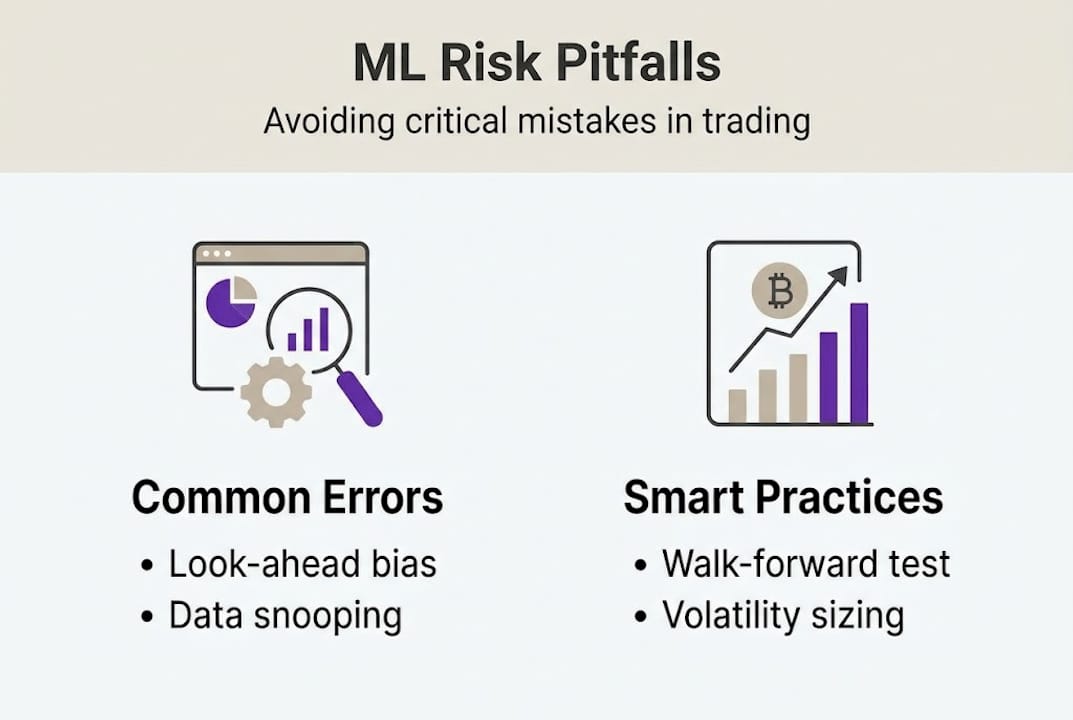
The most common failure mode is look-ahead bias, where your backtest accidentally uses future data to make past decisions. This inflates returns dramatically and produces strategies that collapse immediately in live trading. Slippage, fees, and API throttling create a persistent gap between backtest and live performance that most traders underestimate. A strategy showing 59% backtest returns might deliver 15% to 20% live, if it holds up at all.
Regime changes are particularly dangerous for ML models trained on historical data. A model optimized for a trending bull market will often fail badly in a sideways or bear regime. This is why MarketRegimeNet and similar tools specifically target regime detection as a first-order problem.
Here are the core risk mitigation practices that actually work:
- Volatility targeting: Size positions to maintain a fixed annualized volatility, typically around 15%, regardless of market conditions.
- ATR-based dynamic stops: Use Average True Range to set stop losses that adapt to current volatility rather than fixed percentage levels.
- Kelly criterion: Size positions based on your estimated edge and variance to avoid overbetting.
- Walk-forward validation: Test your model on rolling out-of-sample windows to confirm it generalizes beyond the training period.
- Monte Carlo simulation: Randomize trade order and timing to stress-test your strategy’s robustness.
Volatility-adjusted sizing combined with ATR stops and Kelly criterion forms the foundation of professional risk management in ML trading. LLM-infused agents add sentiment and regime awareness but introduce latency and API cost tradeoffs worth evaluating carefully.
Pro Tip: Never evaluate a strategy by annualized return alone. A 60% return with a Sharpe of 0.4 is worse than a 20% return with a Sharpe of 1.8. The latter compounds reliably; the former will eventually wipe you out.
For a structured approach to protecting capital, the resources on crypto trading risk management and the crypto trading risk checklist offer practical frameworks you can apply immediately.
From GitHub to trading desk: Practical steps and integration tips
Understanding theory and risks prepares you to take the leap. Here’s how to put those ML repos into action for your trading strategies without the common stumbling blocks that trip up most traders.
Follow this workflow when evaluating and deploying any GitHub ML trading repository:
- Audit the repository: Check last commit date, open issues, and contributor activity. A stale repo is a risk.
- Fork and isolate: Fork the repo into your own GitHub account before making any changes. Never modify the upstream version directly.
- Set up a paper trading environment: Most major repos support simulation mode. Use it for at least 30 days before touching real capital.
- Configure API keys carefully: Use read-only keys during testing. Only enable trading permissions when you’re ready to go live, and always use IP whitelisting.
- Run walk-forward validation: Split your data into training and out-of-sample windows. Rotate them forward in time to confirm your model generalizes.
- Analyze drawdowns before going live: If your simulated max drawdown exceeds your personal risk tolerance, adjust position sizing before committing real funds.
- Start live with minimum capital: Deploy with the smallest viable position size to validate live execution matches your simulation results.
LLM-based agents like LLM-TradeBot are promising for adaptive decision-making but carry high API costs and execution latency that can erode edge in fast-moving markets. Genetic evolution tools like FinClaw avoid manual strategy coding but require serious compute resources, often GPU clusters or cloud instances, to run efficiently.
Pro Tip: Start your live deployment with a single asset pair and one strategy. Complexity is the enemy of debugging. Once you confirm live performance matches simulation within acceptable variance, then expand.
For traders looking to build smarter crypto trading strategies, combining GitHub-sourced ML signals with a reliable execution layer is the practical path forward.
What most traders miss about GitHub ML tools for crypto
Before wrapping up, it’s worth addressing the blind spots that even experienced users consistently fall into. Most traders who explore these repositories focus on the wrong thing entirely.
They chase the headline backtest number. A 1,504% return or a 59% annual gain looks compelling in a README. But no repository guarantees live profits, and backtests structurally overstate future performance. The traders who actually profit from these tools are obsessing over Sharpe ratios, Calmar ratios, and walk-forward consistency, not raw return figures.
There’s also a discipline gap. GitHub repos give you the engine, but they don’t enforce position sizing, drawdown limits, or portfolio-level correlation controls. Those decisions fall entirely on you. Advanced ML methods mean nothing if your portfolio risk management is sloppy.
The real edge isn’t in finding the most sophisticated algorithm. It’s in finding a smaller, repeatable edge and applying it with consistent risk management across hundreds of trades. A Sharpe of 1.5 applied consistently beats a Sharpe of 3.0 that falls apart after two months of live trading. Smaller, validated edges compound. One-off miracle strategies don’t.
Connect to smarter trading with AI-powered automation
You now have a clear map of the GitHub ML landscape, the strategies that work, and the risk practices that protect capital. The logical next step is connecting those insights to a platform built to execute them reliably.
Darkbot’s AI-powered crypto trading bots bring together automated strategy execution, real-time portfolio analytics, and seamless exchange integration through API keys, exactly the infrastructure that GitHub ML strategies need to run effectively in live markets. Whether you’re migrating a FreqAI strategy or building from scratch, Darkbot’s portfolio management tools handle rebalancing, risk controls, and multi-asset coordination without requiring you to manage infrastructure manually. Free, standard, and premium tiers mean you can start small and scale as your confidence grows. Personalized onboarding support is available even if you’re coming directly from a GitHub repository setup.
Frequently asked questions
Which GitHub repository is best for beginners wanting to automate crypto trading?
FreqAI in Freqtrade is the most accessible starting point, offering plug-and-play ML modules with LightGBM and XGBoost support, strong documentation, and an active community for troubleshooting.
What returns can I realistically expect from GitHub ML trading repos?
Well-validated models typically produce 10% to 20% annualized excess returns in live conditions, even when backtests show much higher figures like 59% or more.
How do I reduce risk when using ML-powered trading bots?
Apply volatility-adjusted sizing, ATR stops, and Kelly criterion together, and always complete walk-forward and Monte Carlo validation before committing real capital to any live strategy.
Are large language model (LLM) agents practical for live trading today?
LLM agents add latency and API costs that limit their use in high-frequency execution, making them better suited for regime detection, sentiment analysis, or advisory decision support rather than direct trade execution.
What’s the fastest platform for backtesting large crypto portfolios?
Rust-based raptorbt delivers 5,000x+ speed improvements over Python-based vectorbt, though it remains less mature and has fewer community resources available compared to established Python libraries.
Recommended

Start trading on Darkbot with ease
Come and explore our crypto trading platform by connecting your free account!
Free plan available • No credit card required