How to Manage Trading Risks in Crypto Markets
TL;DR:
- Most traders who lose their accounts do so because they fail to define their maximum acceptable loss before trading, not because of poor entries. Implementing a layered risk management system, including position sizing, stop-loss placement, daily and weekly limits, and automation, is crucial for survival in volatile crypto markets. Enforcing these rules through automated tools ensures discipline, consistency, and minimizes behavioral mistakes that often lead to catastrophic losses.
Most traders who blow up their accounts don’t lose because of bad entries. They lose because they never defined how much they were willing to lose before they placed the trade. Knowing how to manage trading risks is the single most consequential skill in cryptocurrency trading, where a 30% intraday move is not unusual and correlated selloffs can hit every position simultaneously. This article walks through a layered framework for trading risk control methods, from position sizing to drawdown protocols, covering both the mechanics and the behavioral discipline required to apply them consistently.
Key takeaways
| Point | Details |
|---|---|
| Use a four-layer risk system | Control risk at the trade, daily, weekly, and portfolio levels simultaneously. |
| Cap single-trade risk at 1-2% | Limiting loss per trade preserves capital through losing streaks without catastrophic drawdown. |
| Set hard stop-loss orders | Place stops at trade entry and never move them further away once a position is open. |
| Stop trading after daily limits | Hitting your daily loss limit means trading stops that day, regardless of conviction. |
| Automate rule enforcement | AI-driven tools remove emotional override and apply risk rules consistently across every trade. |
How to manage trading risks: the foundational framework
Before applying any specific technique, you need a precise understanding of what trading risk actually is in a crypto context. Trading risk is the probability and magnitude of capital loss on any given position or across your portfolio at any given time. In crypto, this is compounded by thin liquidity on smaller assets, 24/7 market exposure, and the speed at which sentiment shifts.
Four concepts anchor every serious risk management system:
- Position sizing: How much capital you allocate to a single trade, expressed as a percentage of your total account.
- Stop loss: A predefined price level at which you exit a losing trade to cap the damage.
- Drawdown: The peak-to-trough decline in your account balance, measured as a percentage.
- Daily loss limit: A hard ceiling on how much you will lose in a single session before you stop trading entirely.
These are not abstract concepts. They are the controls you configure before you place a single order. A written trading plan that specifies each of these parameters is not optional. Without it, every decision under pressure becomes discretionary, and discretionary decisions under pressure tend to be bad ones. Position size calculators and risk analytics dashboards, including those built into automated trading platforms, make it straightforward to define and track these numbers in real time.
Pro Tip: Before you fund any live account, write down your maximum risk per trade, your daily loss limit, and your drawdown threshold. Review these numbers before every trading session, not after a loss.
A layered approach to limiting trading losses
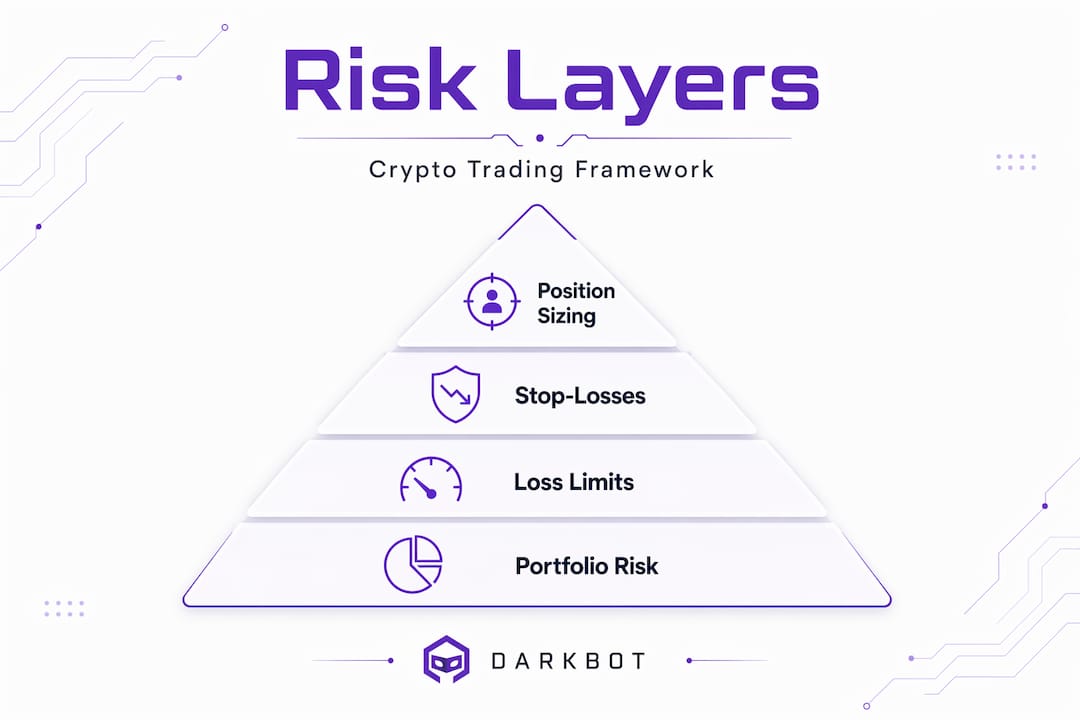
The most practical way to think about risk management techniques is as a set of concentric controls, each catching what the previous layer misses. Here is how to build and apply each layer systematically.
Layer 1: position sizing
Risk per trade should stay near 1%, with a hard maximum of 2% of total account value on any single position. On a $50,000 account, that means your maximum loss per trade is $500 at 1% or $1,000 at 2%. This sounds conservative until you realize that a ten-trade losing streak at 2% per trade removes roughly 18% of your capital. At 1%, the same streak removes about 9.5%, and you are still very much in the game.
Fractional Kelly sizing (using 25-50% of the theoretically optimal Kelly Criterion) offers a more mathematically grounded approach for traders who track their historical win rates and average win-to-loss ratios. Full Kelly maximizes growth in theory but produces drawdowns that are psychologically and financially unsustainable in practice.
Layer 2: stop-loss placement
Hard stop-loss orders must be placed as working orders in the market at the moment of trade entry, not kept as mental notes. Mental stops fail because they require a calm, rational decision in the exact moment when fear or greed is highest. Hard orders execute automatically.
Placement matters as much as having a stop at all. Volatility-based stops using the Average True Range (ATR) reduce false stop-outs caused by normal market noise. A fixed 2% stop on a crypto asset with a daily ATR of 4% will get triggered constantly. Setting your stop at 1.5x to 2x the current ATR gives the trade room to breathe while still defining your loss.
| Stop type | How it works | Best use case |
|---|---|---|
| Fixed percentage | Stop placed X% below entry | Low-volatility, stable assets |
| ATR-based | Stop placed at 1.5-2x ATR below entry | Volatile crypto assets |
| Structure-based | Stop placed below a key support level | Technical swing trades |
| Time-based | Exit after X hours if target not reached | Short-duration setups |
Layer 3: daily and weekly loss limits
A daily loss limit of 3% on total capital is a widely used standard. For the $50,000 example, that is $1,500. Once you hit that number, trading stops for the day. No exceptions, no “one more trade to make it back.” The research is clear: continuing to trade after a bad session leads to emotional escalation and compounds losses well beyond the initial drawdown.
Weekly limits typically sit at 5-6% of account capital. These exist because a trader can have three consecutive losing days under the daily limit and still find themselves in serious drawdown by Friday without a weekly ceiling to stop the bleeding.
Pro Tip: Set your daily and weekly loss limits in your trading platform as hard stops, not reminders. If the system enforces the limit automatically, it removes the moment of temptation entirely.
Layer 4: portfolio risk and drawdown management
Correlated positions in crypto are one of the most underestimated sources of aggregate risk. During broad market selloffs, Bitcoin, Ethereum, and most altcoins drop together. Holding five separate long positions across five assets does not give you diversification if all five have a correlation coefficient above 0.8. Your aggregate exposure is closer to one large position than five small ones.
Monitor your net directional exposure across the portfolio, not just individual position sizes. If six out of eight positions are long and highly correlated, your real risk is far higher than any single position’s stop loss implies.
For drawdown management, tiered protocols work better than a single rule. A 5% account drawdown triggers a reduction in position sizing. A 10% drawdown triggers a pause and review. A 15% drawdown triggers a full stop and a systematic review of what is not working before any new positions are opened.
Common mistakes that break trading risk control
Most risk management failures are behavioral, not technical. Traders know the rules and break them anyway. These are the patterns worth actively guarding against.
- Moving stops further away. This single behavior ends more trading accounts than any other. The logic always feels rational in the moment (“it’ll come back”), but it converts a manageable loss into a catastrophic one.
- Oversizing after a winning streak. Increasing position size after several wins is a classic overconfidence trap. Your edge does not get stronger because you had a good week.
- Ignoring portfolio correlation. Taking multiple long positions in correlated assets multiplies real exposure while appearing diversified on paper.
- Abandoning limits during drawdowns. Trading beyond your daily or weekly loss limit to recover losses is where the most severe account damage occurs.
- Using mental stops. Mental stops are not stops. They are intentions, and intentions fail under pressure.
- Skipping trade review. Without systematic record-keeping, you cannot identify which behaviors are causing losses and correct them.
Discipline in risk management is not about following rules when conditions are ideal. It is about following rules when every instinct is pushing you to break them.
Pro Tip: Review your last 20 trades and flag every instance where you moved a stop, sized up based on conviction, or kept trading after your daily limit. The pattern will tell you exactly where your system is leaking.
For a broader look at monitoring digital asset risk in real time, systematic tracking tools can surface portfolio-level exposure that position-by-position review misses.
Using automation and AI for consistent risk enforcement
Manual risk management has one persistent weakness: the human applying it. Automated risk tools enforce position sizing, stop-loss placement, and loss limits with consistency that manual execution cannot reliably match, especially in fast-moving markets where decisions happen in seconds.
Here is what well-configured automation handles that most traders struggle with manually:
- Position size calculation at order entry. The system computes the correct lot size based on account balance, risk percentage, and stop distance before the order is placed.
- Hard stop-loss attachment. Every order is placed with a stop already attached. There is no step where the trader decides to add it later.
- Daily loss limit enforcement. Once the daily threshold is hit, the system halts new orders for that session without requiring a manual decision.
- Portfolio correlation monitoring. Automated analytics flag when aggregate directional exposure crosses defined thresholds.
- Drawdown protocol execution. When drawdown reaches defined levels, the system reduces position sizing or pauses trading based on pre-set rules.
A 50% account loss requires a 100% gain just to return to breakeven. That asymmetry is the core mathematical argument for conservative, automated risk control. Every percentage point you protect on the way down requires less recovery work on the way up.
AI in this context is not making predictions about price. It is enforcing a set of rules consistently, evaluating pattern conditions probabilistically, and adapting execution parameters based on defined logic. The crypto trading bot risk management capabilities built into modern platforms treat risk rules as system constraints, not suggestions.
My take: survival comes before everything else
I’ve watched traders with genuinely good market reads blow up their accounts because they couldn’t apply their own rules under pressure. The insight and the discipline are two completely separate skills.
What changed my own trading was accepting that the primary goal is not to make money. It’s to still be in the game six months from now. Once I committed to that framing, the rules stopped feeling like constraints and started feeling like the actual strategy. You can’t compound gains if you’ve lost the capital base.
The part most traders resist is automation. There’s a belief that discretion creates flexibility and flexibility creates an edge. In my experience, discretion creates inconsistency, and inconsistency is where edge disappears. When I moved to automated stop placement and hard daily limits enforced by the system, my drawdowns tightened immediately. Not because my entries got better, but because I stopped overriding my own rules at the worst possible moments.
The other thing I’ve learned: correlation risk is invisible until it isn’t. During stable periods, those five altcoin longs look like five separate bets. Then a macro event hits Bitcoin and you realize in real time that you were holding one large unhedged position the whole time. Build correlation checks into your pre-trade checklist, not your post-loss review.
If you only take one thing from this article, let it be this: your risk rules need to be enforced by a system, not by willpower. Willpower is finite and context-dependent. A correctly configured trading system runs the same rule every time.
— Grisha
How Darkbot supports disciplined risk management
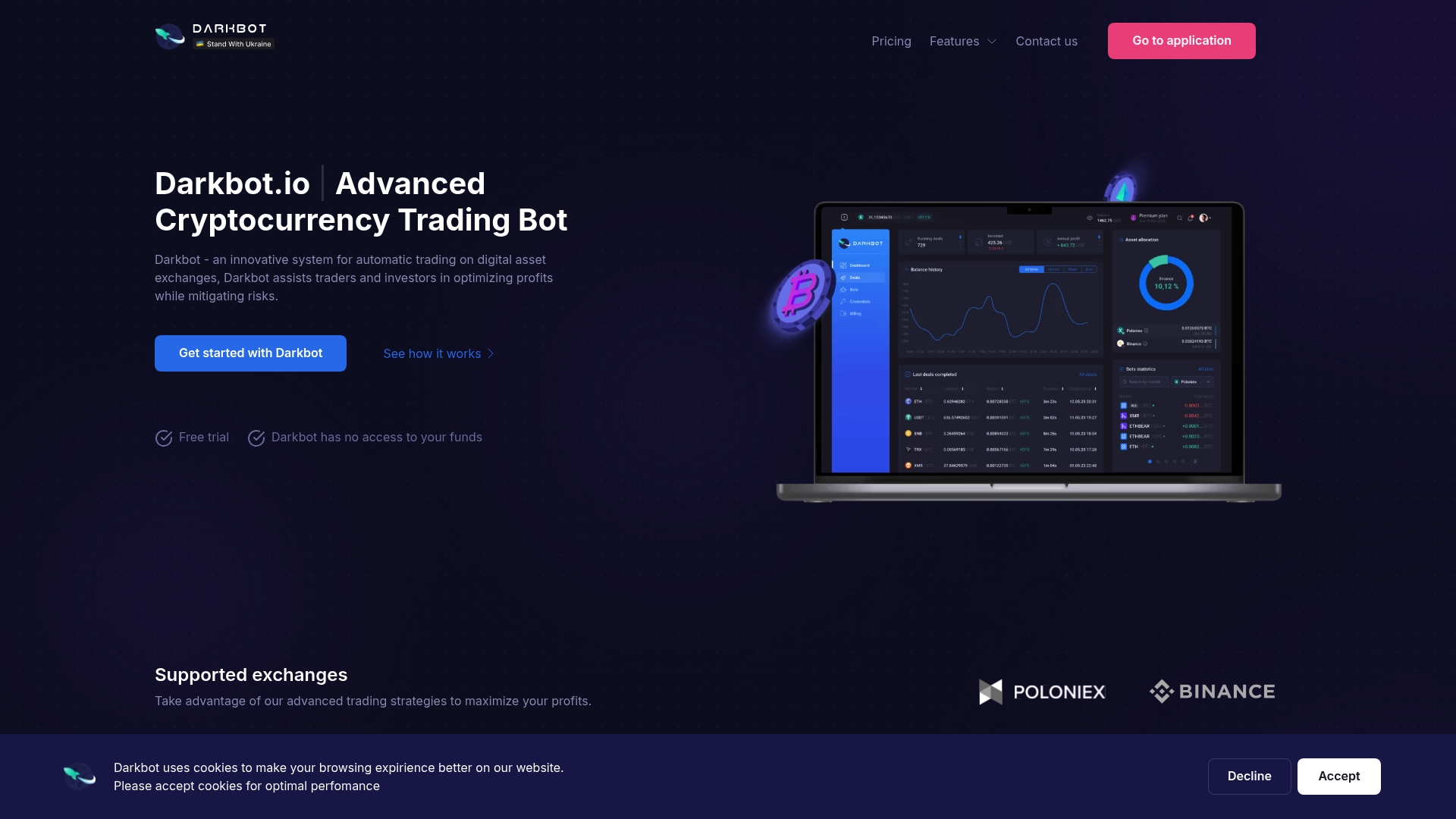
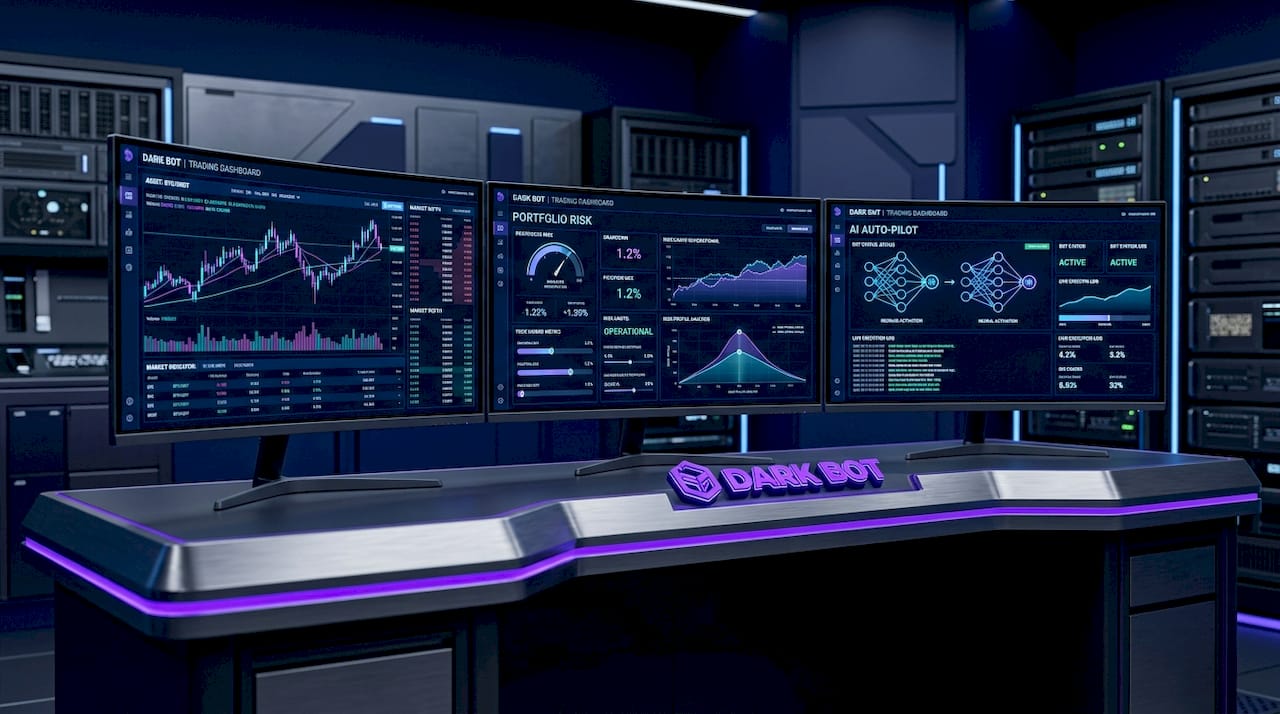
Darkbot’s AI-powered platform is built around the risk control framework described in this article. Position sizing is calculated automatically based on your configured risk percentage and stop distance. Stop-loss orders are attached at order creation. Daily loss limits halt new orders when thresholds are reached, and portfolio management tools provide real-time correlation and exposure analytics across all open positions.
For traders who want systematic rule enforcement without building custom infrastructure, Darkbot’s trading platform applies these controls consistently across every trade, across multiple exchanges, without discretionary override. The platform supports both strategy customization and automated rebalancing, covering all four layers of the risk management system in one environment.
FAQ
What is the recommended risk per trade in crypto?
Most systematic traders cap single-trade risk at 1% of account capital, with a hard maximum of 2%. This keeps any single loss manageable and preserves the capital base through extended losing streaks.
How do daily loss limits work in practice?
A daily loss limit defines the maximum amount you will lose in a single session before stopping all trading. A standard setting is 3% of total account capital. Once that threshold is hit, no new positions are opened for the rest of that day.
Why do mental stop losses fail?
Mental stops require a calm, rational decision at the exact moment when emotions are highest. Hard orders placed at trade entry execute automatically and remove the temptation to override the rule when a trade moves against you.
What is portfolio correlation risk in crypto?
Correlation risk occurs when multiple positions move together in the same direction. In crypto, most assets become highly correlated during broad market declines, meaning several separate long positions can behave like one large concentrated position.
How does automation improve risk management discipline?
Automated risk enforcement applies position sizing, stop-loss placement, and loss limits without discretionary override. This consistency is what manual execution cannot reliably replicate, particularly in fast-moving or high-stress market conditions.
Recommended

Start trading on Darkbot with ease
Come and explore our crypto trading platform by connecting your free account!
Free plan available • No credit card required