Step by Step Trading Strategy for Crypto Traders

TL;DR:
- Most traders fail not from poor analysis but because they lack a consistent, systematic process that prevents emotional decisions. Establishing a well-documented, rule-based trading plan, testing it with at least 200 demo trades, and enforcing strict risk management are essential for developing a sustainable edge. Automation tools like Darkbot help ensure disciplined execution of this plan, reducing emotional bias and supporting long-term success.
Most crypto traders don’t fail because of bad analysis. They fail because they don’t have a consistent, repeatable process. Without a step by step trading strategy, decisions get made emotionally, position sizes drift, and losses compound before you recognize the pattern. This guide walks you through every stage of building and executing a structured trading plan, from setting up your tools and defining entry rules, to testing your edge in demo conditions and managing risk on live accounts. Whether you’re just starting out or refining an existing approach, the framework here is designed to give your trading a foundation that holds up under pressure.
Key takeaways
| Point | Details |
|---|---|
| Structure beats intuition | A written trading plan converts ideas into repeatable rules that prevent emotional decision-making. |
| Test before risking real capital | Complete 100 to 200 demo trades before going live to establish a statistically meaningful edge. |
| Risk sizing is non-negotiable | Limit each trade to 1 to 2% of account capital and cap daily losses at 3% to stay in the game long term. |
| Journaling drives improvement | Logging every trade with entry reasoning, stop, and target creates the data needed for honest performance review. |
| Automation enforces discipline | Automated execution removes the gap between what your plan says and what you actually do under pressure. |
Step by step trading strategy: your starting setup
Before you write a single rule into your plan, you need the right environment. The platform you trade on, the assets you follow, and the charting tools you use all affect execution quality in ways that compound over time.
Platform and account setup matter more than most beginners expect. TradingView is the standard for charting in crypto because of its depth of indicators, replay functionality, and community scripts. For execution, your exchange needs to offer reliable API access, low fees, and adequate liquidity on the pairs you intend to trade. Thin markets introduce slippage that distorts your actual risk per trade.
Your watchlist should stay narrow, especially early on. Pick three to five assets with high daily volume, such as BTC, ETH, and SOL, and learn how they move relative to market sessions. Spreading attention across twenty tokens is one of the fastest ways to dilute your edge.
The table below compares relevant characteristics for building your initial setup:
| Factor | What to prioritize | Why it matters |
|---|---|---|
| Exchange liquidity | High daily volume pairs | Reduces slippage on entries and exits |
| Charting platform | Replay and multi-timeframe tools | Supports backtesting and pattern study |
| Account capital | Sufficient to apply 1 to 2% sizing rules | Prevents forced position mismanagement |
| Market sessions | Overlap hours (London/New York) | Higher volatility and cleaner setups |
| Leverage | Conservative use, 2 to 5x maximum | Keeps drawdowns manageable while learning |
Charting skill is a prerequisite, not a bonus. You need to read price structure, identify support and resistance zones, and understand how volume interacts with price movement before any strategy logic makes sense. Spend dedicated time on this before moving to the next phase.
Building your trading rules from scratch
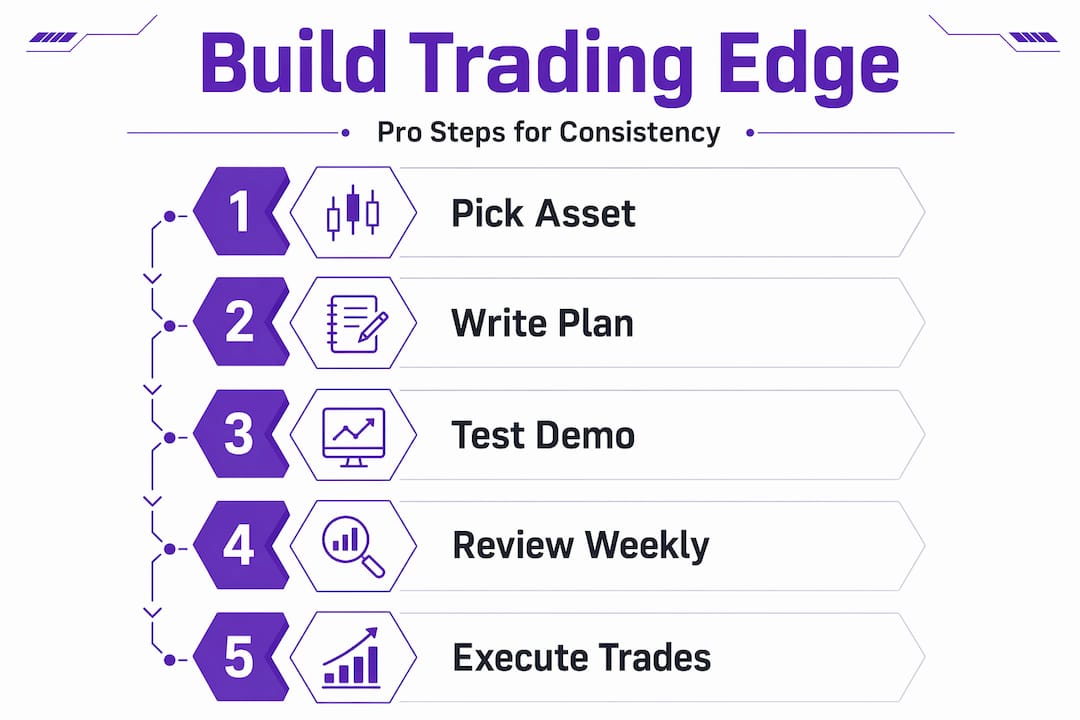
This is where most traders either do the work or skip it and pay later. A documented trading plan with specific entry, exit, stop loss, and position sizing rules is what separates a trading business from gambling. The process below gives you a repeatable framework to follow.
-
Define your entry criteria precisely. Vague rules like “buy when price looks strong” don’t work. Your entry should require multiple confirming conditions. For example: price returns to a demand zone identified on the 4-hour chart, a bullish engulfing candle forms on the 15-minute chart, and volume on the signal candle exceeds the 20-period average. Successful trading systems combine market structure frameworks like Smart Money Concepts with systematic entry timing based on institutional order flow and liquidity zones.
-
Set non-negotiable exit rules. Your take profit and stop loss must be defined before you enter. A 1:2 risk-to-reward minimum means for every dollar risked, you require two dollars of potential gain. Write this down. If the math doesn’t work at the time of entry, the trade doesn’t happen.
-
Apply strict position sizing. Limit risk to 1 to 2% per trade. This is not a suggestion. At 1% risk per trade and a stop loss of 50 pips or points, your position size is calculated from that math, not from a gut feel about conviction level.
-
Filter for market conditions. Trending markets and ranging markets require different approaches. Momentum and breakout strategies suit different trader profiles and risk tolerances. Define whether your strategy works best in trending or consolidating conditions, and include a rule that prevents trading when conditions don’t match.
-
Write everything down in one document. Not mentally. Not on a sticky note. A single reference document that you consult before every session. When you’re in a losing streak and tempted to override your rules, that document is your anchor.
Pro Tip: Most beginners try to learn three or four strategies simultaneously. Focused mastery of a single framework, tested across 100 to 200 trades, teaches you far more than rotating between setups. Commit to one approach for at least three months before evaluating changes.
Testing your strategy before live capital
Writing a plan is the easy part. Verifying that it has a real edge is where most traders skip steps, and it costs them. The standard for statistically valid testing is 200 or more trades. Under 100 trades is statistically insufficient to distinguish a real edge from random variance.
Here is how to approach the testing phase correctly:
- Use replay tools, not just backtesting. Static backtesting lets you see past results but doesn’t build the real-time decision-making muscle you need. Platforms like TradingView have bar replay features that simulate live conditions. Use them daily.
- Journal every trade in detail. A well-structured trading journal logs entry reason, stop level, target level, actual outcome, and emotional state during the trade. This is the most underused tool in trading and the most important for diagnosing problems.
- Enforce cooling-off periods after losses. 15-minute breaks after losing trades prevent the cascade effect of revenge trading, where each bad trade leads to a larger, less disciplined follow-up trade.
- Run at least three profitable demo months before live trading. The threshold for going live is not “I feel ready.” It’s three profitable months on demo with 100 or more documented trades showing a consistent edge.
- Track win rate, average risk-to-reward, and maximum drawdown. These three numbers tell you whether your plan is viable. A 40% win rate with a 1:2.5 average reward-to-risk is mathematically profitable. A 60% win rate with a 1:0.8 average is not.
Pro Tip: Don’t optimize your strategy based on demo results alone. If your journal shows 80 trades with a 70% win rate on demo, resist the urge to immediately scale up. Outlier performance in demo often normalizes when real money and real emotions enter the equation.
Executing with discipline on live accounts
Live trading introduces a psychological layer that demo never fully replicates. The mechanics stay the same. The emotional response to real capital at risk is different. Your execution process needs to account for this.
The core risk rules don’t change. Limit each trade to 1 to 2% risk and set a hard daily loss limit of 3%. When you hit that daily cap, the session ends. No exceptions. Daily loss limits prevent the kind of emotional trading that turns a bad morning into an account-destroying afternoon.
“The daily 3% loss cap is not a sign of weakness in your strategy. It’s the circuit breaker that keeps one bad session from becoming a permanent setback.” — Structured trading principle
Stop losses should be placed based on market structure, not round numbers or fixed pip values. Volatility-based stop losses using ATR align your risk with actual market movement rather than arbitrary placement. A stop placed at the nearest structural low, with size calculated to match your 1% risk, is a calculated risk. A stop placed 20 points below entry because it “feels right” is not.
Professional traders also limit sessions to 2 to 4 focused hours per day. Extended screen time degrades decision quality. Trade your plan during the highest-probability hours, then step away. Your daily routine should include pre-session preparation (reviewing relevant news, marking key levels) and post-session journaling (reviewing every trade taken and not taken).
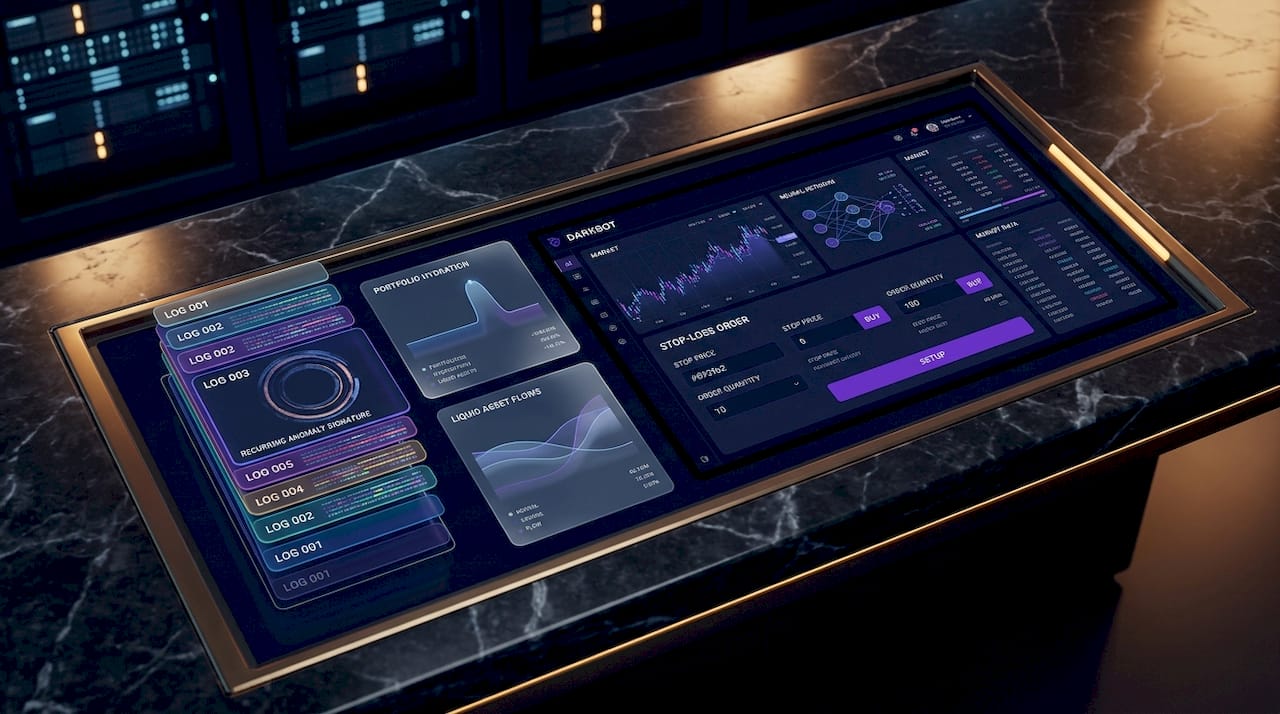
Scale position sizes gradually as your live track record builds. Start at 0.5% risk per trade if needed. The goal is to preserve capital and build confidence simultaneously, not to rush toward full sizing.
Common mistakes and how to fix them
Knowing the rules is different from consistently applying them. The table below maps the most frequent mistakes traders make and what to do instead.
| Mistake | Impact | Fix |
|---|---|---|
| Memorizing patterns without understanding context | Poor long-term results as market conditions shift | Study the logic behind price movement, not just visual shapes |
| Changing strategies before sufficient testing | No real edge is ever established | Commit to one framework for at least 100 documented trades |
| Trading without a daily loss cap | Single bad sessions wipe weeks of gains | Set and enforce a hard 3% daily stop |
| Skipping trade journaling | No data to identify actual weaknesses | Log every trade, every session, without exception |
| Overtrading outside of defined setups | Excessive exposure and emotional fatigue | Only take trades that meet all criteria in your written plan |
| Adjusting stops mid-trade based on emotion | Risk management breaks down and losses grow | Place stops before entry, then do not move them against you |
Weekly reviews are where improvement actually happens. Set aside 30 minutes each Sunday to analyze the week’s trades, identify recurring errors, and note any environmental factors (news events, unusual volatility) that affected results. Adapt your plan based on patterns in your data, not in response to a single frustrating session.
Frequent strategy changes before sufficient statistical validation are one of the most consistent predictors of long-term failure. Every time you abandon a strategy before testing it thoroughly, you reset the clock and never accumulate the evidence needed to know whether the approach has a real edge.
My honest take on what actually builds a trading edge
What I’ve learned after working closely with systematic traders and reviewing how automated strategies perform over time is that the traders who succeed share one observable behavior: they get bored in the best possible way. They run the same checks, follow the same rules, and review the same journal every session. There’s no excitement in a well-running process.
The traders who struggle are almost always the ones chasing novelty. A new indicator, a new setup, a new framework. I’ve seen this pattern repeatedly. The constant switching is not a search for better tools. It’s avoidance of the discomfort that comes with honest self-assessment.
In my experience, understanding why price moves beats memorizing what price looks like when it moves. The second you understand institutional order flow and why liquidity gets swept before a reversal, your pattern recognition becomes adaptive. You stop looking for the same candle and start reading the same logic in different forms.
The psychological traps, revenge trading especially, don’t disappear with experience. What changes is the speed at which you recognize them. Journaling accelerates that recognition by creating a paper trail of your own behavior. You can’t argue with your own data.
I’ve also found that automation doesn’t replace discipline. It enforces it. When a rule-based system executes exactly what your plan specifies, without hesitation or second-guessing, you see clearly whether the plan itself is the variable that needs adjustment.
— Grisha
How Darkbot supports systematic trading execution
Building a step by step trading strategy takes real effort. Keeping it consistent across hundreds of live trades takes infrastructure. Darkbot’s AI-powered automation platform is built around exactly this problem: the gap between a well-designed plan and disciplined execution at scale.
Darkbot enforces the risk rules your plan specifies. Stop-loss levels, daily loss caps, and position sizing parameters are built into the automation layer, not left to manual execution under pressure. You can explore automated strategy execution to see how a tested plan maps directly into a bot configuration.
For traders managing multiple assets or strategies, Darkbot’s portfolio management tools keep exposure aligned with your overall risk framework. The platform integrates with major exchanges via API and runs continuously, applying your defined logic without fatigue or emotional override. If you’re ready to move from manual to systematic, Darkbot is built for that transition.
FAQ
What is a step by step trading strategy?
A step by step trading strategy is a structured framework that defines entry criteria, exit rules, stop-loss placement, and position sizing before any trade is taken. It converts trading ideas into repeatable, rule-based decisions that remove emotional discretion from the process.
How many demo trades should I complete before going live?
You need at least 200 trades to statistically validate whether your strategy has a real edge. Fewer than 100 trades is insufficient to distinguish skill from variance, and live trading before this threshold significantly increases the risk of capitalizing on randomness rather than a proven approach.
What is the correct risk per trade for crypto trading?
The standard for beginners and intermediate traders is 1 to 2% of account capital per trade, with a hard daily loss cap of 3%. These limits prevent any single trade or session from causing account-level damage while you build experience.
Why do most trading strategies fail before they get tested properly?
Most strategies are abandoned too early because traders interpret short-term losing streaks as evidence of a broken system. Frequent changes before 100 to 200 documented trades prevent any real edge from being established, making it impossible to separate strategy flaws from normal statistical variance.
How does automated trading support a structured plan?
Automated trading systems execute your predefined rules without deviation, removing the emotional override that causes most live trading mistakes. Tools like Darkbot apply your stop-loss, position sizing, and entry logic consistently across every trade, which is what allows a structured plan to perform as designed.
Recommended

Start trading on Darkbot with ease
Come and explore our crypto trading platform by connecting your free account!
Free plan available • No credit card required