Machine Learning Algorithms in Finance: 2026 Practitioner Guide

TL;DR:
- Most finance professionals believe that increased model complexity leads to better results, but choosing simpler, well-tuned models often yields more reliable outcomes. The 2026 regulatory framework emphasizes lifecycle oversight, model risk tiering, and continuous monitoring to ensure responsible ML deployment in finance. Practical strategies include matching model complexity to data constraints, prioritizing interpretability, and implementing robust drift detection to maintain model reliability.
Most finance professionals entering the machine learning space carry the same assumption: more model complexity means better results. That assumption has real consequences. Machine learning algorithms in finance span a wide spectrum of architectures, from simple regularized regressions to deep learning networks with millions of parameters, and choosing the wrong model for your data environment routinely produces worse outcomes than a well-tuned simpler baseline. This guide covers model selection, financial predictive modeling applications, regulatory governance under the 2026 interagency framework, and advanced strategies for practitioners who need ML to perform reliably, not just impressively on a test set.
Key takeaways
| Point | Details |
|---|---|
| Model complexity requires calibration | Tree-based models often outperform deep networks in limited or noisy financial datasets. |
| Interpretability is operationally useful | SHAP, PDP, and ALE tools guide model tuning and risk decisions, not just regulatory compliance. |
| Governance starts at development | The 2026 regulatory framework mandates lifecycle oversight, continuous drift monitoring, and versioned testing from day one. |
| Horizon shapes algorithm choice | Lasso fits short-term inflation forecasting while Random Forest and XGBoost perform better over longer horizons. |
| Non-stationarity demands probabilistic design | Wrapping ML models in simulation and stress-test workflows prevents failures from market regime changes. |
Machine learning algorithms in finance: the core model landscape
Ensemble and deep models consistently outperform traditional statistical methods by capturing nonlinear dependencies across financial datasets. But that finding comes with a critical qualifier: the performance advantage is context-dependent.
The four model families that dominate current financial ML research are tree-based ensembles, support vector machines, recurrent architectures, and convolutional neural networks. Each carries distinct trade-offs.
Tree-based models: Random Forest and XGBoost excel in tabular financial data with moderate sample sizes. They handle mixed feature types well, tolerate outliers, and produce outputs that interpretability tools can analyze with precision. Credit risk scoring, financial distress prediction, and factor-based equity models are natural fits. Their gradient boosting variants (XGBoost, LightGBM) are the practical default for most structured finance datasets because they train fast, generalize reliably, and expose feature importance natively.
LSTM and CNN architectures become relevant when you are working with sequential or high-frequency data where temporal dependencies matter. LSTM networks model time-series patterns in price data, macroeconomic indicators, or order flow sequences. CNNs applied to financial charts or spectrogram representations of price movements capture spatial patterns that recurrent layers miss. The cost is data volume requirements, training time, and interpretability overhead.
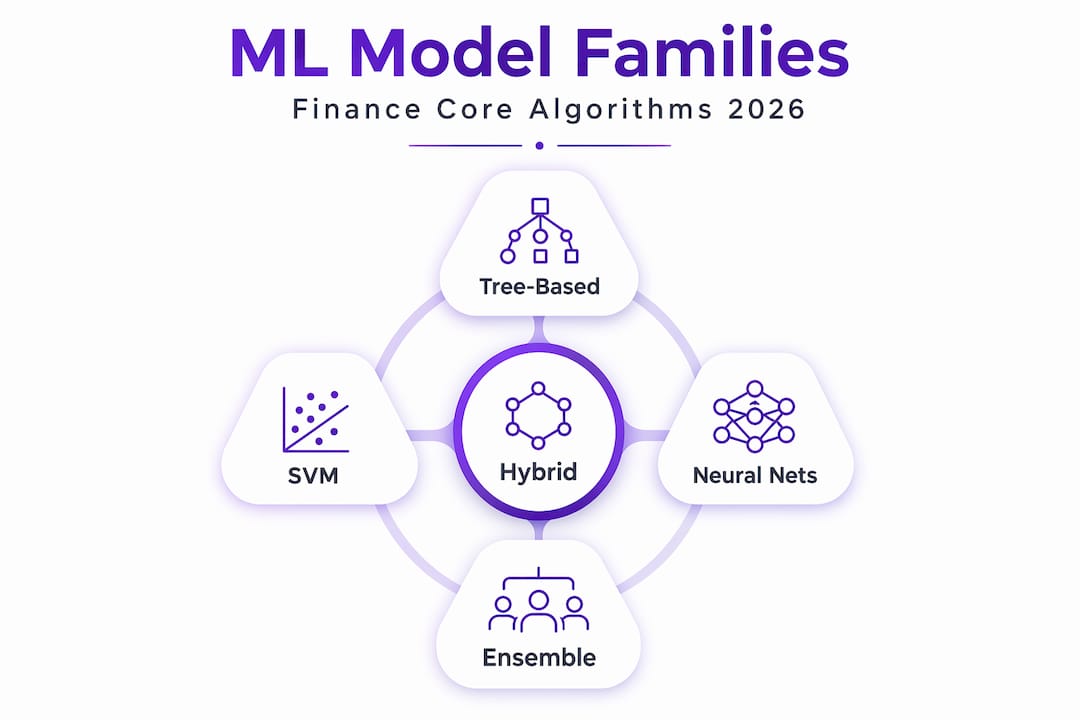
Hybrid and ensemble approaches combine model families to improve robustness across regimes. A practical example: pairing an XGBoost signal generator with an LSTM-based volatility filter, where each component handles the data structure it is suited for, rather than asking one architecture to do both jobs.
| Model | Strengths | Weaknesses | Best financial use case |
|---|---|---|---|
| Random Forest | Robust, handles missing data, interpretable | Lower ceiling than deep models | Credit scoring, default prediction |
| XGBoost | High accuracy, fast training, feature importance | Requires careful hyperparameter tuning | Factor models, inflation forecasting |
| SVM | Effective in high-dimensional spaces | Slow on large datasets | Classification tasks, fraud detection |
| LSTM | Captures sequential dependencies | Data-hungry, hard to interpret | Time-series forecasting, price modeling |
| CNN | Extracts spatial and pattern features | Less common, complex to validate | High-frequency data, chart pattern recognition |
Pro Tip: Before selecting a model architecture, define your data constraints first. How many training samples do you have? How stable is the feature distribution over time? Matching model capacity to data reality prevents the common mistake of defaulting to deep learning when a gradient boosted tree would have trained faster and generalized better.
Practical applications in predictive modeling and risk
The practical range of AI in financial analysis covers asset pricing, credit evaluation, volatility forecasting, and macroeconomic prediction. What makes ML useful across these domains is not raw accuracy alone. It is the ability to capture nonlinear relationships and interaction effects that linear models systematically miss.
ML models outperform traditional methods in inflation forecasting, with model selection depending sharply on forecast horizon. Lasso regression performs best at short horizons because sparse, regularized models handle recency better than complex ensembles. Random Forest and XGBoost take over at longer horizons where feature interaction effects matter more than recency weighting.
In equity markets, tree models outperform deep networks in emerging market stock return prediction when datasets are limited. A study on Korean equity markets found that interpretability techniques like partial dependence plots and accumulated local effects identified 36-month momentum as a nonlinear threshold factor. That insight came from the interpretability layer, not the raw prediction, which is exactly what operational interpretability looks like in practice. See how ML improves trading efficiency for a practical framing of these same principles.
The financial functions where ML adds measurable value include:
- Credit risk scoring and probability of default estimation
- Volatility and tail risk forecasting for portfolio construction
- Factor signal generation for quantitative investment strategies
- Bankruptcy and financial distress prediction
- Liquidity risk assessment, including for digital asset portfolios
- Inflation and macroeconomic regime forecasting
- Fraud detection and anomaly identification in transaction data
Pro Tip: When using interpretability tools, treat SHAP values as a diagnostic instrument. If a feature’s SHAP contribution behaves erratically across the input range, that is a signal to audit data quality or reconsider feature engineering before trusting the model in production.
AI methods including neural networks, random forests, and large language models improve both accuracy and decision-making agility across bankruptcy prediction and financial performance forecasting. The underlying mechanism is consistent: structured pattern recognition across high-dimensional feature spaces where traditional parametric methods impose assumptions that financial data routinely violates.
Regulatory governance for ML models in 2026
The April 2026 interagency guidance from the Federal Reserve, FDIC, and OCC replaced the prior model risk framework with a more structured approach that treats model risk as equivalent to credit and market risk. For finance data scientists and ML practitioners, this has direct implications for how you design, validate, and monitor every model in production.
The framework introduces risk-based tiering, meaning that higher-stakes models (those influencing credit decisions, capital calculations, or systemic risk) require proportionally more rigorous governance. Lifecycle oversight is now mandatory from development through decommissioning, not just at deployment.
| Lifecycle stage | Governance requirement |
|---|---|
| Development | Documented assumptions, version control, initial benchmarking |
| Validation | Effective challenge by independent teams, sensitivity analysis |
| Deployment | Tiered approval based on model risk classification |
| Monitoring | Continuous drift detection for model outputs and input data distributions |
| Retirement | Evidential records, reproducibility of prior decisions |
Versioned, ongoing evaluation embedded in the development cycle, rather than post-deployment audits, is now the regulatory expectation. That shift matters practically: governance cannot be bolted on after a model goes live. It needs to be part of the data pipeline architecture, the feature engineering process, and the model registry design from the start.
Regulatory frameworks are expanding to include GenAI and large language models under the same model risk governance umbrella as classical ML. If your institution is piloting LLM-based document analysis or automated credit memo generation, the 2026 guidance applies. Unified model risk management across classical and generative AI is no longer optional.
Pro Tip: Map every ML model to a risk tier before development begins, not after validation. Early tiering drives proportional documentation, testing scope, and monitoring cadence decisions. Retrofitting governance to a production model is expensive and introduces compliance gaps.
Challenges and advanced strategies for robust ML deployment
Non-stationarity is the defining challenge of financial ML. Markets shift regimes. Features that predicted credit defaults reliably in one economic cycle carry diminishing signal in the next. A model calibrated on pre-2020 data will encounter distribution shifts that degrade its behavior in ways that aggregate accuracy metrics will not immediately reveal.

ML models embedded in probabilistic engines that simulate various input scenarios outperform models deployed as static predictors. Simulation wrapping forces a model to be evaluated across plausible stress scenarios rather than just its training distribution. For risk assessment algorithms specifically, this distinction between point prediction and probabilistic behavior is operationally meaningful.
Key challenges practitioners need to plan for explicitly:
- Model drift: Input distribution changes over time; monitoring feature statistics in production is as important as monitoring output accuracy.
- Overfitting to historical regimes: High in-sample accuracy on a bull market period provides no guarantee of robustness through a credit contraction.
- Calibration versus accuracy: A model can rank-order risks correctly while producing miscalibrated probability estimates. Risk management needs calibrated outputs, not just rankings.
- Data quality and lookback bias: Financial datasets frequently contain survivorship bias, restated figures, and point-in-time availability issues that inflate backtested metrics.
Distinguishing predictive accuracy from model stability is a practical discipline that requires fail-safe benchmarking and rollback capabilities built into model infrastructure from day one. Ensemble approaches help because combining diverse model families reduces the variance introduced by any single architecture’s sensitivity to regime shifts.
Interpretability as an operational tool means using SHAP and related methods to monitor which features are driving model decisions in production, not just during validation. If a credit model begins attributing unexpected weight to a macroeconomic proxy after a regime shift, that signal should trigger a review before the performance metrics degrade.
Pro Tip: Build a rollback protocol before your first production deployment. Define the conditions that trigger an automatic switch to a prior model version, and test the protocol quarterly. Governance documentation that assumes models will perform as expected in all conditions is not governance.
Future directions for finance ML practitioners
The trajectory of machine learning in banking and quantitative finance is moving toward explainable hybrid models, real-time governance integration, and broader adoption of open financial datasets that improve reproducibility and external benchmarking.
Several developments are worth tracking closely:
- Hybrid architectures that pair tree-based signal generators with deep learning volatility models are gaining traction in algorithmic trading applications
- Open datasets in credit and macro forecasting are reducing the reproducibility gap that has historically made financial ML research harder to validate
- Real-time governance platforms that monitor model and data drift continuously are becoming infrastructure requirements, not optional tooling
- GenAI agents operating on financial documents require the same lifecycle controls as any other model risk category under current regulatory guidance
For finance professionals looking to deepen their ML capability, the priority sequence is practical: start with model governance literacy before expanding model complexity. Understanding what the 2026 regulatory framework requires of your institution’s ML stack is more immediately valuable than experimenting with the latest architecture. From there, build interpretability tools into your standard workflow, and treat crypto trading automation as a real-time testbed for systematic ML execution principles.
My take on what actually works in production
I’ve seen enough financial ML projects move from promising backtest to unreliable production system to have a clear view on where the real risk sits. It is almost never the model architecture. The failures I’ve observed consistently trace back to three sources: governance designed as an afterthought, interpretability treated as a compliance checkbox, and drift monitoring absent until something breaks.
What I’ve learned is that complexity budgets matter. When you are working with an emerging market equity dataset of a few hundred companies, a gradient boosted tree with careful feature engineering will almost always beat a two-layer LSTM. The data environment does not support the capacity of the more complex model. Practitioners who recognize this spend less time debugging unexplainable failures and more time improving the features and monitoring logic that actually drive production reliability.
The other shift that changes outcomes is treating governance as a technical discipline rather than an administrative burden. Versioning every model artifact, documenting every feature transformation, and building monitoring into the pipeline from the start is not regulatory theater. It is what separates models that degrade predictably and safely from those that fail in ways you cannot diagnose. ML becomes an asset to the institution when it operates within a framework that manages its own uncertainty.
— Grisha
Apply ML principles with Darkbot’s systematic trading framework
The same principles that make machine learning algorithms effective in institutional finance apply directly to systematic crypto trading: disciplined model design, structured risk control, and rule-driven execution that does not depend on manual judgment in real time.

Darkbot is an AI-based crypto trading automation platform built around exactly these principles. The platform supports automated strategy execution across multiple exchanges, portfolio management optimization with rebalancing logic, and real-time analytics designed for practitioners who think about risk in probabilistic terms. If you apply ML-driven decision frameworks in traditional finance and want a systematic environment to extend that thinking to digital assets, explore Darkbot’s platform to see how automated, rule-based execution translates to the crypto context. The platform is designed for both experienced quants and structured thinkers new to digital asset markets.
FAQ
What machine learning models are most used in finance?
Random Forest, XGBoost, SVM, LSTM, and CNN architectures dominate current financial ML applications, with model choice depending on data volume, structure, and forecasting horizon.
How does machine learning improve risk assessment in banking?
ML models capture nonlinear relationships in credit and market data that traditional statistical methods miss, improving default prediction accuracy and enabling more granular risk segmentation.
What does the 2026 regulatory framework require for ML in finance?
The April 2026 interagency guidance from the Federal Reserve, FDIC, and OCC mandates risk-based model tiering, full lifecycle governance, continuous drift monitoring, and effective independent challenge for all ML models used in financial institutions.
Why do simpler models sometimes outperform deep learning in finance?
In datasets with limited observations or high feature noise, simpler tree-based models generalize better because deep learning architectures overfit to patterns that do not persist out of sample.
What is model drift and why does it matter for financial ML?
Model drift occurs when the statistical relationship between input features and outcomes changes over time due to market regime shifts, making a previously accurate model unreliable without recalibration or retraining.
Recommended

Start trading on Darkbot with ease
Come and explore our crypto trading platform by connecting your free account!
Free plan available • No credit card required