Live Bot Monitoring: What to Track on a Crypto Trading Bot
Live monitoring of a crypto trading bot means checking, continuously, that the bot receives fresh market data, sends the orders its rules call for, records the fills the exchange actually produced, and alerts a human when any of that breaks. It is a process, not a dashboard you stare at. This guide sets out the layers to watch, the alerts worth configuring, a reconciliation routine, and a response procedure for failures.
TL;DR
- Monitor four layers: infrastructure health, execution quality, position integrity and strategy behavior. A bot can look healthy on one and be failing on another.
- Alert on states that require action (stale data, missing heartbeat, unknown orders, balance mismatch), not on every event.
- Reconcile the bot’s internal records against exchange records on a fixed schedule, and investigate any difference.
- Use purpose-specific API keys with minimum permissions and IP restrictions, so monitoring never requires exposing credentials.
- When something fails, stop new risk first, then diagnose, then restart in stages.
What live monitoring actually covers
Automation removes the need to click, not the need to supervise. A bot executes rules faithfully, including when the conditions those rules assumed no longer hold. Monitoring is the control that notices when that happens.
Practitioner guidance on algorithmic trading monitoring describes four layers, and they are a useful frame:
- Infrastructure health: is the process running, is data arriving, is the exchange API reachable?
- Execution quality: are orders filled at the expected times and prices?
- Position integrity: do the bot’s holdings match the exchange’s records?
- Strategy performance: is live behavior consistent with what testing suggested?
The distinction between monitoring and risk controls matters. A risk control blocks or halts an individual transaction, such as a per-trade size cap. Monitoring tracks operational and performance metrics over time and raises an alert when they leave their expected range. You need both: controls limit the damage of a single bad order, monitoring catches the slower problems that no single order reveals.
The metrics worth tracking
A short list tracked reliably beats a long list nobody reads. The table groups what to watch by layer and states why each item matters.
| Layer | Metric | What a deviation usually indicates |
|---|---|---|
| Infrastructure | Heartbeat (bot emits a timestamp on schedule) | Process crashed, hung or is in a restart loop |
| Infrastructure | Market-data freshness | Decisions are being made on stale prices |
| Infrastructure | API latency and error rate | Connectivity trouble, rate limiting or exchange degradation |
| Execution | Order states (acknowledged, filled, canceled) | Orders stuck, rejected or never sent |
| Execution | Slippage versus expected price | Thin liquidity or delayed execution |
| Position integrity | Internal balance and positions versus exchange | Missed fill, manual intervention, duplicate or orphan order |
| Strategy | Live results versus the expected range | Market regime differs from the tested one, or a configuration error |
This list follows the checks described in a guide to crypto bot monitoring, which centers on heartbeat, data freshness, API latency and errors, order states and fills, slippage, and balance and position agreement with the exchange.
Heartbeat and watchdog
A heartbeat is the simplest reliable signal. The bot writes a timestamp every N seconds. A separate watchdog reads it and raises an alert if the timestamp is older than a threshold. Because the watchdog runs independently of the bot, it still works when the bot has frozen. A bot that crashes and restarts repeatedly also shows up here, as a pattern of short-lived heartbeats rather than a clean gap.
Data freshness
A running process is not proof of a working strategy. If the price feed stalls while the bot keeps running, it will keep evaluating rules against old prices. Track the age of the latest market-data update and treat it as a first-class metric.
Order lifecycle
Every order should move through known states: submitted, acknowledged, then filled or canceled. Attaching a unique correlation ID to each order lets you follow it end to end and spot the ones that stop moving. An order with no ID that your bot recognizes is the one to investigate first.

Why one check is never enough
A single external ping can report that a service is up while the trading logic has quietly stopped placing orders. Operational guidance for trading bot uptime makes this point: combine an external availability check, application telemetry and log analysis, and connect them to thresholds and notifications, so a failure is noticed before it becomes a loss.
In practice that means asking three different questions:
- From outside: is the service reachable?
- From inside: is it doing the work (orders placed, data processed)?
- From the logs: are errors accumulating that the first two do not show?
A failure is easy to miss when only one of the three is answered.
Setting up alerts that someone will act on
Alert fatigue is a monitoring failure of its own. If alerts fire constantly, they get muted, and the one that matters is lost. A workable rule: every alert states the current condition and the action required.
Alerts worth configuring:
- Missing heartbeat or crash loop. The expected instance has stopped reporting.
- Stale market data. Data age exceeds a threshold you set per market.
- Lost private stream. The connection that delivers your own order and balance updates has dropped, so the bot may not know its own state.
- Unknown or orphan orders. An open order exists on the exchange that the bot has no record of.
- Position or balance mismatch. Internal and exchange figures disagree.
- Repeated API failures. Documentation for one alerting tool shows the pattern: an alert fires after three consecutive failures to reach an exchange API and repeats at a set interval while the problem lasts. Requiring several consecutive failures filters out one-off network blips.
- Risk-limit proximity. Daily loss, exposure or drawdown approaching the limits you defined.
Send alerts to a channel you actually see, such as push notification, email or a messaging app. For high-severity conditions, use a channel that interrupts. Test the path end to end before relying on it: trigger a deliberate test alert and confirm it arrives.
Checking that live trades match the strategy
A bot can be operationally healthy and still behave differently from what you intended. Two checks address this.
Reconciliation
Reconciliation compares the bot’s internal ledger with authenticated exchange records. For each asset, list the internal quantity, the exchange quantity and the difference. Any non-zero discrepancy gets investigated, not ignored. Guidance on live algorithm monitoring suggests doing this at least once per trading session, and hourly for intraday strategies. Crypto markets do not close, so a fixed daily or hourly schedule is the practical equivalent.
Common causes of a mismatch include a fill the bot never received, a manual trade placed on the exchange, a fee denominated in a different asset, and a duplicate order.

Comparing live results with expectations
Strategy monitoring is statistical, not emotional. One approach is to compare live results against the distribution of out-of-sample backtest results, using standard deviations (z-scores) of daily profit and loss and rolling performance measures. A single losing day inside the expected range is normal variation. A run of results far outside that range is a signal to review the configuration or the market conditions, not to assume the strategy is broken or to change parameters impulsively.
This is also the point of paper trading and backtesting before going live: they give you the baseline that live results are measured against. For a broader look at whether live results stay consistent with expected behavior, see this analysis of how copy trading performance holds up, which addresses the same question of tracking results against expectations.
Monitoring without exposing credentials
Monitoring should never require handing out more access than the bot needs. Good key hygiene is part of the monitoring design:
- Create separate API keys for separate purposes, for example one for trading and a read-only one for reporting.
- Grant minimum permissions. A trading bot does not need withdrawal rights.
- Restrict keys to specific IP addresses where the exchange supports it.
- Prefer short-lived tokens where offered. Kraken’s documentation, for example, describes API key permissions and notes that its private WebSocket channels use short-lived tokens rather than the raw API key.
Watch the account side too: unexpected permission changes, new keys you did not create, and logins you do not recognize. For more detail on this, see our articles on API key security in automated trading and IP restrictions for API keys.
When something goes wrong: a response procedure
Decide the procedure before you need it. Under pressure, people improvise, and improvisation on a live account tends to add errors. A sequence that works for a bot that stops responding, loses connectivity or places an unexpected or duplicate order:
- Freeze new risk. Pause the bot or disable new entries. Do not start by changing parameters.
- Preserve evidence. Save logs and the current configuration before restarting anything.
- Verify the exchange side. Check open orders, recent fills and balances directly on the exchange. The exchange record is the authority.
- Reconcile. Match the bot’s internal state to the exchange. Cancel orphan orders deliberately.
- Repair, then restart in stages. Fix the cause, restart with reduced size or a single market, confirm normal behavior, then restore full operation.
This order follows the incident sequence in the monitoring guide cited above. Its logic is that each step limits uncertainty before the next one acts on it.
How often to review a running bot
No regulator or exchange sets a review cadence, so this is a design decision. A reasonable structure separates what machines check continuously from what you check periodically:
- Continuously (automated): heartbeat, data freshness, API errors, unknown orders, risk-limit proximity.
- Each session or day (you): reconciliation result, open orders, exposure against limits, any alerts that fired.
- Weekly: live results against expected range, slippage trends, fee impact.
- After any change: a closer look for the first sessions following a configuration change, an exchange update or a key rotation.
When you cannot watch at all, rely on controls that act without you: position size caps, per-trade and daily loss limits, stop logic on the exchange side where available, and alerts that reach your phone. The common 1 to 2 percent per-trade risk guideline is a starting point for sizing, covered in our risk checklist and our piece on risk management in trading bots. Automation does not remove market risk, and no monitoring setup guarantees any outcome.
Our perspective
We built Darkbot around a simple premise: automation is only as trustworthy as your ability to see what it is doing. A trading bot is a system for systematic execution, applying the same rules each time without fatigue. That consistency is its value, and it is also why oversight matters: a rule-driven system repeats whatever it was configured to do.
This is why we treat the machine learning component as a mechanism for consistency and probabilistic pattern evaluation within defined rules, not as a forecast of price. It does not promise results, and monitoring is what keeps it honest. We prefer a human-oversight approach, where the operator can see orders, positions and risk state and can intervene.
Our design choices follow from that. Exchange connections run through API keys, so you keep custody of funds and can limit permissions. Orders are routed directly to the exchange, which makes the exchange record the source of truth for reconciliation. Risk management tools, real-time analytics, paper trading and backtesting give you a baseline to measure live behavior against, and personalized support is there when something looks wrong.
If you automate, build the monitoring first and scale position size second.
Grisha
Monitoring with Darkbot
Darkbot is an AI-based crypto trading automation platform, not a signal provider. It connects to supported exchanges through API keys and provides strategy customization, backtesting, paper trading, risk management tools, portfolio management, automated rebalancing and real-time analytics, so you have a baseline and a view of live activity in one place. Our guide to API-based exchange integration explains how the connection works.
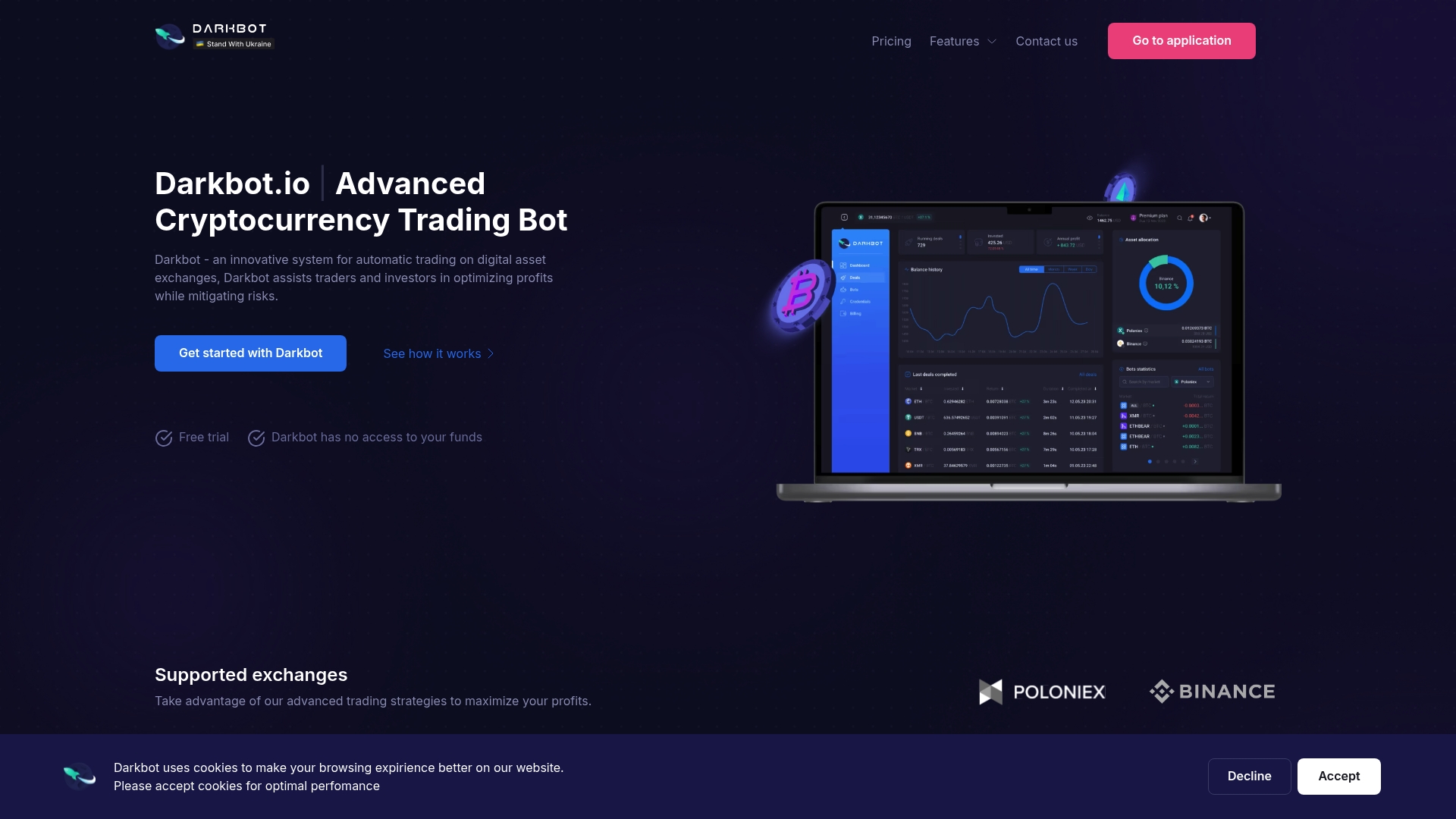
Plans are listed on the pricing page: a Free plan with limited features, Standard at $12.50 per month, Premium at $25.00 per month, and an Enterprise tier. Paid plans carry a 14-day money-back guarantee. Starting with paper trading on the free tier is a sensible way to test your monitoring routine before real capital is involved.
FAQ
What is live bot monitoring in crypto trading?
It is the continuous tracking of a bot’s health, orders, positions and results, with alerts when something leaves its expected range. It checks that data is fresh, orders are sent, fills match exchange records and failures reach a human quickly.
Which metrics matter most?
Start with the heartbeat, market-data freshness, API errors and latency, order states and fills, slippage, and agreement between the bot’s balances and the exchange’s. Add a comparison of live results with your backtest range once you have enough live history.
Do I need to watch the bot all day?
No, but you need automated alerts and fixed review points. Let machines watch heartbeat, data age and unknown orders continuously, and review reconciliation and exposure at set intervals. Loss limits and size caps should act without you.
Is it safe to give a bot my exchange API key?
It can be, if you limit the exposure. Use a dedicated key, enable only the permissions the bot needs, leave withdrawals off and restrict the key to known IP addresses where the exchange allows it. Review your keys periodically and delete any you no longer use.
Sources
- Crypto Trading Bot Monitoring: 11 Critical Checks
- Monitoring and Alerting for Live Algos
- Trading bot monitoring: healthcheck, alerts, watchdog
- BitMe Alerts documentation
- API key permissions, Kraken Developers
- Is Copy Trading Profitable? What the Evidence Shows
Recommended

Start trading on Darkbot with ease
Come and explore our crypto trading platform by connecting your free account!
Free plan available • No credit card required