Best Swing Trading Bots: Compare 3 Types, Then Test the Evidence
For AI-powered multi-day swing trading automation, we built Darkbot as a recommended starting point because it bundles configurable strategies, exchange API routing, and risk controls designed for swing timeframes. Beyond our own platform, the broader shortlist traders consider includes broker-integrated bots, DIY strategy builders, and institutional flow tools. This article covers how each type fits swing trading, what to test before committing, typical pricing shapes, and the safety controls worth demanding from any vendor.
TL;DR:
- Before funding a bot, require backtests validated across successive historical periods that include fees, slippage, and market impact, then compare results with paper trades.
- Keep paper trading active for several weeks across multiple swing cycles; move to a small live allocation only when results track backtests reasonably.
- Restrict exchange API keys to trading, without withdrawal permission, and require hard daily loss limits, position caps, trade frequency controls, alerts, and audit logs.
- Choose bots built into a broker for single exchange execution, DIY builders for transparent rules, and flow tools for research rather than automated execution.
Comparing the top swing trading automation options
Swing trading bots fall into a handful of distinct categories, each suited to a different kind of trader. We built Darkbot as an AI-based crypto trading automation platform that lets you configure strategies, route orders directly through exchange APIs, and set risk guardrails before a bot ever touches live capital. It fits traders who want a single, configurable system that handles multi-day positions without requiring custom code.
Several named platforms also appear often in AI options research and ranked trade ideas in swing trading discussions. Tickeron packages AI-driven pattern recognition into ranked trading robots aimed at retail investors. TradeAlgo focuses on institutional-style order flow data repackaged for individual traders. Danelfin scores stocks using AI-driven probability models. TrendSpider centers on automated technical analysis and chart pattern detection. Trade Ideas Holly AI runs simulated trading agents that scan for setups during market hours. Kavout applies machine learning to rank stocks by expected performance. Each targets a different piece of the swing trading workflow: some emphasize signal generation, others emphasize execution, and few combines both with direct exchange connectivity the way a dedicated automation platform does.
Beyond named products, three generic categories matter when you are shopping for a bot. Broker-integrated bots ship built into a brokerage or exchange account, which simplifies onboarding because the execution layer and the account are already connected. They suit traders who want to stay inside one exchange and avoid managing separate API credentials. DIY strategy builders are low-code or visual tools that let you design and test your own rules from scratch, which appeals to traders who want full transparency into every decision the bot makes but accept a steeper setup curve. Institutional flow tools focus on orderbook and flow data rather than execution, giving you research inputs to inform swing entries without automating the trade itself.
| Option type | Best for | Key features | Pricing shape | Standout capability | Risk and safety controls |
|---|---|---|---|---|---|
| Darkbot | Traders who want a configurable, exchange-integrated AI bot for multi-day swing strategies | API integration, strategy customization, portfolio management | Standard Plan and Premium Plan, plus a free tier | Backtesting and risk management tools | Paper trading |
| Broker-integrated bots | Traders who prioritize tight execution with a single exchange | One-click deployment, native account connectivity | Varies by broker | Built-in execution routing | Limited to broker’s native risk tools |
| DIY strategy builders | Traders who want maximal control over strategy logic | Visual or low-code rule design, parameter tuning | Varies by provider | High transparency into strategy logic | Risk controls depend on what you build in |
| Institutional flow tools | Traders seeking proprietary flow or orderbook signals | Aggregated order flow, research dashboards | Varies by provider | Access to flow data not visible on standard charts | Research only, no native execution controls |
Before committing capital to any of these, three tests apply regardless of category. On a broker-integrated bot, run an integration test that confirms order types and fill behavior match what the interface shows. On a DIY builder, run a backtest that includes transaction costs and compare it against a short paper trading window to see how far the two diverge. On an institutional flow tool, cross-check a handful of its flagged setups against your own multi-day chart review before trusting its signals as an input to a trade.
What to check before you commit to a swing trading bot
Choosing a swing trading bot comes down to verifying a short list of operational details rather than trusting a feature page. Most of what separates a platform that holds up in live markets from one that only looks good in a demo shows up in these checks.
- Confirm the platform supports your target holding period, typically a multi-day holding period for swing positions, not just intraday scalping.
- Ask whether backtests use walk-forward validation rather than a single static historical window, which reduces the risk of overfitting to past data.
- Verify that backtesting and any performance figures account for transaction costs, slippage, and market impact, since omitting them can overstate live results, a point Darkbot’s own methodology notes emphasize directly.
- Test the paper trading mode against a few real trade setups to see how closely simulated fills match what you would expect from a live order.
- Check exchange and API coverage against the specific venues you actually trade on.
- Review the order types and execution routing available, including limit, stop, and conditional orders.
- Confirm you can set hard risk limits: maximum position size, daily loss caps, and per-trade exposure.
- Look for monitoring and alerting that notifies you of fills, errors, or risk-limit breaches in real time.
- Ask whether the platform keeps audit logs of every automated decision and trade, which matters for reviewing performance after the fact.
When you demo a platform, ask directly: “How do you simulate slippage and fees in backtests?” and “Can I set a hard daily loss limit that actually blocks further trading once it’s hit?” A vendor that cannot answer either question clearly is one you should test cautiously before funding it with real capital. Our own risk management guidance and trading bot checklist walk through these checks in more detail.
Pricing shapes across the category generally fall into three patterns: a free or trial tier for initial testing, subscription tiers that scale with the number of bots or strategies you run, and occasionally usage-based fees tied to trading volume. The features that typically drive price up are multi-bot support, advanced backtesting depth, and priority support access.
Pro Tip: Run the same strategy through backtesting, paper trading, and a small live position before scaling size, and compare the three results side by side rather than trusting any single one.
How platforms should validate their algorithms before you trust them
A backtest that ignores trading friction is close to meaningless for live decision-making. Transaction costs, slippage, and market impact can shrink apparent returns substantially, which is why reliable backtesting requires walk-forward validation and Monte Carlo simulation rather than a single pass over historical data.
Regulatory guidance on algorithmic trading offers a useful framework even for retail-facing tools. FINRA’s guidance on algorithmic trading recommends supervisory controls including unit testing, integration testing, and stress testing against both historical and simulated market data before any strategy goes live. FINRA Regulatory Notice 15-09 outlines five effective-practice areas that apply just as well to a retail automation platform: risk assessment, software development, testing and validation, trading systems controls, and compliance monitoring.
A platform’s backtest methodology is a stronger trust signal than its marketing claims, since a sound methodology is verifiable while a performance claim alone is not.
Human oversight expectations follow from the same logic. Human-in-the-loop oversight is considered critical for automated trading systems, with granular control over trade frequency, position sizing, and mandatory stop-loss parameters as baseline requirements. We apply this principle directly: our approach to automated decision-making uses explicit guardrails.
A few checks separate legitimate platforms from questionable ones:
- Verify the platform or any advisory service tied to it is registered where required, which you can check through public disclosure databases recommended by the SEC.
- Treat guaranteed-return claims as a warning sign rather than a selling point.
- Confirm the platform discloses its backtesting assumptions rather than only publishing a headline return figure.
- Look for an unregistered or unverifiable auto-trading claim, which regulators have flagged directly as a pattern tied to investment fraud.
Setting up a swing trading bot from account creation to first strategy
Onboarding to an AI swing trading bot generally follows a consistent sequence regardless of which platform you choose. You start by creating an account and selecting a plan tier, then connect the exchange or exchanges you trade on through API keys, which the platform uses to read balances and route orders without taking custody of funds. Most platforms require you to generate these keys directly from your exchange account and restrict their permissions to trading only, not withdrawals.
Next comes strategy selection or configuration. Some platforms offer prebuilt templates tuned for multi-day holding periods, while others require you to define entry and exit rules, position sizing, and risk parameters from scratch. This is where backtesting against historical data comes in, followed by a paper trading period that runs the strategy on live market data without committing real capital.
Only after paper trading results align reasonably with backtested expectations should you move to live trading with a small allocation. Monitoring tools, including alerts for fills, errors, and risk-limit breaches, should be active from the first live trade. Our own guidance on automating crypto trading covers this integration and workflow sequence in more detail.

How long it takes to go from setup to live swing trading
The timeline from account creation to live trading varies by how much configuration a strategy needs, but a cautious sequence typically spans several weeks rather than a single sitting. Account setup and exchange API connection time varies by platform. Strategy configuration or template selection can take anywhere from a few minutes for a prebuilt template to several days for a custom rule set that needs tuning.
Backtesting itself is fast computationally but should not be rushed analytically. Walk-forward validation across multiple historical periods takes longer to set up than a single static backtest, but it produces a more honest picture of how a strategy might behave across different market conditions.
Paper trading is the step most traders compress or skip, which is a mistake. A meaningful paper trading window needs to span enough multi-day swing cycles to generate a reasonable sample of trade outcomes, which for swing timeframes often means several weeks rather than several days. Only after that window shows paper results tracking reasonably close to backtested expectations does moving to live capital, starting small and scaling gradually, make sense. Rushing this sequence to reach live trading faster increases the odds of being surprised by execution costs the backtest did not capture.
Comparing performance metrics across swing trading bots
Return figures, win rates, and drawdown statistics are the headline numbers most platforms publish, but they are only meaningful alongside the methodology behind them. A high win rate paired with a large average loss on losing trades can still produce a negative expectancy, and a backtested return that excludes transaction costs and slippage routinely overstates what a live account would have achieved.
Research on AI-discovered trading strategies points to a related problem: strategies found through extensive search over historical data often reflect selection luck rather than a genuine edge, and honest evaluation requires deflating performance metrics by the number of strategies tested during that search. This applies whether the strategy comes from a vendor’s AI model or from your own parameter tuning in a DIY builder.
Drawdown, the peak-to-trough decline in account value, matters as much as return because it reflects how much volatility you would have had to tolerate to earn that return. A platform or strategy that reports strong returns but omits maximum drawdown is giving you half the picture. When comparing bots, ask for drawdown figures alongside returns, and treat any platform that only publishes return percentages without context on methodology or time period with caution.
Security and data privacy in automated bot operation
Connecting a trading bot to your exchange account means granting it programmatic access through API keys, which makes key management the first security question to resolve. Legitimate platforms let you restrict API permissions to trading only, excluding withdrawal rights, so that even if credentials were compromised, funds could not be moved off the exchange directly.
Beyond key permissions, look for how a platform handles data in transit and at rest, whether it supports additional authentication safeguards on your account, and whether it maintains audit logs of every action taken on your behalf. An audit trail matters not just for security review but for understanding exactly what the bot did and why after the fact.
Data privacy extends to how a platform uses your trading history and account data. Reputable platforms state clearly whether your data is used to train shared models or kept isolated to your account, and whether it is shared with third parties. Before connecting an exchange account to any bot, confirm these practices are documented, not just implied, and treat a platform that is vague about data handling as a reason to dig further before funding an account.
Support quality and availability across plan tiers
Support availability tends to scale with plan tier across the category, with free or entry-level tiers typically limited to documentation and community resources, while paid tiers add direct access to support staff. For a tool that manages live capital, the gap between these tiers matters more than it would for a typical software subscription, since an unresolved execution issue during a live trade can carry real cost.
When evaluating support, check response time commitments if any are published, whether support channels include live chat or only ticketing, and whether higher tiers include any form of personalized onboarding or strategy review. A platform’s support quality is easier to judge from its actual channels and stated response expectations than from marketing language describing it as responsive, which is why confirming these details directly during a trial period is worth the time it takes.
What a swing trading bot actually costs beyond the sticker price
Base subscription pricing is only part of the cost picture. Exchange trading fees apply on every order the bot places, independent of what the platform itself charges, and these accumulate faster with higher trade frequency, which is a reason to confirm expected trade frequency before choosing a plan tier. Some platforms also charge usage-based fees tied to the number of active bots or the trading volume processed, on top of the base subscription.
Slippage and spread costs are not a line-item fee but function like one, since they represent the gap between expected and actual fill price on every trade. A strategy that looks profitable in a backtest without these frictions modeled in can turn marginal or unprofitable once they are included, which is part of why walk-forward validation and realistic cost modeling matter before scaling any strategy with real capital.
Before committing to a plan tier, check whether advanced features like multi-bot support, deeper backtesting history, or priority support sit behind a higher tier than you initially expected to need, since that gap is where the actual monthly cost tends to land higher than the advertised entry price.
Why human oversight remains part of the risk control stack
Automated execution does not remove the need for a human to set and periodically review the boundaries a bot operates within. Risk controls worth demanding from any platform include configurable daily loss limits that halt trading once triggered, per-trade position sizing caps, and a hard limit on trade frequency to prevent a malfunctioning strategy from compounding losses quickly.
Human-in-the-loop oversight is considered a baseline requirement for automated trading systems, not an optional add-on, because AI-driven agents can behave unexpectedly outside the conditions they were tested under. Granular control over these parameters, paired with an audit trail of every decision the system makes, gives you the ability to catch a problem early rather than discover it after a string of losing trades.
A practical starting point is the 1-2% rule for position sizing, which caps the capital risked on any single trade to a small percentage of total account value. Our risk checklist covering this rule walks through how to apply it alongside daily loss caps when configuring a bot for the first time.
A sober view on what AI swing trading bots can and cannot do
AI in this context automates pattern detection and execution discipline. It does not predict price moves or guarantee returns, and treating it that way sets up disappointment regardless of which platform you choose.
A reasonable first sequence: paper trade one strategy, verify execution against backtested expectations including real transaction costs, then scale position size gradually only once the two track closely. Keep human oversight active throughout, with clear risk parameters set before, not after, capital is at risk.
— Grisha
Getting started with Darkbot’s plans and risk controls
Our plan structure maps directly to where you are in the checklist above. The free tier is available for testing before you commit capital. The Standard Plan at $12.50 per month is one of our subscription options. The Premium Plan at $25.00 per month is one of our subscription options, and current Enterprise pricing is on our pricing page.
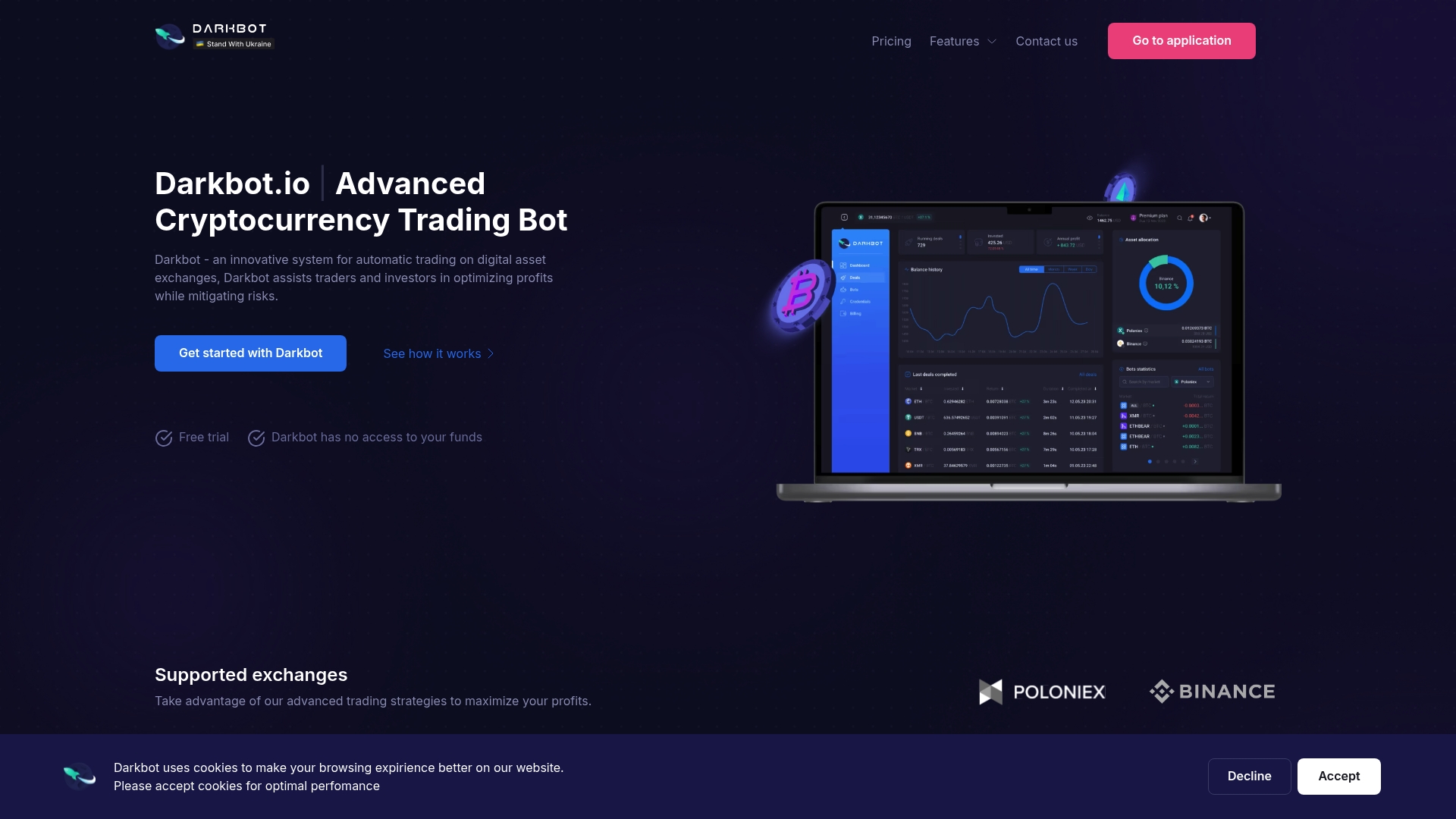
- Darkbot supports API integration and exchange routing.
- Backtesting and paper trading are available before you commit any live capital.
- Darkbot includes risk management tools to support oversight.
Review the full plan breakdown on our pricing page and start with the tier that matches your current testing stage.
This article is general information, not a substitute for advice from a qualified financial advisor. Consult a qualified financial professional about your own circumstances before acting on anything here.
FAQ
What is the best AI for swing trading?
There is no single tool that fits every trader, since the right choice depends on whether you need execution automation, signal generation, or research data. We built Darkbot as an AI-based automation platform suited to traders who want configurable strategies with exchange integration and risk controls for multi-day positions, while other named platforms lean more toward scoring or chart-pattern detection.
What is the most successful trading bot?
No platform publishes verified, audited performance figures that would support naming one bot as the most successful, and any claim of guaranteed or exceptional returns should be treated as a warning sign rather than a credential, consistent with regulatory guidance on AI investment fraud. Evaluate a bot by its testing methodology and risk controls rather than by a headline return number.
What are the top 5 trading bots?
Rankings vary depending on whether the focus is execution automation, signal generation, or research data, and the category includes named platforms like Tickeron, TradeAlgo, Danelfin, TrendSpider, Trade Ideas Holly AI, and Kavout alongside broker-integrated and DIY options. We recommend comparing them on the checklist covered above, including backtesting rigor and risk controls, rather than relying on a fixed ranking.
Do any AI trading bots work?
AI trading bots can work as execution and pattern-detection tools when paired with realistic backtesting and active risk controls, but none of them predict markets or guarantee profit. Their value comes from consistent, rule-driven execution and the discipline of removing manual emotional decisions, not from a promised return.
How do I choose between different swing trading bot providers?
Compare providers on backtesting methodology, exchange and API coverage, configurable risk limits, and support availability rather than on marketing claims. A demo or trial period, paired with the specific questions covered in the buying guide above, is the most reliable way to judge fit before committing capital.
Sources
Recommended

Start trading on Darkbot with ease
Come and explore our crypto trading platform by connecting your free account!
Free plan available • No credit card required