Machine Learning for Trading on Coursera: Boost Crypto
TL;DR:
- Coursera’s course teaches practical machine learning skills applicable to crypto trading after adaptation.
- Model effectiveness in crypto relies heavily on proper data, validation, and avoiding overfitting.
- Successful ML traders treat the course as a foundation, stressing continuous validation and risk management.
Most crypto traders rely on gut instinct, rigid rules, or recycled strategies they found on a forum. The result? Inconsistent returns that swing wildly with the market. Machine learning changes that equation by letting your models find patterns humans simply cannot see at scale. Coursera’s Machine Learning for Trading specialization promises to teach you exactly that, but the real question traders ask is whether it translates to crypto or stays locked in the world of stocks. This article breaks down what the course actually covers, what works, what falls short, and how to adapt it into a live crypto edge.
Key Takeaways
| Point | Details |
|---|---|
| Course adapts to crypto | You can apply Coursera’s machine learning trading frameworks to cryptocurrency markets with the right data and safeguards. |
| Hands-on coding required | Backtesting and modeling assignments demand familiarity with Python, making it practical for serious traders. |
| Beware of overfitting | Course projects may look strong in stocks but must be carefully adapted to avoid pitfalls in volatile crypto markets. |
| Automation boosts performance | Combining course knowledge with crypto trading bots like Darkbot can enhance consistency and returns. |
| Continuous learning vital | Ongoing data updates, validation, and strategy refinement are key to sustained ML trading success. |
What is Coursera’s Machine Learning for Trading?
Coursera’s Machine Learning for Trading is a multi-course specialization developed in collaboration with Google Cloud and New York Institute of Finance. It covers the intersection of quantitative finance and applied machine learning, walking you through building, testing, and deploying trading models using Python. The course is not a passive video series. You write real code, run real backtests, and submit projects that are graded against performance benchmarks.
The specialization is structured across three main courses:
- Fundamentals of machine learning in finance: Covers supervised and unsupervised learning, feature engineering, and model evaluation.
- Advanced machine learning in finance: Dives into time-series modeling, natural language processing for sentiment analysis, and risk metrics.
- Reinforcement learning for trading strategies: Explores agent-based models and decision optimization, though this section is heavier on theory.
The intended audience is someone who already knows basic Python and has some comfort with statistics. If you are a crypto investor who has built a simple script or worked with Pandas before, you are in the right zone. Complete beginners will struggle with the pace.
One of the things that sets this course apart from generic ML education is the emphasis on crypto trading automation and real-world relevance. Assignments are not toy problems. Models must outperform buy-and-hold benchmarks in graded projects, which forces you to think like an actual quant rather than a student.
The Google Cloud Platform (GCP) integration appears in some modules, particularly around data pipelines and scalable compute. For most traders, these sections feel more like product introductions than essential curriculum. You can absorb the concepts without committing to a cloud subscription, and most of the core backtesting work runs fine on a local machine.
Pro Tip: If you are a crypto trader with no stock market background, do not let the equity-focused examples discourage you. The underlying logic of feature engineering and model validation transfers directly to digital assets once you swap the data source.
Core skills and concepts taught in the course
The course teaches a practical stack of skills that, when applied correctly, can power smarter crypto strategies. Here is what you actually learn:
- Supervised learning for price prediction: Linear regression, random forests, and gradient boosting applied to financial features.
- Unsupervised learning for clustering: Grouping assets by behavior, useful for portfolio construction.
- Feature engineering: Creating meaningful inputs from raw price and volume data, including rolling statistics and momentum signals.
- Backtesting methodology: Building walk-forward tests that avoid lookahead bias.
- Sentiment analysis: Using NLP to extract signals from news and social data.
- Portfolio optimization: Sharpe ratio maximization, risk-adjusted return frameworks.
- Reinforcement learning (RL): Theoretical agent models for sequential decision-making.
The course requires Python, Pandas, and a stats background, and the RL sections remain more theoretical with limited hands-on coding. That is an honest limitation worth knowing upfront.
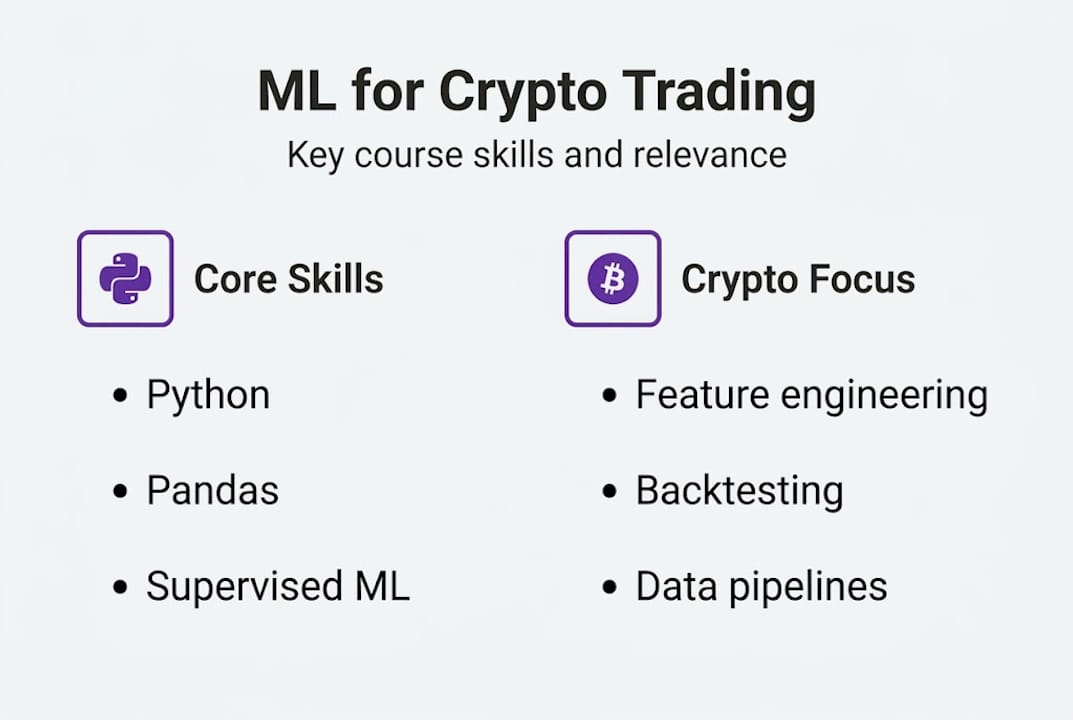
Here is how the core skill areas compare in terms of practical utility for crypto traders:
| Skill area | Crypto relevance | Hands-on depth |
|---|---|---|
| Supervised learning | High | Strong |
| Feature engineering | High | Strong |
| Sentiment analysis | Very high | Moderate |
| Backtesting | High | Strong |
| Portfolio optimization | High | Moderate |
| Reinforcement learning | Moderate | Weak |
| GCP cloud tools | Low | Moderate |
Time-series analysis is where crypto traders get the most immediate value. Crypto markets run 24/7 and generate dense price data. The course’s time-series modules teach autocorrelation, lag features, and rolling window statistics, all of which map cleanly onto BTC or ETH price feeds.
Sentiment analysis is arguably even more valuable for crypto than for stocks. Social media and news cycles move digital asset prices fast. Learning to build NLP pipelines that score sentiment from text data gives you a signal layer that most retail traders completely ignore. This directly feeds into AI in algorithmic trading frameworks that serious traders are already using.
Key insight: The practical coding sections of this course are genuinely rigorous. The RL module, while intellectually interesting, is not something most traders will deploy in live markets anytime soon.
How well do course models work in crypto trading?
This is the question that matters most. Completing a course is one thing. Generating alpha in volatile crypto markets is another entirely.
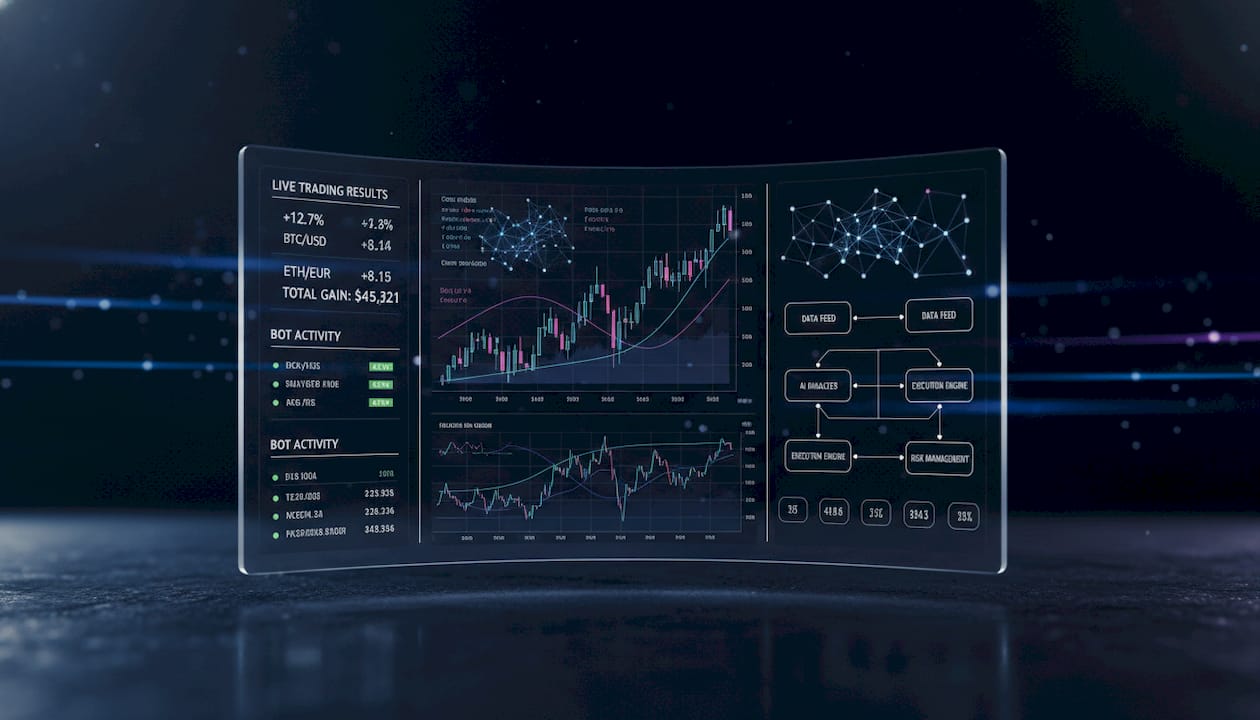
The course assignments are designed around stock market data, and models must outperform buy-and-hold benchmarks in graded projects, with real learner examples showing outperformance on stocks but a high risk of overfitting. That last part is critical. Overfitting means your model learned the noise in historical data instead of the signal. It looks brilliant in a backtest and falls apart the moment live market conditions shift.
Crypto amplifies this problem. The asset class is younger, more volatile, and driven by sentiment cycles that stocks simply do not experience in the same way. A model trained on 2021 bull market data will likely fail in a 2022 bear market, and vice versa.
Some course reviewers also note that models underperform buy-and-hold in certain GenAI track versions of the course, which is a useful reality check. ML is not magic. It is a tool that requires careful calibration.
Here is a realistic performance comparison based on course-style model types:
| Model type | Backtest performance | Live crypto risk |
|---|---|---|
| Random forest (tuned) | Often beats benchmark | High overfitting risk |
| Linear regression | Modest, stable | Lower overfitting risk |
| Sentiment-enhanced model | Strong in trending markets | Data quality dependent |
| RL agent | Theoretically strong | Rarely production-ready |
The machine learning impact in crypto is real, but it requires you to go beyond the course’s stock-centric examples. The path to optimizing crypto trading returns means cross-validating on crypto-specific data, not just reusing stock assignment code.
Pro Tip: Always test your model on a completely held-out time period that you never touched during training or tuning. If performance collapses on that period, your model has overfit and is not ready for live trading.
Practical application: Adapting course insights for crypto trading
The course gives you tools. Crypto trading requires you to rewire how you use them. Here is a step-by-step path for making the transition:
- Replace stock data with crypto feeds. Use APIs from Binance, Coinbase Advanced, or CoinGecko to pull OHLCV (open, high, low, close, volume) data. The Pandas workflows from the course transfer directly.
- Add crypto-specific features. On-chain metrics like active addresses, exchange inflows, and funding rates are signals that have no stock equivalent. Layer these into your feature engineering pipeline.
- Source sentiment data for crypto. Tools like LunarCrush, Santiment, or even Reddit API feeds give you social sentiment signals. The NLP pipeline from the course applies here with minimal modification.
- Run walk-forward backtests on crypto periods. Test your model across at least three distinct market regimes: a bull run, a bear phase, and a sideways consolidation. A model that only works in one regime is not a trading edge.
- Cross-validate aggressively. Leverage sentiment analysis and time-series ML from the course for crypto, but supplement with crypto-specific data sources since the course provides no dedicated crypto benchmarks.
- Automate, measure, iterate. Once a model passes your validation criteria, connect it to a live trading interface. Track real performance weekly. Retrain on fresh data monthly.
The course frameworks for ML for crypto trading optimization are solid starting points, not finished products. Think of them as blueprints you adapt, not scripts you run. The ML in crypto investing guide perspective reinforces this: adaptation and iteration separate the traders who profit from those who just have interesting backtests.
Pro Tip: Start with a single asset like BTC/USDT before scaling your model to a portfolio. Complexity compounds errors. Prove the logic works on one pair first.
The hard truth: What separates the winning ML traders
Finishing Coursera’s Machine Learning for Trading course will not make you profitable. That is not cynicism. It is the most useful thing we can tell you.
The traders who actually generate sustained returns from ML strategies share one habit: they treat the course as a foundation, not a finish line. Overfitting is the most common failure mode, and it is almost invisible until you are losing real money. The models that look best in backtests are often the most dangerous in live markets.
Real edge comes from adaptation. You take the supervised learning framework, strip out the stock assumptions, inject crypto-specific features, and validate ruthlessly. The boring work, meaning data quality checks, rigorous out-of-sample testing, and ongoing model review, matters far more than any clever algorithm.
We have seen traders chase the “AI magic” angle and blow up accounts that looked great on paper. The ones who see automated trading results that hold up over time are the ones who obsess over risk controls and treat every live trade as a new data point. The course teaches you how to think. What you do with that thinking is entirely on you.
Take your automated crypto trading to the next level
You have learned the frameworks. Now the question is execution. Building and maintaining ML trading models from scratch takes serious time, and even well-designed models need constant monitoring to stay relevant in shifting crypto markets.
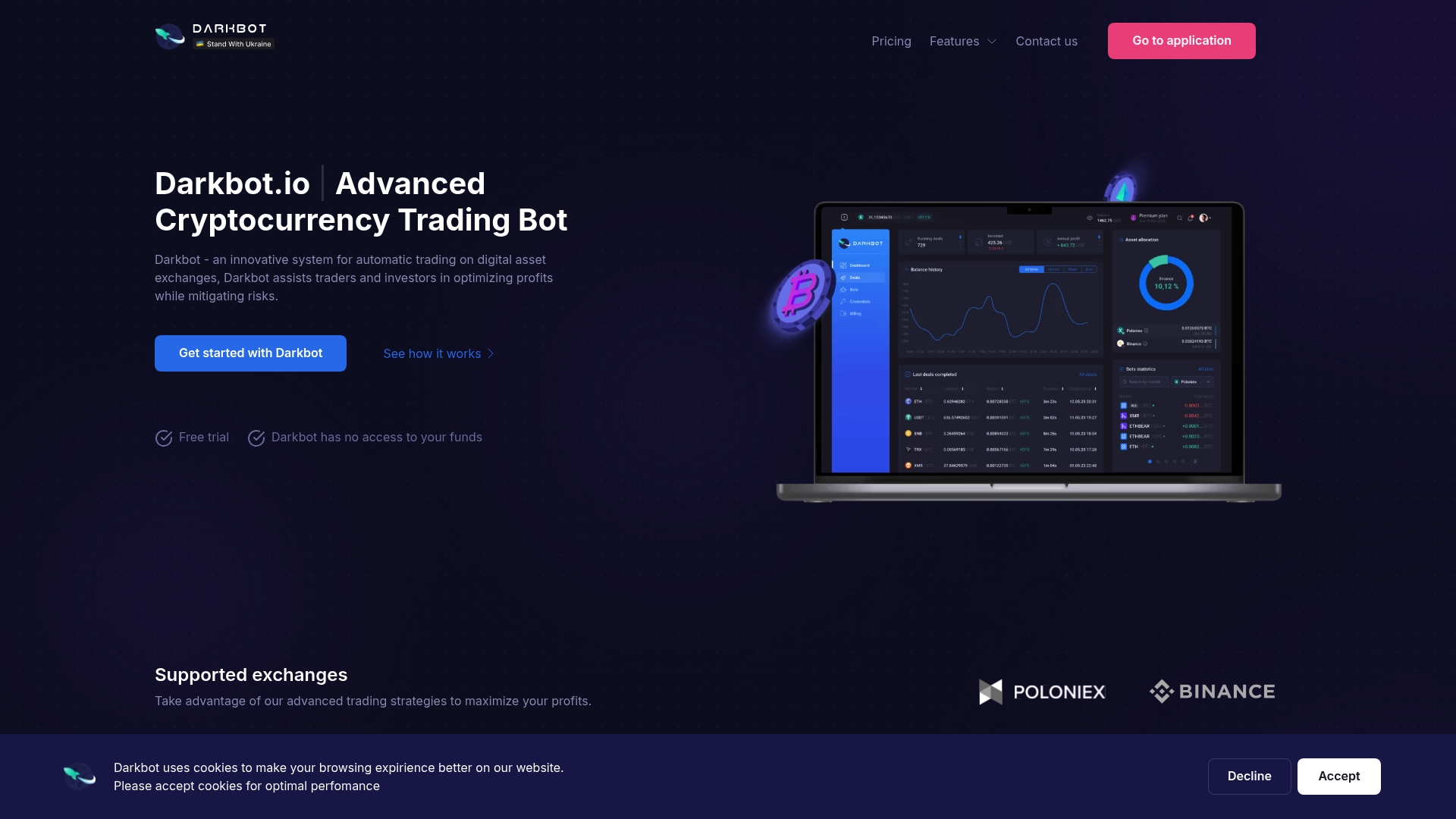
That is exactly where Darkbot trading automation closes the gap. Darkbot is built for traders who want AI-driven strategies running around the clock without the overhead of managing infrastructure. From seamless exchange integration to real-time analytics and crypto portfolio optimization, the platform puts sophisticated automation within reach for both experienced quants and traders still building their ML skills. If you are serious about moving from theory to consistent, automated crypto trading, Darkbot gives you the engine to do it.
Frequently asked questions
Is Coursera’s Machine Learning for Trading course suitable for crypto traders with no Python experience?
The course requires Python, Pandas, and a stats background, so those brand new to coding will find the pace challenging and should build basic Python skills first.
Do the strategies taught outperform simple buy-and-hold for cryptocurrencies?
While models must outperform buy-and-hold benchmarks in stock-based assignments, crypto performance depends heavily on proper adaptation and disciplined overfitting prevention.
Can I use the course frameworks with live crypto market data?
Yes, but you should supplement with crypto-specific data sources and validate your models across multiple distinct market timeframes before going live.
How hands-on is the course compared to other ML trading courses?
The course includes hands-on Python and backtesting assignments throughout, though the reinforcement learning modules stay more theoretical and involve less direct coding practice.
Do I need access to paid cloud platforms like GCP to finish the course?
Some modules introduce GCP tools, but the practical backtesting can be done locally without a paid cloud subscription for the majority of assignments.
Recommended

Start trading on Darkbot with ease
Come and explore our crypto trading platform by connecting your free account!
Free plan available • No credit card required