How Machine Learning Transforms Stock Market Trading

TL;DR:
- Machine learning enables faster, more accurate trading decisions by recognizing complex market patterns.
- Risks include overfitting, black-box models, and market regime shifts requiring diligent management.
- Successful implementation requires ongoing validation, regular retraining, and combining AI insights with human judgment.
Stock market volatility has long convinced traders that consistent gains are more luck than skill. That belief is losing ground fast. Machine learning algorithms are now helping traders identify price patterns, execute trades at optimal moments, and manage risk with a precision that manual analysis simply cannot match. Whether you trade crypto, equities, or both, understanding how these tools work gives you a real edge. This article breaks down what machine learning means for stock market trading, how it sharpens strategy, where it falls short, and how you can start applying it to your own trading workflow right now.
Key Takeaways
| Point | Details |
|---|---|
| Machine learning boosts trading | Machine learning enables traders to uncover patterns and automate strategies with greater consistency. |
| Risk and data quality matter | The effectiveness of machine learning in trading depends on high-quality data and solid risk controls. |
| Actionable integration steps | Applying ML to your trading requires planning, testing, and ongoing monitoring for real results. |
| Human insight is still critical | Combining automation with human judgment yields the best trading outcomes in volatile markets. |
What is machine learning in stock trading?
Machine learning is a branch of artificial intelligence where algorithms learn from data rather than following rigid, pre-written rules. Instead of telling a program exactly what to do in every scenario, you feed it historical data and let it find patterns on its own. In stock trading, this means feeding algorithms years of price data, volume figures, earnings reports, and even news sentiment to generate predictions about future price movements.
There are two core approaches you will encounter:
- Supervised learning: The algorithm trains on labeled data, meaning past price movements with known outcomes, and learns to predict future results based on similar conditions.
- Unsupervised learning: The algorithm finds hidden structure in unlabeled data, useful for clustering stocks by behavior or detecting anomalies in trading activity.
- Reinforcement learning: The algorithm learns by trial and error, receiving rewards for profitable decisions and penalties for losses, making it well suited for dynamic trading environments.
Machine learning uses algorithms to recognize patterns and make data-driven predictions, which is exactly why it fits financial markets so well. Markets generate enormous volumes of structured data every second, and that data contains repeating patterns that human traders simply cannot process fast enough.
“Pattern recognition at scale is what separates machine learning from every other analytical method in finance. The sheer volume of signals that algorithms can process simultaneously is beyond human capability.”
Pro Tip: Never treat machine learning as a plug-and-play solution. A model is only as good as the data it trains on. Garbage data produces garbage predictions, no matter how sophisticated the algorithm.
Understanding machine learning in finance is the foundation for using it effectively. Once you grasp the basics, the application becomes much more intuitive.
How machine learning optimizes trading strategies
Knowing what machine learning is matters far less than knowing how it actually improves your trading. The process from raw data to live strategy follows a clear sequence.
- Data collection: Gather historical price data, order book depth, macroeconomic indicators, and sentiment data from news or social media.
- Model training: Feed this data into your chosen algorithm. The model identifies correlations between inputs and price outcomes.
- Backtesting: Run the trained model against historical data it has never seen before. This tests whether patterns it learned actually generalize to new conditions.
- Paper trading: Deploy the model in a simulated environment with real-time data but no real capital at risk.
- Live deployment: Once performance meets your benchmarks, deploy with real capital under strict position sizing rules.
ML models adapt trading strategies in real time as new market data becomes available, which gives them a significant edge over static rule-based systems.
| Feature | Traditional strategies | Machine learning strategies |
|---|---|---|
| Update frequency | Manual, periodic | Continuous, automatic |
| Adaptability | Low | High |
| Data requirements | Minimal | Large and diverse |
| Pattern complexity | Simple rules | Non-linear, multi-variable |
One underappreciated advantage is ML’s ability to spot AI trading strategies examples that involve non-obvious correlations, such as the relationship between social media sentiment spikes and short-term price reversals, which no human analyst would reliably catch across thousands of assets simultaneously.
Pro Tip: Backtest regularly, not just once at model launch. Markets evolve, and a model that performed well six months ago may be working with stale assumptions today. Schedule monthly validation checks as a minimum.
Exploring AI trading strategy optimization in depth will show you exactly how top-performing bots stay relevant in changing market conditions.
Benefits and risks of applying machine learning to the stock market
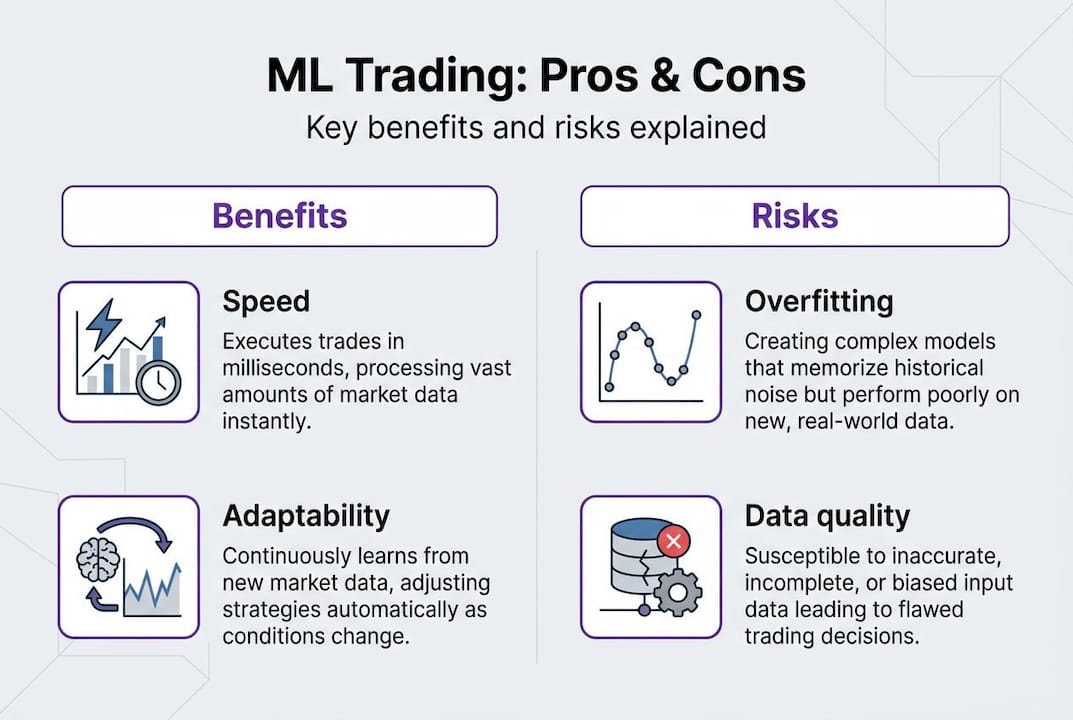
Machine learning brings genuine advantages to trading, but it also introduces risks that many traders underestimate until they experience them firsthand.
Key benefits:
- Speed: Algorithms execute trades in milliseconds, capturing opportunities that disappear before a human can click.
- Emotion-free execution: No fear, no greed, no hesitation. The model executes exactly what the data supports.
- Improved prediction accuracy: By processing thousands of variables simultaneously, ML models surface patterns invisible to manual analysis.
- Scalability: One algorithm can monitor hundreds of assets at once, something no human trading desk can replicate cost-effectively.
Key risks:
- Overfitting: A model trained too closely on historical data performs brilliantly in backtests but fails in live markets because it memorized noise rather than real patterns.
- Black-box opacity: Many advanced models, particularly deep neural networks, cannot explain why they made a specific trade. This makes debugging and trust-building difficult.
- Market regime shifts: Machine learning systems can outperform traditional strategies but are sensitive to poor data quality and sudden regime changes like the 2020 COVID crash or the 2022 crypto winter.
Many institutional traders now allocate over 30% of their trades to AI-driven models, reflecting strong confidence in the technology. But those same institutions employ dedicated teams to monitor model behavior around the clock.
Strong algorithmic trading and risk management practices are not optional when you deploy ML strategies. They are the difference between a profitable system and a catastrophic drawdown.

The role of AI in cryptocurrency trading success is growing precisely because traders who combine automation with disciplined risk controls consistently outperform those relying on either alone.
Practical frameworks: Integrating machine learning into your trading
Knowing the theory is one thing. Building a working system is another. Here is a practical framework you can follow to start integrating machine learning into your trading routine.
| ML algorithm | Common use in trading |
|---|---|
| Linear regression | Price trend forecasting |
| Random forest | Feature selection and classification |
| LSTM neural networks | Time-series price prediction |
| Support vector machines | Identifying market regime changes |
| Gradient boosting | High-accuracy classification tasks |
Stepwise implementation and oversight are essential for effective machine learning trading systems, especially when you are moving from backtesting to live capital.
Follow these best practices when deploying and monitoring your models:
- Start small: Allocate a small percentage of your portfolio to the ML strategy initially. Scale only after consistent performance over at least 60 trading days.
- Set hard stop rules: Define maximum drawdown thresholds. If the model breaches them, pause it automatically and investigate.
- Monitor data feeds: A broken data feed is one of the most common causes of model failure. Build alerts for data gaps or anomalies.
- Retrain on schedule: Markets drift. Retrain your model on fresh data at regular intervals, typically monthly or quarterly.
- Document every change: Keep a log of every parameter adjustment. This makes it far easier to diagnose performance drops.
The AI trading strategy tutorial at Darkbot.io walks through this process in detail, covering everything from algorithm selection to live deployment best practices. Always experiment in a test environment before committing real capital.
A hard truth about machine learning in trading
Most guides on machine learning in trading stop at the exciting part: the potential gains, the speed, the precision. What they skip is the uncomfortable reality that even the best models fail, and they fail in ways that are hard to predict.
A sudden geopolitical shock, a regulatory announcement, or a coordinated short squeeze can render months of training data irrelevant overnight. No algorithm predicted the March 2020 crash with enough lead time to fully protect a portfolio. No model anticipated the FTX collapse in November 2022 before it happened.
The traders who survive these events are not the ones with the most sophisticated models. They are the ones who treat their ML systems as one input among several, not as an oracle. Combining AI in trading success with human judgment and strict position limits is what actually produces long-term results.
We have also seen traders dramatically underestimate the ongoing maintenance burden. A deployed model is not a passive income machine. It requires regular recalibration, data quality checks, and performance reviews. Understanding AI trading performance means accepting that automation reduces manual effort, but it does not eliminate it. The traders who treat ML as a set-and-forget tool are the ones who eventually face unexpected losses.
Ready to enhance your trading strategy with AI?
If you have made it this far, you already understand more about machine learning in trading than most retail traders ever will. The next step is putting that knowledge to work with tools built specifically for automated, AI-driven trading.
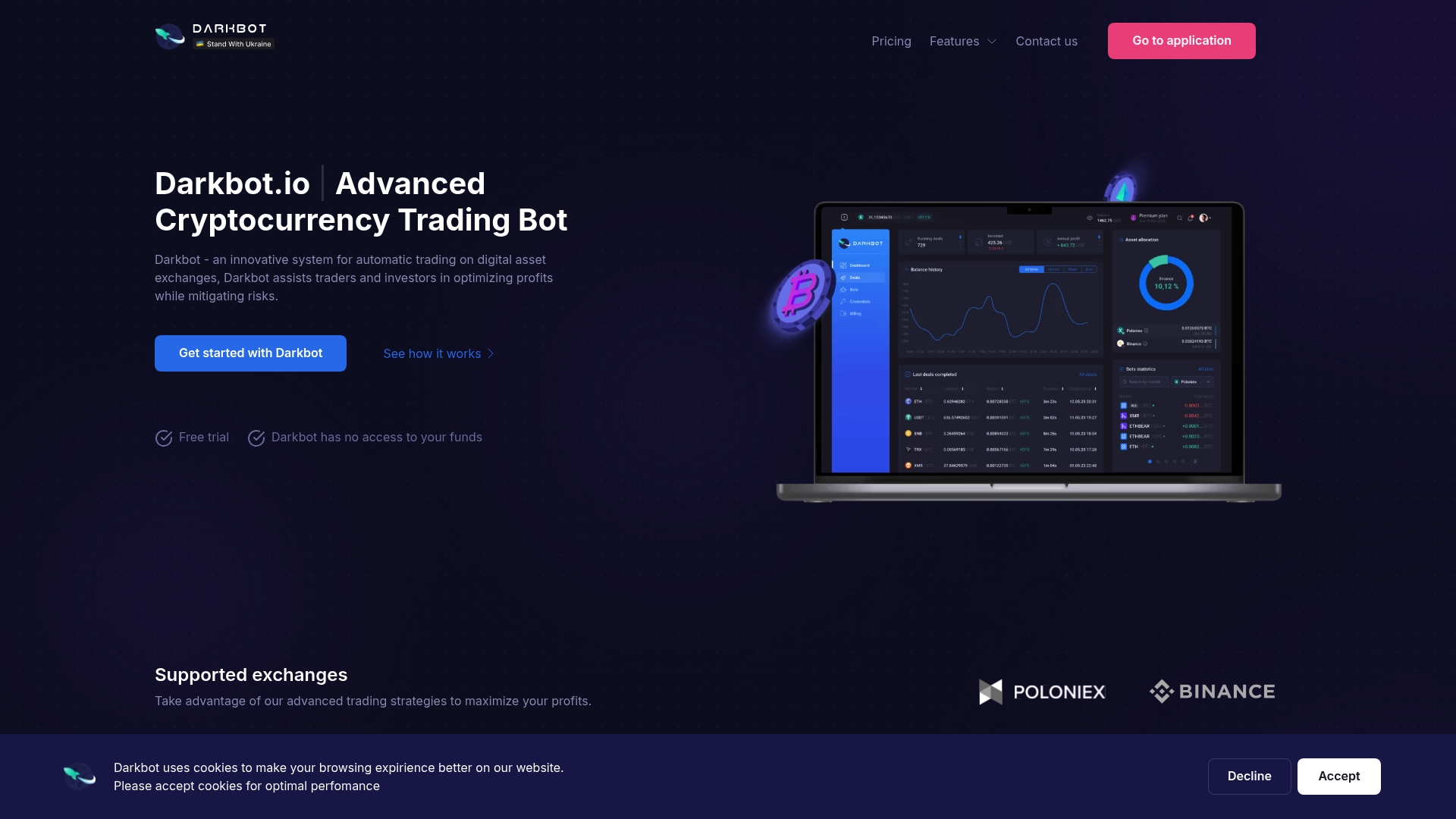
Darkbot.io gives you access to AI-powered trading tools that integrate machine learning directly into your strategy workflow, from backtesting to live execution across multiple exchanges. You can customize bot behavior, fine-tune risk parameters, and monitor performance in real time. For traders focused on protecting capital while growing it, the portfolio management solutions at Darkbot.io offer automated rebalancing and risk controls built for volatile markets. Start with a free plan and scale as your confidence grows.
Frequently asked questions
What types of machine learning models work best for stock market prediction?
Supervised models are widely used in finance for prediction tasks, with decision trees and LSTM neural networks being the most common choices for forecasting price trends and market direction.
How accurate are machine learning trading strategies compared to traditional methods?
ML strategies can meaningfully improve prediction accuracy, but ML systems require regular tuning and high-quality data to maintain that edge over time.
Is machine learning trading suitable for beginners?
Beginners can start with pre-built ML trading tools, but stepwise implementation is essential even for new users who should begin with small positions and simple strategies before scaling.
How do I reduce the risk of overfitting in my ML trading model?
Ongoing validation reduces overfitting risks by testing your model against fresh, out-of-sample data sets on a regular schedule rather than relying solely on initial backtest results.
Recommended

Start trading on Darkbot with ease
Come and explore our crypto trading platform by connecting your free account!
Free plan available • No credit card required