Crypto Risk Management: Automated Strategies That Work

TL;DR:
- Crypto markets require specialized risk controls like adjusted position sizing and volatility-aware stop-losses.
- Automated trading needs thorough backtesting, real-time monitoring, and integration of machine learning to adapt risk strategies.
- Network issues, DeFi protocol failures, and tail risks are critical, often underestimated dangers in crypto trading.
Automated crypto trading promises efficiency and round-the-clock execution, but most traders enter assuming a solid stop-loss is enough. It is not. Crypto markets move with a ferocity that traditional financial models were never designed to handle, and automation amplifies every gap in your risk framework. A strategy that worked last quarter can blow up tomorrow when market regimes shift and your bot keeps firing orders into a freefall. This guide breaks down the core risk controls, automation-specific tactics, DeFi edge cases, and regulatory requirements you need to protect capital and trade smarter in 2026.
Key Takeaways
| Point | Details |
|---|---|
| Risk control basics | Limit trade risk to 0.5–2% and use both stop-loss and take-profit orders. |
| Automated systems outperform | Reinforcement learning and backtesting consistently beat traditional strategies in crypto trading. |
| DeFi risks are unique | Tokenization and network failures introduce risks not seen in legacy finance. |
| Continuous monitoring | Real-time oversight and advanced tools are essential for adapting to changing crypto markets. |
| Stay ahead of regulation | Align your automated strategies with emerging rules like MiCA and AMLR to avoid compliance issues. |
Core principles of risk management in crypto trading
Traditional risk management was designed for markets that mostly follow normal distributions: slow-moving equities, regulated futures, predictable bond yields. Crypto does not play by those rules. Prices can drop 40% in hours, liquidity can vanish overnight, and correlations between assets can collapse or spike without warning. This is why applying a standard portfolio textbook to crypto is like using a rain jacket in a hurricane.
The foundational tools still matter, but you need to calibrate them for extreme volatility. Core risk mechanics in crypto include position sizing at 0.5 to 2% of capital per trade, stop-loss orders, take-profit levels, diversification across uncorrelated assets, and a risk/reward ratio above 1:2. These are your floor, not your ceiling.
Here is a snapshot of each control and what it actually does for you:
| Risk control | Purpose | Crypto-specific note |
|---|---|---|
| Position sizing (0.5–2%) | Limits loss per trade | Tighter in high-volatility pairs |
| Stop-loss orders | Caps downside automatically | Set beyond noise, not tight |
| Take-profit levels | Locks in gains | Trailing versions adapt better |
| Diversification | Spreads exposure | Avoid correlated altcoin clusters |
| Risk/reward ratio >1:2 | Ensures wins outpace losses | Required for any positive-EV strategy |
The most common mistake? Traders copy the 2% rule from stock trading and apply it directly to crypto without adjustment. If you are trading a token with 80% annualized volatility, 2% is actually conservative enough on calm days but dangerously loose on breakout days. Review your 1-2% rule checklist and recalibrate per pair, not per portfolio.
Key risk tools every crypto trader should use:
- Position sizing calculator tied to your current capital balance
- Dynamic stop-losses that adjust with volatility (ATR-based)
- Diversification across sectors: L1s, DeFi, stablecoins, and infrastructure plays
- Risk/reward screening before every trade entry
Pro Tip: When volatility spikes above your 30-day average, cut your position size in half automatically. This one habit protects more capital than most advanced strategies. For a deeper framework on defining safer crypto trading, revisit your baseline before adding automation.
“The cost of skipping foundational risk controls in crypto is not just a single bad trade. It is the compounding erosion of capital across dozens of them.”
Automated risk control mechanisms for crypto bots
Automation changes the risk game in two big ways: it removes emotional decision-making, and it executes at a speed and frequency no human can match. Both of those qualities are double-edged. Your bot will follow flawed logic faster than you can stop it.

Setting up solid automated risk controls requires three stages. First, hyperparameter optimization to tune your strategy parameters (entry thresholds, position sizes, stop levels). Second, rigorous backtesting using historical data. Third, live implementation with real-time monitoring in place. Skip any stage, and you are flying blind.
Automated trading methodologies in 2025 and beyond include volatility-based trailing stops, hyperparameter optimization via tools like Freqtrade, reinforcement learning models such as SAC (Soft Actor-Critic) and TD3 (Twin Delayed DDPG), and dynamic position sizing that adapts to current market conditions.
Here is how traditional rule-based bot risk management compares to modern ML/RL approaches:
| Metric | Traditional bot | RL/ML-optimized bot |
|---|---|---|
| Drawdown management | Fixed stop-loss | Adaptive, volatility-aware |
| Sharpe ratio | 0.8 to 1.2 (typical) | 2.0 to 2.8+ (SAC models) |
| Return consistency | Regime-dependent | More stable across market cycles |
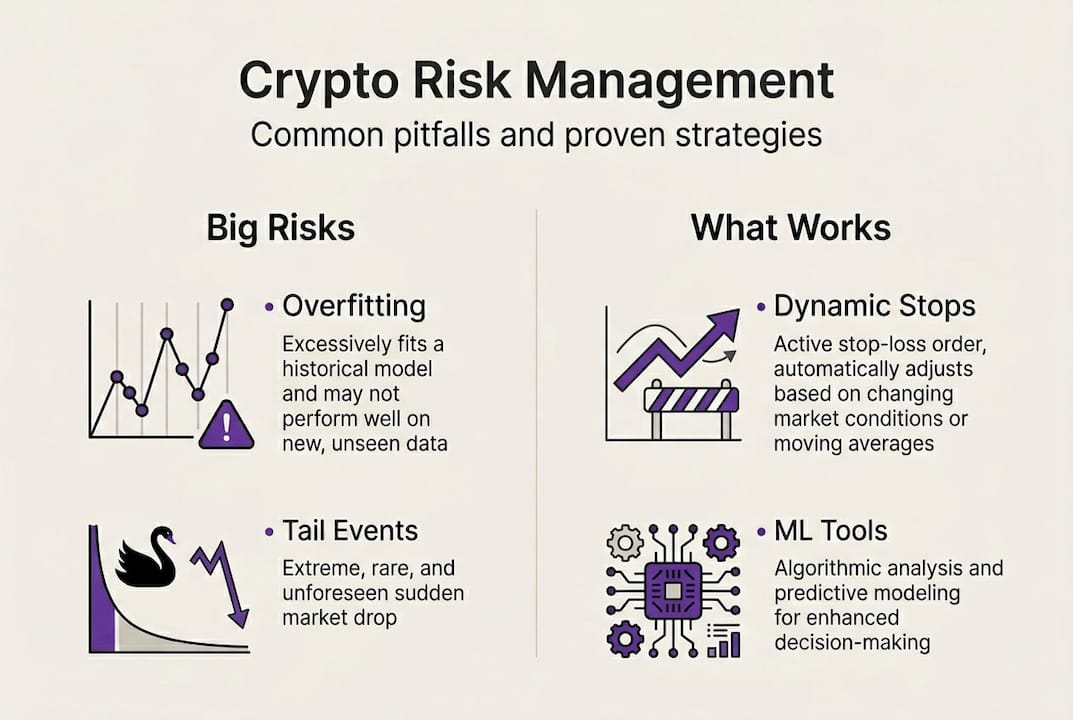
| Overfitting risk | Moderate | High without proper controls |
Steps for integrating machine learning into your bot’s risk controls:
- Define your risk objective clearly (minimize drawdown, maximize Sharpe, or balance both)
- Select a training dataset that covers at least one full market cycle, including a bear market
- Use walk-forward validation, not just in-sample backtesting
- Implement the model in paper trading before going live
- Set hard circuit breakers that override ML outputs during anomalous market events
The IEEE evidence on risk-optimized bots confirms that reinforcement learning approaches significantly outperform naive strategies in risk-adjusted returns. But this only holds when the model is properly constrained. For a practical overview of algorithmic crypto trading, start with your risk architecture before adding intelligence on top.
Pro Tip: Overfitting is the silent killer of backtested bots. If your bot shows a Sharpe ratio above 3.5 in backtesting but underperforms live, you have overfit to historical noise. Use out-of-sample data and reduce parameter count. Read more on smart automation risk controls and bot risk management to build a more resilient system.
Nuanced risks: networks, tokens, DeFi, and tail events
Automating risk controls does not remove all dangers. Crypto carries a category of risks that no amount of clever stop-loss placement will solve, and these are the ones most retail traders are completely unprepared for.
Blockchain network risks are real and underestimated. Solana, for example, has experienced multiple outages that froze trading entirely. If your bot relies on a single chain or a small set of protocols, a network-level failure can leave you with no exit. BTC and ETH network congestion during volatile periods can also spike transaction costs and cause delayed order execution, turning a minor loss into a major one.
Edge-case risks in DeFi and tokenization include composability failures, haircuts for net capital in tokenized asset frameworks, and systemic interconnectedness that amplifies losses across seemingly unrelated protocols.
Specific vulnerabilities to monitor:
- Composability risk: DeFi protocols stack on top of each other. One exploit in a base layer protocol can cascade across multiple dependent dApps
- Tokenization haircuts: Regulated tokenized assets may face forced capital reductions in stress scenarios
- Oracle manipulation: Price feeds can be attacked, causing your bot to execute trades at artificial prices
- Liquidity evaporation: During panic events, even mid-cap tokens can become essentially untradeable
Standard normal distribution models badly underestimate how often extreme price moves happen in crypto. The Lévy-GJR-GARCH model and similar fat-tailed approaches better capture the tail risk reality of crypto markets. The generalized CoVaR metric shows significantly higher systemic risk during tail scenarios than basic VaR implies.
“In crypto, the extreme event is not the exception. It is priced into the market’s DNA.”
For a complete picture of what automated systems commonly miss, the biggest automated trading risks include these exact blind spots. Tools like Metrika for token risk monitoring provide on-chain analytics that can flag network-level stress before it affects your positions.
Modern tools, expert insights, and regulatory checklists
Knowing the risks is step one. Having the tools and regulatory awareness to act on that knowledge is what separates professionals from gamblers.
For monitoring, platforms like Metrika provide real-time on-chain data, validator health tracking, and liquidity analytics that generic exchange dashboards simply do not offer. For risk modeling, non-normal risk models using AVaR (Average Value-at-Risk) and fat-tailed distributions are now considered best practice for any serious crypto operation.
Regulatory checklist under MiCA and AMLR (critical for 2026 compliance):
- Document your bot’s decision logic and risk parameters for audit readiness
- Implement AML screening on all counterparties and wallet addresses
- Maintain transaction records with timestamps and reasoning trails
- Ensure real-time monitoring of ML model behavior and flag anomalies
- Conduct quarterly risk assessments as market conditions evolve
Regulatory focus on ML/TF risks under MiCA and AMLR is intensifying, with regulators emphasizing that dynamic risk assessment is essential as innovation outpaces existing controls.
What most retail traders miss entirely:
- Real-time wallet tracking across multiple chains simultaneously
- Dynamic risk assessment that updates as volatility regimes shift
- Pattern recognition for wash trading and market manipulation signals
- Cross-exchange exposure monitoring to avoid unintended concentration
Pro Tip: Reinforcement learning is not just for returns. Train your RL model to recognize regulatory red-flag patterns (unusual transaction clustering, sudden volume spikes from flagged wallets) and you build a compliance layer into your automation. Pair this with smarter crypto automation and machine learning for trading to stay ahead of both market risk and compliance risk.
Why most crypto risk management strategies fail—and what actually works
Here is an uncomfortable truth: most traders following textbook risk frameworks are still losing. Not because the frameworks are wrong in principle, but because they were built for markets that crypto does not resemble.
The 1/N diversification rule (equal weight across N assets) looks elegant in theory. In crypto, it often just concentrates risk in correlated altcoins that all crash together during a broad market selloff. Simple stop-losses get hunted by market makers in thin-liquidity environments. Backtested strategies trained on 2020 to 2021 bull data fail catastrophically when applied to 2022 or 2024 bear conditions.
Traditional strategies fail in fat-tailed crypto markets, with win rates dropping from 62% to 39% under real conditions, while RL-optimized approaches deliver a 37.2% return boost by adapting to regime changes in real time.
What actually works is a hybrid approach: start with disciplined position sizing and stops as your floor, layer on ML-driven signal filtering to reduce false entries, and use live monitoring to catch regime shifts before they blow up your account. Regime shifts are the real killer. A strategy tuned on trending markets fails hard when markets go sideways or reverse.
We also warn against survivorship bias in strategy selection. The published backtests that look great almost always reflect the strategies that happened to survive, not the average outcome. When you explore ML in trading lessons, prioritize frameworks that explicitly account for sample bias and out-of-sample validation.
Ready to level up your crypto trading risk management?
The gap between knowing these strategies and actually implementing them is where most traders get stuck. Reading frameworks is one thing. Running them on live capital across multiple exchanges with real-time risk controls is another.
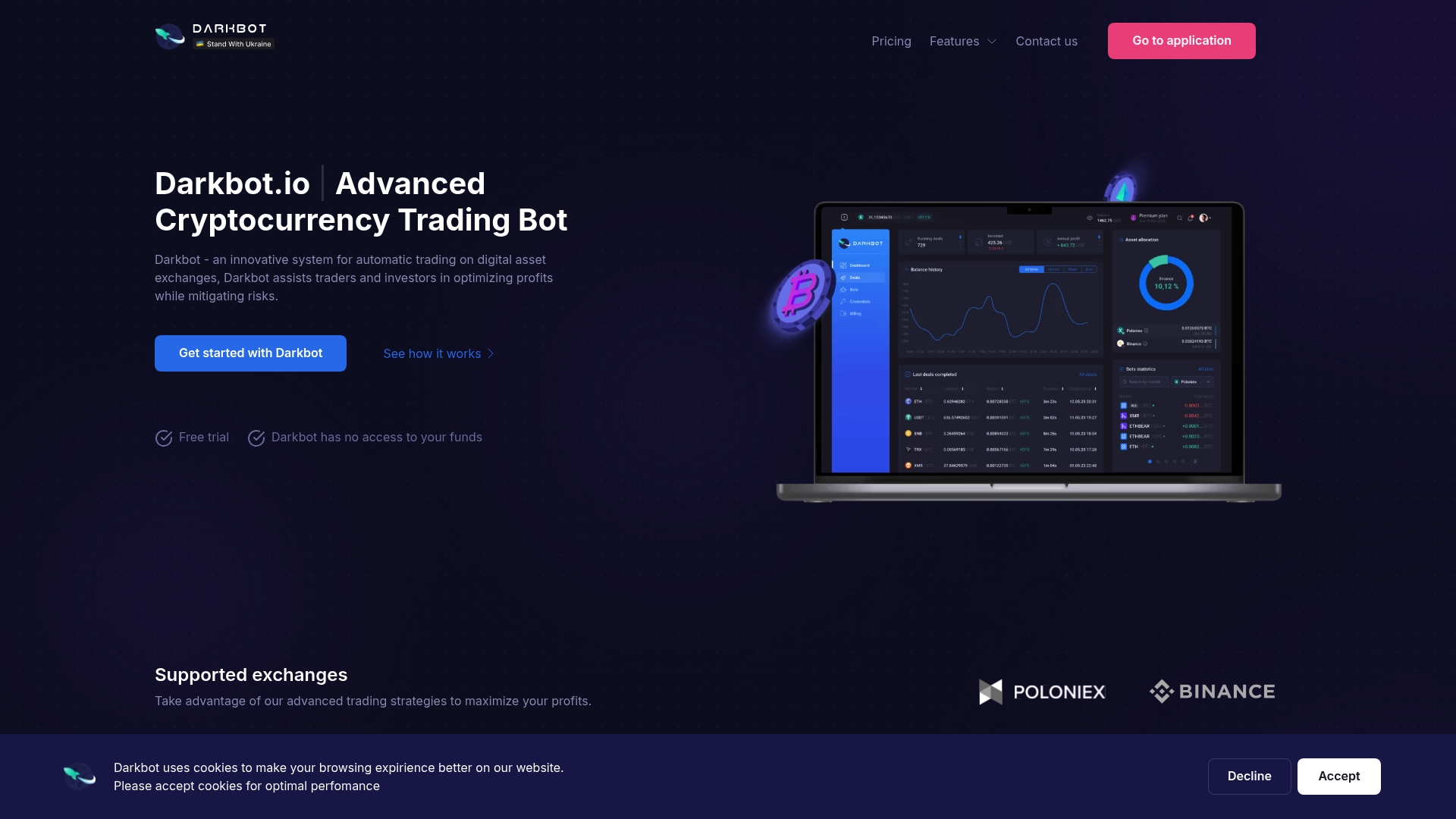
Darkbot.io is built precisely for this challenge. Whether you want to run automated bots with dynamic position sizing, integrate ML-driven risk filters, or manage a diversified crypto portfolio with automated rebalancing, the platform gives you the infrastructure to do it right. Explore the AI-powered trading bot and see how it handles risk controls natively across exchanges. For portfolio-level protection, the advanced portfolio optimization tools apply the same evidence-based frameworks covered in this guide, without requiring you to build everything from scratch.
Frequently asked questions
What is the safest amount to risk per trade in crypto?
Most experts recommend risking 0.5 to 2% of your total trading capital per crypto trade, with lower percentages for highly volatile pairs.
How does machine learning improve risk management in automated crypto trading?
ML models like SAC allow bots to adapt dynamically to changing market conditions, with SAC achieving 152% excess returns and a Sharpe ratio of 2.81 by continuously optimizing its own risk controls.
What extra risks should I watch for in DeFi and tokenized assets?
Beyond price risk, watch for network outages, composability failures in stacked DeFi protocols, and underestimated tail events that normal distribution models will not flag in advance.
How can I ensure my crypto bot meets regulatory standards?
Follow MiCA and AMLR guidelines by documenting bot logic, implementing AML screening, maintaining transaction records, and running regular dynamic risk assessments as markets evolve.
Recommended

Start trading on Darkbot with ease
Come and explore our crypto trading platform by connecting your free account!
Free plan available • No credit card required