Machine Learning for Financial Risk Management with Python

TL;DR:
- Machine learning techniques in Python are used to model, forecast, and control financial risk at scale with advanced architectures. Hybrid models like LSTM-Attention and Regime-Weighted Conformal prediction enhance volatility and tail risk management, while libraries like wraquant and SHAP support end-to-end workflows and regulatory compliance. Combining traditional finance methods with machine learning improves robustness, but careful validation and explainability are essential for effective, compliant risk systems.
Machine learning for financial risk management with Python is defined as the application of statistical learning algorithms, specialized Python libraries, and structured data pipelines to model, forecast, and control financial risk at scale. The field has moved well beyond simple regression. Practitioners now deploy hybrid LSTM-Attention architectures, Regime-Weighted Conformal prediction, and ensemble frameworks that blend classical quantitative signals with ML-generated features. Tools like the wraquant library, SHAP-based explainability, and CVXPY-based optimization have made production-grade risk modeling accessible in Python. This article covers the models, libraries, compliance requirements, and implementation practices you need to build reliable risk management systems in 2026.
What are the most effective ML models for financial risk forecasting?
The strongest architectures for financial risk forecasting Python workflows combine sequential learning with attention mechanisms. Hybrid LSTM-Attention models improve volatility prediction accuracy by 17.3% over standard LSTM-only models and achieve a Value-at-Risk violation rate near 1.05%. That violation rate matters because Basel III requires banks to keep VaR breaches below 1% of trading days, making this architecture directly regulatory-relevant.

Beyond LSTM variants, Regime-Weighted Conformal (RWC) prediction has become a leading method for tail risk control. RWC prediction offers robust sequential VaR control in nonstationary markets, outperforming standard VaR models during structural breaks. The key advantage is that it provides finite-sample coverage guarantees without assuming normally distributed returns, which standard VaR models cannot claim.
Ensemble strategies round out the toolkit. Combining classical financial signals with ML features reduces overfitting and improves institutional adoption. The logic is straightforward: ML models trained on noisy financial data overfit easily, and blending them with time-tested factor signals stabilizes out-of-sample performance.
| Model Type | Core Strength | Best Use Case |
|---|---|---|
| Hybrid LSTM-Attention | Captures long-range temporal dependencies with focused weighting | Multi-horizon volatility and VaR forecasting |
| Regime-Weighted Conformal | Distribution-free tail risk bounds across market regimes | Nonstationary markets and structural break periods |
| XGBoost Ensemble | Fast training, handles tabular features well | Credit risk scoring and factor-based return forecasting |
| CVXPY + ML Alpha | Integrates ML signals into convex portfolio optimization | Multi-asset portfolio construction with risk constraints |
Pro Tip: Start with a simpler XGBoost baseline before deploying LSTM-Attention. If the simpler model performs comparably on your dataset, the added complexity of a deep architecture is not justified by the marginal accuracy gain.
Which python libraries support full ML risk management pipelines?
A complete Python machine learning finance pipeline requires tools that cover data ingestion, feature engineering, model training, validation, and deployment. No single library handles all of these, but a well-chosen stack covers the full workflow without gaps.
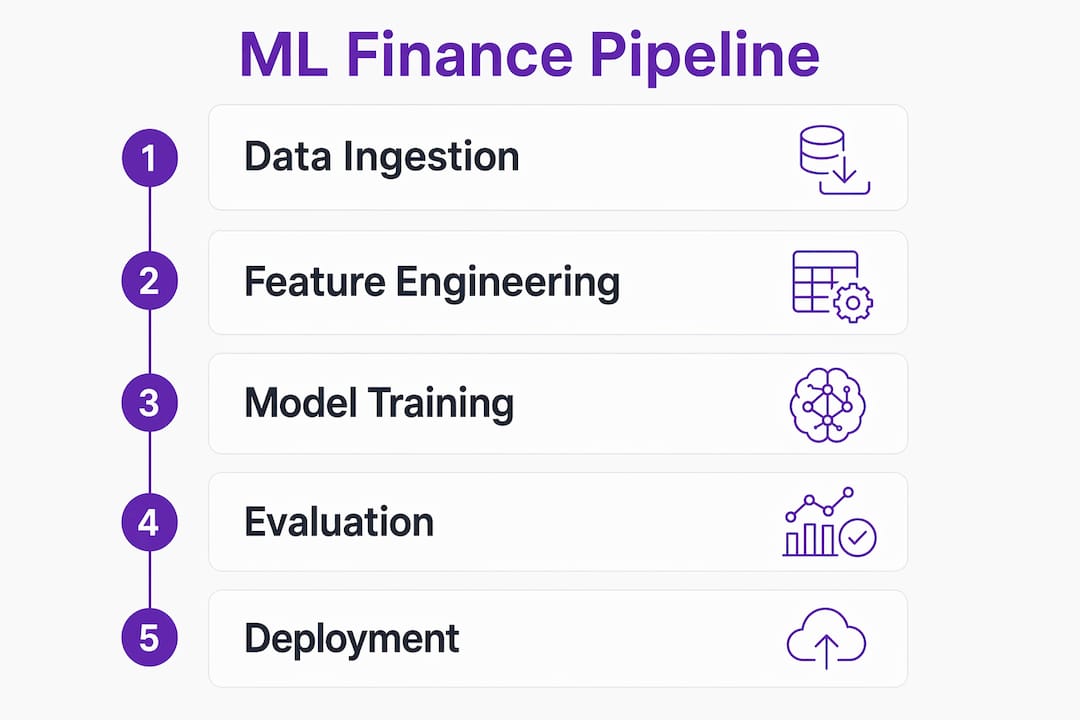
The wraquant library is the most purpose-built option for quantitative risk work. It includes over 44 specialized ML pipeline functions for financial risk contexts, including regime detection, credit risk modeling, and automated model selection. It also supports 21-day forecasting horizons out of the box, which aligns with standard risk reporting cycles at financial institutions.
For feature engineering at scale, the choice of data processing library matters more than most practitioners expect. Switching from Pandas to Polars-based toolkits can yield speed improvements of 10x–100x when processing financial data, with no C-level dependencies to manage. For large tick datasets or multi-asset pipelines running daily, that performance difference is the gap between a pipeline that finishes in minutes and one that runs overnight.
Key libraries for a production-grade risk pipeline include:
- wraquant: ML pipeline functions, regime detection, credit risk modeling, 21-day forecast support
- Polars / finasys: High-speed feature engineering with 15+ built-in technical indicators
- SHAP: Feature attribution and model explainability for regulatory audits
- MLflow: Experiment tracking, model versioning, and reproducible run management
- CVXPY: Convex optimization for portfolio construction with ML-generated alpha signals
- scikit-learn: Cross-validation, regularization, and classical ML baselines
- statsmodels: Time series diagnostics, cointegration tests, and GARCH modeling
Pro Tip: Use MLflow from day one, even on small experiments. Reconstructing which hyperparameters produced a given model six months later is nearly impossible without systematic tracking, and regulators may ask for exactly that audit trail.
How do you ensure regulatory compliance and interpretability in ML risk models?
Regulatory compliance is not optional for ML models deployed in financial risk contexts. Basel III and the Federal Reserve’s SR 11-7 guidance both require that risk models be transparent, auditable, and explainable to non-technical stakeholders. ML models that cannot satisfy these requirements will not pass model validation review at regulated institutions.
SHAP (SHapley Additive exPlanations) is the standard tool for meeting these requirements in Python. SHAP-based explainability satisfies Basel III and SR 11-7 compliance by providing both global feature importance rankings and local explanations for individual predictions. A risk officer can see not just that a model flagged a credit exposure, but which specific input features drove that decision and by how much.
Beyond explainability, three technical challenges consistently undermine ML risk models in practice:
- Non-stationarity: Financial time series change their statistical properties over time. A model trained on 2020 data may perform poorly in 2024 without regime-aware retraining or adaptive weighting.
- Lookahead bias: Using future information in feature construction produces models that appear accurate in backtests but fail in live deployment. Strict chronological data splits are the only reliable defense.
- Overfitting on noisy data: Financial returns have low signal-to-noise ratios. Regularization (L1/L2 penalties, dropout in neural networks) and walk-forward validation are necessary, not optional.
Risk management goals prioritize control techniques that guarantee valid risk bounds under varying market regimes over pure prediction accuracy. This principle, drawn from conformal risk research, explains why distribution-free methods like Conformal Prediction are gaining ground over accuracy-maximizing approaches in regulated environments.
For practitioners working within compliance frameworks, integrating SHAP outputs directly into model documentation and validation reports is the most efficient path to regulatory approval. Tools like the AI compliance risk guidance from BizDevStrategy provide additional context on documentation standards for AI-driven risk models.
How do you blend classical finance methods with ML signals in python?
Classical quantitative finance methods and ML models are not competing approaches. The most reliable risk management systems use both. Modern Portfolio Theory, Fama-French factor models, and standard risk metrics like VaR and CVaR provide structural discipline. ML models contribute pattern recognition and nonlinear feature extraction that classical methods cannot replicate.
The practical integration follows a clear sequence:
- Build the classical baseline: Compute Fama-French factor exposures, calculate rolling VaR and CVaR, and establish a benchmark portfolio using mean-variance optimization in CVXPY.
- Generate ML alpha signals: Train XGBoost or LSTM models on engineered features including momentum, volatility regimes, and sentiment scores from FinBERT applied to financial news.
- Blend signals with a fixed weight scheme: A 70/30 blend of historical signals and ML predictions smooths noise sensitivity while preserving classical optimization rigor. The 70% weight on historical signals prevents the portfolio from overreacting to ML outputs that may reflect overfitting.
- Apply risk constraints in CVXPY: Set maximum position sizes, sector concentration limits, and CVaR targets as convex constraints. The optimizer then finds the portfolio that maximizes expected return subject to those bounds.
- Validate with Monte Carlo and backtesting: Monte Carlo simulation and backtesting with realistic costs provide comprehensive risk metrics including Sharpe ratio, Sortino ratio, and maximum drawdown across asset classes.
| Component | Classical Tool | ML Enhancement |
|---|---|---|
| Return forecasting | Fama-French factor model | XGBoost, LSTM return predictions |
| Sentiment integration | None | FinBERT on financial news |
| Portfolio optimization | CVXPY mean-variance | ML alpha as input signal |
| Tail risk control | Historical VaR/CVaR | Regime-Weighted Conformal prediction |
For a deeper look at how ML improves trading efficiency in practice, the Darkbot blog covers applied examples across asset classes.
What are the key pitfalls when implementing ML for financial risk in python?
The most common failure mode in applying machine learning in finance is not a modeling error. It is a data handling error. Lookahead bias, where future information leaks into training features, produces models that look excellent in backtests and fail immediately in live deployment. Rolling-window backtests over simple k-fold validation are the standard defense, because they respect the chronological structure of financial data and mimic live market conditions.
Three additional pitfalls consistently affect production risk models:
- Overfitting to regime-specific patterns: A model trained exclusively on low-volatility data will underperform during stress periods. Regime detection, available in wraquant, allows models to adapt their behavior based on detected market states.
- Ignoring transaction costs in validation: Backtests that exclude realistic bid-ask spreads and slippage overstate strategy performance. Monte Carlo simulations that include cost assumptions produce more honest risk estimates.
- Treating model outputs as ground truth: ML risk forecasts are probabilistic estimates, not certainties. Risk managers should treat model outputs as one input among several, not as a replacement for judgment.
Pro Tip: When engineering features for financial ML models, compute all features using only data available at the prediction timestamp. A common mistake is using a 20-day moving average that includes the current day’s closing price in a model that predicts intraday risk.
For practitioners working in crypto markets, the same principles apply. The crypto risk management fundamentals covered on the Darkbot blog show how derivatives-based hedging complements ML-driven risk signals in volatile digital asset markets.
Key takeaways
Effective machine learning for financial risk management with Python requires combining the right model architectures, production-grade libraries, strict validation practices, and regulatory-compliant explainability tools.
| Point | Details |
|---|---|
| Hybrid LSTM-Attention leads on accuracy | These models improve volatility prediction by 17.3% over LSTM-only and hit near-compliant VaR violation rates. |
| wraquant covers the full pipeline | Its 44+ functions handle regime detection, credit risk, and 21-day forecasting in one library. |
| SHAP is non-negotiable for compliance | Basel III and SR 11-7 require feature-level explainability that SHAP provides directly. |
| Blend classical and ML signals | A 70/30 historical-to-ML signal ratio reduces noise sensitivity while preserving optimization discipline. |
| Rolling-window backtests are mandatory | Simple k-fold validation breaks chronological integrity and produces misleading performance estimates. |
Why interpretability matters more than accuracy in risk ML
My honest view is that most practitioners building Python ML risk models spend 80% of their effort on model architecture and 20% on explainability. That ratio should be closer to 50/50, especially for anyone working inside a regulated institution.
I have seen technically strong models rejected by model validation teams not because the predictions were wrong, but because no one could explain why the model made a specific decision. SHAP solves this problem, but only if you build it into your workflow from the start, not as an afterthought before a review meeting.
The other lesson I keep returning to is the value of classical methods as a guardrail. XGBoost and LSTM models are powerful, but they have no built-in understanding of financial theory. A model that violates basic no-arbitrage conditions or produces implausible factor exposures is a model that will embarrass you in front of a risk committee. Fama-French factor constraints and CVXPY-based optimization bounds are not limitations on ML. They are the structure that makes ML outputs defensible.
The Python ecosystem for risk management in trading has matured significantly. The tools exist. The gap is almost always in validation discipline and documentation rigor, not in modeling capability.
— Grisha
How Darkbot applies systematic risk logic to crypto trading
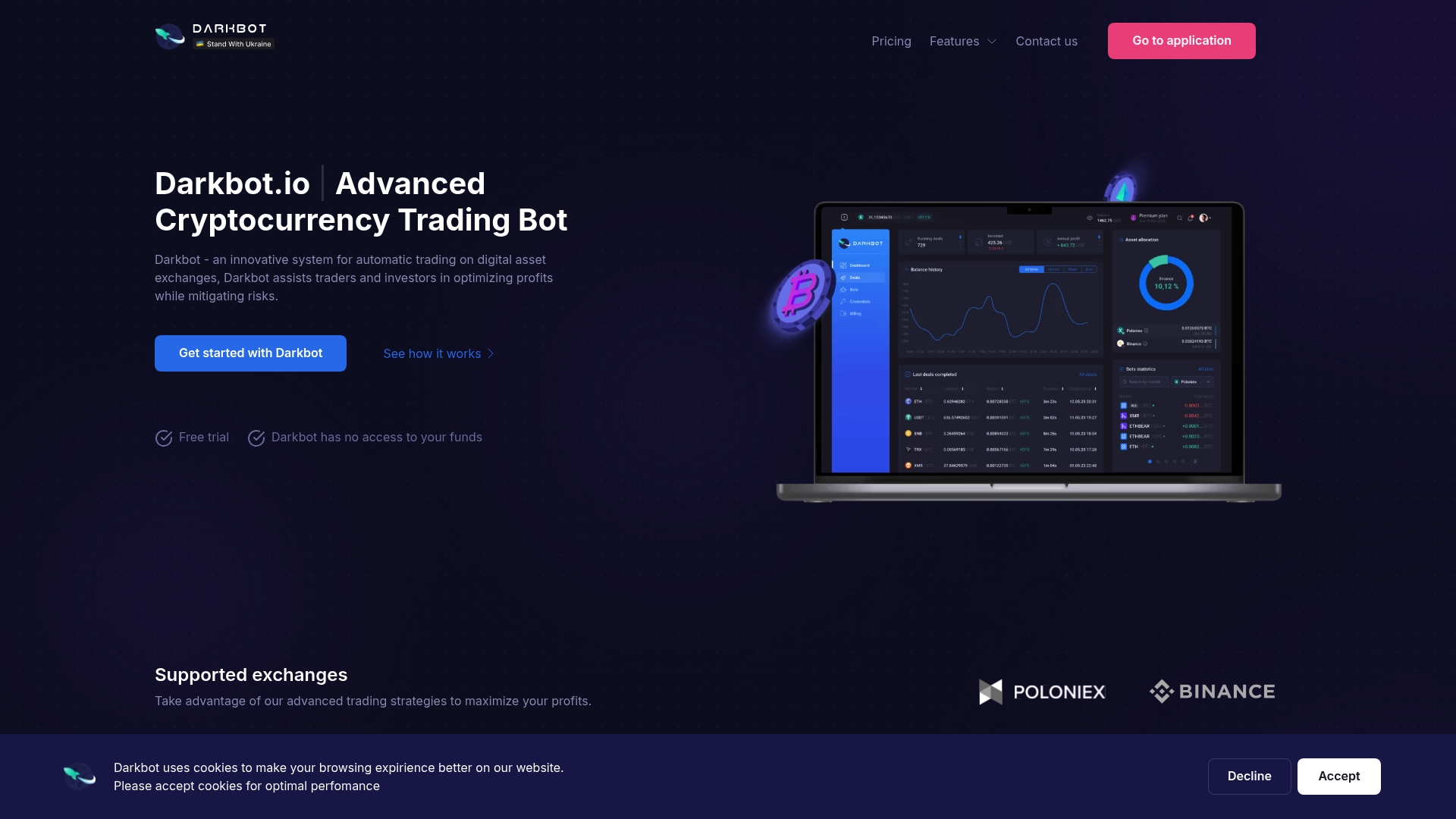
The same principles that govern ML-driven financial risk management, structured execution, rule-based decision frameworks, and adaptive signal weighting, are the foundation of how Darkbot operates in cryptocurrency markets. Darkbot is an AI-powered trading automation platform built around repeatable logic and disciplined risk control, not discretionary signals or performance promises. The platform integrates automated rebalancing, portfolio-level risk constraints, and real-time analytics across multiple exchanges via API. For practitioners who want to see systematic risk management applied to live digital asset portfolios, Darkbot’s trading platform and its portfolio management tools provide a structured environment for rule-driven execution at scale.
FAQ
What python libraries are best for financial risk forecasting?
The wraquant library covers over 44 ML pipeline functions for financial risk, including regime detection and credit risk modeling. Polars-based toolkits, SHAP, MLflow, and CVXPY complete a production-grade stack for end-to-end risk management workflows.
How does SHAP help with regulatory compliance in ML risk models?
SHAP provides global and local feature attribution, satisfying Basel III and SR 11-7 transparency requirements. It allows risk officers and auditors to trace exactly which input features drove a model’s risk forecast.
What is regime-weighted conformal prediction in risk management?
Regime-Weighted Conformal prediction is a distribution-free method for sequential VaR control that outperforms standard VaR models during structural market breaks. It provides finite-sample coverage guarantees without assuming normally distributed returns.
How do you avoid lookahead bias in financial ML models?
Enforce strict chronological data splits so no future information appears in training features. Use rolling-window backtests rather than k-fold cross-validation to replicate live market conditions accurately.
What is the recommended signal blend for hybrid classical-ml portfolios?
A 70% weight on historical financial signals combined with 30% ML-predicted signals reduces noise sensitivity while preserving the rigor of classical portfolio optimization frameworks like CVXPY-based mean-variance construction.
Recommended

Start trading on Darkbot with ease
Come and explore our crypto trading platform by connecting your free account!
Free plan available • No credit card required