Leverage Management Bots: How to Compare Your Options
A leverage management bot is software that watches a leveraged position and acts on rules you set: reducing exposure when risk rises, adding exposure when risk falls, and keeping leverage near a target. The options fall into four groups: on-chain automation, exchange-native bots, API-connected platforms, and self-hosted frameworks. Darkbot belongs to the third group and is built around rule-based execution and structured risk control. This guide compares the groups on the criteria that matter and explains what to verify before you connect any bot to a leveraged account.
TL;DR
- A leverage management bot enforces rules on position size, leverage and exit levels, so risk decisions are made in advance and not under pressure.
- The main options are on-chain automation (such as DeFi Saver), exchange-native bots, API-connected platforms like Darkbot, and self-hosted code.
- Compare them on custody, supported venues, available risk controls, testing tools, setup effort and cost structure.
- Whatever you choose, use API keys with trading permission only, test in paper mode, and start with small size.
- Darkbot offers a free tier, a Standard plan at $12.50 per month and a Premium plan at $25.00 per month, with a 14-day money-back guarantee.
What a leverage management bot actually does
Leverage multiplies both exposure and the speed at which a mistake becomes a liquidation. The task of managing it is mechanical: measure how close a position is to its danger zone, then change the position according to a rule. A bot performs that task continuously, without fatigue, and the same way each time.
The clearest published example comes from DeFi, where positions are collateralized loans. DeFi Saver’s Automated Leverage Management can partially unwind a position (auto-repay) if it falls below a threshold you configure, and lever it up again (auto-boost) if it rises above another threshold. Its documentation describes the typical uses as liquidation protection or holding a constant leverage level.
The same logic applies on centralized exchanges with perpetual futures, even though the mechanics differ. In practice a leverage management bot covers some combination of:
- Position sizing: limiting how much capital each trade can commit, so one loss cannot dominate the account.
- Leverage caps: refusing orders that would push effective leverage above a set ceiling.
- Exit rules: stop-loss and take-profit orders placed automatically with every entry.
- Exposure rebalancing: trimming or adding to positions when the portfolio drifts from its target allocation.
- Continuous monitoring: acting at 3 a.m. on rules you wrote at 3 p.m.
None of this predicts the market. The value is consistency: a rule written in a calm moment is executed in a volatile one.
The four types of options
The choice is less about brand names than about architecture. Where the bot runs, who holds the funds and how much you must build yourself determine most of the trade-offs.
On-chain automation
Tools such as DeFi Saver operate on smart-contract positions: lending protocols and vaults. They suit users who hold leveraged positions on-chain and want protection against liquidation or a constant leverage ratio. Their scope is the protocols they integrate with, so they do not cover centralized exchange futures.
Exchange-native bots
Some exchanges, Pionex being a well-known case, run grid and other bots inside their own platform. Setup is simple because there is nothing to connect. The trade-off is that the bot, the margin and the strategy menu all live with one venue, so your risk rules are limited to what that venue offers.
API-connected platforms
Platforms such as Bitsgap, 3Commas, WunderTrading and Darkbot connect to your exchange account through API keys. Funds stay on the exchange, and the platform sends orders on your behalf. This gives you one control layer across several exchanges, plus strategy tools, backtesting and analytics that exchanges rarely provide. Plans, supported exchanges and futures coverage differ by platform and change over time, so confirm them on each provider’s own pricing and documentation pages before subscribing.
Self-hosted frameworks
Freqtrade is the usual example: open-source software you run on your own server, where you code the strategy and the risk logic. It offers maximum control and no subscription, but you carry the engineering, hosting, monitoring and security. It fits developers who want to own every rule.
Comparison on the criteria that matter
The table compares the groups structurally. It deliberately avoids per-provider prices, which change often; check each provider’s pricing page for the current figure.
| Criterion | On-chain automation | Exchange-native bots | API-connected platforms (incl. Darkbot) | Self-hosted framework |
|---|---|---|---|---|
| Where funds sit | In your wallet or protocol position | On the exchange, inside its bot product | On your exchange account | On your exchange account |
| Venue coverage | Supported DeFi protocols | One exchange | Several exchanges through API keys | Any exchange the library supports |
| Risk-rule flexibility | Threshold-based repay and boost | Limited to the bot’s settings | Configurable strategies and risk tools | Unlimited, if you code it |
| Setup effort | Low to moderate | Low | Low to moderate | High |
| Testing tools | Limited | Varies | Backtesting and paper trading on many platforms | Build or configure yourself |
| Ongoing maintenance | Minimal | Minimal | Handled by the provider | Yours entirely |
| Cost structure | Protocol and gas fees | Trading fees | Subscription plus exchange fees | Server cost plus exchange fees |
Three observations follow from the table.
First, custody and permission design matter more than features. A bot that never needs withdrawal rights is structurally safer than one that does.
Second, the more venues you use, the more a single control layer pays off. If you hold positions on two or three exchanges, checking leverage separately on each is exactly the manual work a bot is meant to remove.
Third, cost is not only the subscription. Futures trading carries funding rates and exchange fees on top of any bot plan, and these affect results regardless of the platform.
Where Darkbot fits
Darkbot is an AI-based crypto trading automation platform. It is not a signal provider: it executes rules you define and does not tell you what to buy. The AI components are used for consistency, probabilistic pattern evaluation and rule-driven adaptation, not for forecasting prices or promising outcomes.
For leverage management, the relevant parts of the platform are:
- Risk management tools that apply stop-loss, take-profit and exposure rules to each strategy. Our guide to risk management in crypto trading bots explains the logic in detail.
- API exchange integration, so the platform works with your existing exchange account. See API-based exchange integration for how the connection works.
- Backtesting and paper trading, which let you examine a rule set against history and run it without capital before it touches live funds.
- Multiple simultaneous bots, so separate strategies can carry separate risk budgets.
- Portfolio management and automated rebalancing, which keep allocation near target. The article on portfolio rebalancing for crypto traders covers the mechanism.
- Human oversight and direct order routing, which are part of how we approach security.
The design principle is that leverage is a parameter inside a defined process, never a lever for speed. A bot that follows a position-sizing rule on every trade does more for survival than one that chases the largest possible exposure.
Before subscribing, review the plan details and the exchanges supported for your plan on the Darkbot pricing page.
How to evaluate any leverage bot before going live
A short, repeatable checklist works for every option above.
- Define the rule before choosing the tool. Write down your maximum leverage, maximum loss per trade as a percentage of account equity, and the action when a limit is hit. A tool is good if it can express those rules.
- Check the permission model. Create API keys with trading permission only and withdrawals disabled. Where the exchange supports it, restrict the key to the platform’s IP addresses and use a sub-account for bot capital. Our article on API-based exchange integration covers these settings.
- Confirm the venue and product coverage. Perpetual futures, margin and spot are different products. Verify on the provider’s own documentation that your exchange and product are supported on the plan you intend to buy.
- Test without capital. Run the rule set in paper mode and compare behavior against the backtest. Differences usually come from fees, slippage and funding rates.
- Start small. Use a fraction of intended size for the first weeks, so any configuration error costs little.
- Review on a schedule. Markets change volatility regimes. A leverage cap that suits a quiet month may be too loose in a turbulent one, so revisit parameters periodically and not only after a loss.
Which approach suits which trader
The right fit depends on account size, experience and time available.
Small accounts ($100 to $1,000). Position sizing dominates here. With a small account, one oversized leveraged trade can end the experiment. A low-cost plan with strict per-trade risk limits and paper trading is the sensible start. Darkbot’s free tier and its Standard plan at $12.50 per month keep the fixed cost low relative to account size.
Part-time traders. If you have under two hours a day, the main value is that rules run while you are away. Prioritize clear alerts, simple configuration and stops that are always attached to entries.
Multi-exchange traders. If you run several accounts or hedge across venues, an API-connected platform with a single dashboard reduces the chance of missing a position that drifted. Multiple simultaneous bots with separate risk budgets are useful here.
On-chain borrowers. If your leverage lives in lending protocols, an on-chain tool like DeFi Saver addresses that exact case.
Developers. If you prefer to code and host everything, a framework such as Freqtrade gives full control at the price of full responsibility.
Larger or custom setups. Darkbot also lists an Enterprise plan for these cases; details are on the pricing page.

Risks that no bot removes
Automation enforces rules; it does not make leveraged trading safe. Several mechanics sit outside any bot’s control.
- Gaps and slippage. In fast markets a stop order can fill beyond its trigger price, so realized loss can exceed the planned loss.
- Funding rates. On perpetual futures, funding payments accrue while a position is open and can erode returns over time.
- Thin liquidity. Illiquid pairs can move sharply on small orders, which triggers stops and liquidations. The patterns behind these moves are described in this overview of pump-and-dump warning signs, written about equities but relevant to any low-liquidity market.
- Exchange and API outages. A bot cannot act if the venue or connection is down, so avoid sizing positions on the assumption that an exit will always execute.
- Rule error. A bot executes a flawed rule just as faithfully as a sound one. This is why backtesting and paper trading come before live capital.
Leveraged trading can lose more than a trader expects in a short time. Size positions so that an unfavorable sequence is survivable, and consider consulting a licensed financial professional about how leveraged products fit your situation.
Our perspective
We built Darkbot around a simple observation: most leverage losses come from process failures, not from bad forecasts. A trader sizes a position too large, forgets a stop, or overrides a rule under stress. A bot cannot remove market risk, but it can remove the inconsistency.
That is why we describe Darkbot as execution infrastructure and not as a source of signals. The platform applies the logic you define: position limits, exit rules, rebalancing and exposure across several bots. Where machine learning is involved, its role is to evaluate patterns probabilistically and adapt within rules, not to predict prices.
We also think the order of operations matters. Define the risk budget, test it through backtesting and paper trading, connect through restricted API keys, then go live small. Tools that skip that sequence make leverage feel easier than it is.
The aim is a system that behaves the same way on a quiet Tuesday and during a sharp drawdown, with human oversight when conditions fall outside the rules.
Grisha
Start with a defined risk budget
Darkbot’s plans are built so you can test a rule set before committing meaningful capital. The free plan has limited features, Standard costs $12.50 per month and Premium costs $25.00 per month, and paid plans carry a 14-day money-back guarantee. Enterprise is available for larger requirements.
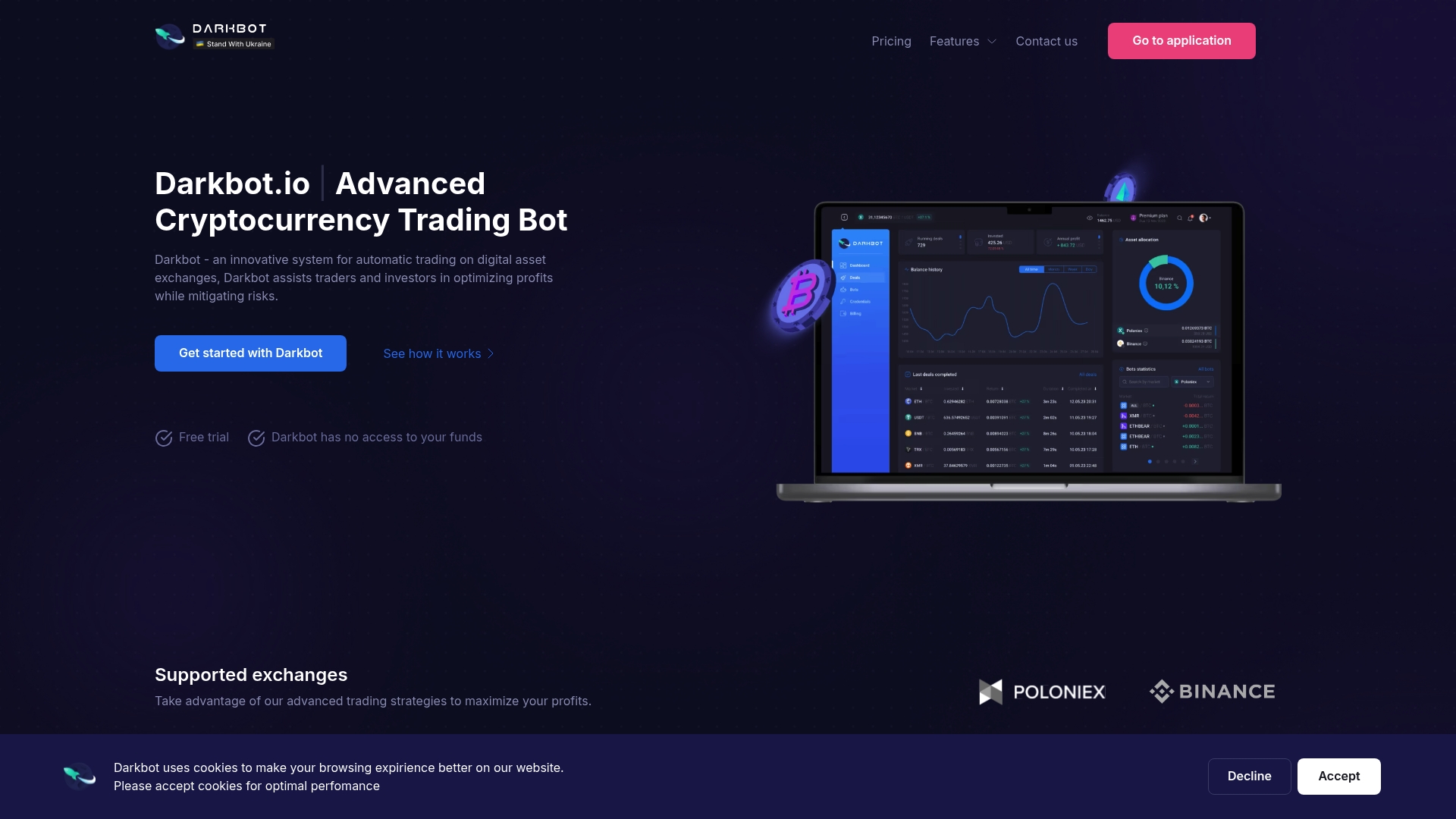
Compare the tiers on the Darkbot pricing page, or read how to automate crypto trading efficiently before you set up your first bot.
FAQ
Does a leverage management bot reduce the risk of liquidation?
It can lower the odds by enforcing position limits, stops and, in on-chain tools, automatic partial repayment when a threshold is crossed. It cannot remove the risk. Gaps, slippage and outages can still produce losses larger than planned, so size positions conservatively.
Are API keys safe to use with a trading bot?
They are safer when configured narrowly. Enable trading permission only, disable withdrawals, and restrict access by IP address if your exchange allows it. Using a sub-account limits exposure to the capital assigned to the bot.
Can I test a leverage strategy without risking money?
Yes, through backtesting against historical data and paper trading in live conditions. Darkbot provides both. Paper results will still differ from live ones because of fees, slippage and funding rates.
Is a leverage management bot the same as a signal service?
No. A signal service suggests trades, while a leverage management bot executes and constrains trades according to rules you set. Darkbot is an execution and risk-control platform, not a signal provider.
How much does it cost to run one?
Costs have two parts: the platform subscription and exchange charges such as trading fees and funding rates. Darkbot’s paid plans are $12.50 per month (Standard) and $25.00 per month (Premium), and exchange fees are additional.
Sources
Recommended

Start trading on Darkbot with ease
Come and explore our crypto trading platform by connecting your free account!
Free plan available • No credit card required