Paper Trading Crypto: How to Practice Risk-Free Before Going Live
Paper trading crypto means simulating buy and sell decisions with virtual money on live or near-live market data, so nothing you do puts real capital at risk. Its value is straightforward: you learn how an exchange or bot behaves, test a strategy against actual price action, and find out whether you can follow your own rules under pressure, all before a single dollar is exposed.
The right next step depends on what you’re testing:
- Charting and manual order flow — start with a broker-style demo account.
- Leveraged perpetuals or futures — use an exchange testnet with realistic liquidations.
- DeFi strategies or large orders — use a mainnet fork.
- Automated bots — use a testnet or sandbox that persists state across sessions.
Key Takeaways
Paper trading crypto only produces a reliable signal when the venue matches the strategy being tested and the results are calibrated against a small live trade.
| Point | Details |
|---|---|
| Match venue to strategy | Use broker demos for charting, testnets for leverage, and forks for DeFi validation. |
| Treat paper P&L as an upper bound | Slippage, downtime, and partial fills are absent from most simulations, so real results run lower. |
| Journal every trade | Record entry rationale, exit rule, and emotional state to catch pattern breaks before losses do. |
| Calibrate with a micro-live test | A small real trade, $10 to $100, reveals the true gap between simulated and live execution. |
| Automate what you’ve validated | Darkbot applies the same risk rules and sizing logic tested in paper mode across live exchange connections. |
What Is Paper Trading and Which Demo Venues Exist?
A paper trading account is a demo environment that lets you buy and sell assets with virtual money and zero financial exposure. TradingView defines it as exactly that: no deposit, no real money, full access to live charts. That’s the simplest tier, but it’s not the only one.
Crypto practice trading now spans four distinct environments, and each one answers a different question:
- Broker or exchange demo accounts. Best for learning order types, chart tools, and platform mechanics. TradingView credits new users with $100,000 in virtual funds the moment paper trading is activated, across nearly every asset class it lists.
- Bot sandboxes. API-connected environments built for persistent, repeatable automated-strategy testing, covering spot, perps, and DeFi pools depending on the exchange.
How Realistic Is Each Paper Trading Venue?
Realism is where most paper trading accounts quietly mislead people. A demo account can make a mediocre strategy look brilliant simply because it never charges you for the friction that live markets impose.
- Broker demos fill orders at or near the quoted price almost every time. That’s fine for learning where the buy button is, but it hides slippage entirely, and it’s one reason paper P&L tends to run optimistic.
- Exchange testnets simulate a real matching engine, so partial fills, funding payments, and liquidation cascades behave much closer to production. That’s why they’re the preferred venue for anyone testing leverage.
- Mainnet forks carry the highest realism for on-chain work. Because you’re trading against actual pool depth at a real block, price impact from a large swap shows up exactly as it would on mainnet.
- Bot sandboxes matter for a different reason: they’re the only tier that captures persistent state across restarts, which automated strategies depend on to be tested honestly.
The core distortion to watch for: paper trading routinely produces an optimistic picture of performance because it skips exchange downtime, wider slippage, and partial fills that live trading forces you to absorb. Treat any paper P&L as an upper bound, not a forecast, until you’ve calibrated it against small live trades.
What’s a Practical 30-Day Roadmap for Practicing?
A month is enough time to move from “learning the interface” to “having evidence a strategy is worth risking money on,” provided you treat each week as a distinct checkpoint rather than one long open-ended trial.
- Week 1: setup. Pick your venue, fund the paper account, and fix your starting virtual capital. Decide your position-sizing rule now, not after a few trades.
- Week 2: baseline runs. Execute your strategy exactly as designed and start a trade journal: entry rationale, exit rule, and the emotion you felt at each decision point.
- Week 3: stress testing. Push larger order sizes, trade through a volatile session, and manually simulate partial fills to see how your rules hold up when execution isn’t clean.
- Week 4: review. Calculate expectancy and maximum drawdown, then build a written checklist before you consider moving to live capital.
Your checklist should include a fixed starting balance, a 1 to 2% risk per trade rule, defined stop-loss placement, an explicit slippage assumption, and a consistent logging format you’ll actually maintain.
Pro Tip: Log losing trades in as much detail as winners. The pattern that ends a strategy almost always shows up in the losers first, and it’s invisible if you only journal the wins.
How Do You Paper-Test Automated Trading Bots?
GUI demo accounts fall short for bots because they don’t capture persistent portfolio state or real API behavior. Automated strategies need testnets or forks that let the bot run continuously across restarts, exactly as it would in production.
A believable bot test requires a few specific practices:
- Run against an exchange testnet or a local fork rather than a browser-based demo, so the portfolio state persists between sessions and journal cycles stay continuous.
- Simulate slippage, funding costs, and trading fees deliberately. One practical method is to intentionally apply execution delay and slippage to paper fills so they approximate what a live order book would actually do.
- Seed your own test liquidity or trade against public testnet liquidity, depending on what the venue supports.
- Add a deterministic risk layer, such as a max leverage cap or a hard daily drawdown halt, so the bot can’t behave unrealistically permissive just because the stakes are fake.
- Once paper results stabilize, compare them against a micro-live test rather than assuming the paper numbers will hold.
When Are You Ready to Move From Paper to Live Trading?
Readiness isn’t a feeling, it’s a set of measurements. Before committing real capital, check four things directly: how close your paper fills were to executable live prices, how your strategy handled partial fills, what latency did to your entries, and whether funding or rollover costs ate into returns you didn’t originally model.
Emotional tolerance matters just as much as the numbers. Trading with even a small amount of real money changes decision-making in ways a purely simulated account never reveals.
- Start the live phase with a micro-live test, something like $10 to $100, specifically to measure the gap between paper and live execution.
- Compare paper drawdown and expectancy against the same metrics from the live micro-test before scaling further.
- Reconfirm your risk controls (stop-loss, position size, max exposure) work identically in the live environment.
- Watch for red flags: consistent negative variance after you’ve already calibrated for slippage, or recurring problems with partial fills and API errors that never resolve.
If those red flags persist past two or three live cycles, the strategy isn’t ready, no matter how clean its paper results looked.
How Does Darkbot Support Rigorous Paper Trading?
Darkbot’s paper trading mode is built around the same tiered logic this article describes: a persistent portfolio, not a one-off simulation that resets on refresh. That matters because a bot’s edge only shows up over repeated cycles, not a single lucky sequence.
Relevant capabilities for this workflow include:
- API exchange integration across major venues, so paper runs reflect the same connectivity your live bot will use.
- Multiple simultaneous bots, letting you paper-test several strategies in parallel under identical market conditions.
- Backtesting against historical data before committing to a forward paper run.
- Persistent paper portfolios that carry state across sessions, addressing the exact gap GUI-only demos leave open.
- Automated rebalancing and real-time analytics to track expectancy and drawdown as they accumulate, rather than reconstructing them manually.
| Feature | Why it matters for paper testing |
|---|---|
| Persistent portfolio state | Captures multi-day behavior instead of resetting each session |
| Multiple simultaneous bots | Compares strategies under the same market conditions |
| Real-time analytics | Tracks expectancy and drawdown as they build |
What the Realism Framework Gets Right (and Where It Falls Short)
Most guidance on paper trading treats it as a single tool, either you’re using it or you’re not, when it’s really four separate testing environments with different failure modes. That distinction is what the tiered framework in this article is built to fix.
Here’s what conventional advice tends to miss: a clean paper track record is weak evidence on its own. It tells you a strategy is internally consistent. It says almost nothing about how that strategy behaves against real slippage, a stalled API call during a liquidation cascade, or the very human urge to override a stop-loss rule you set yourself three weeks earlier.
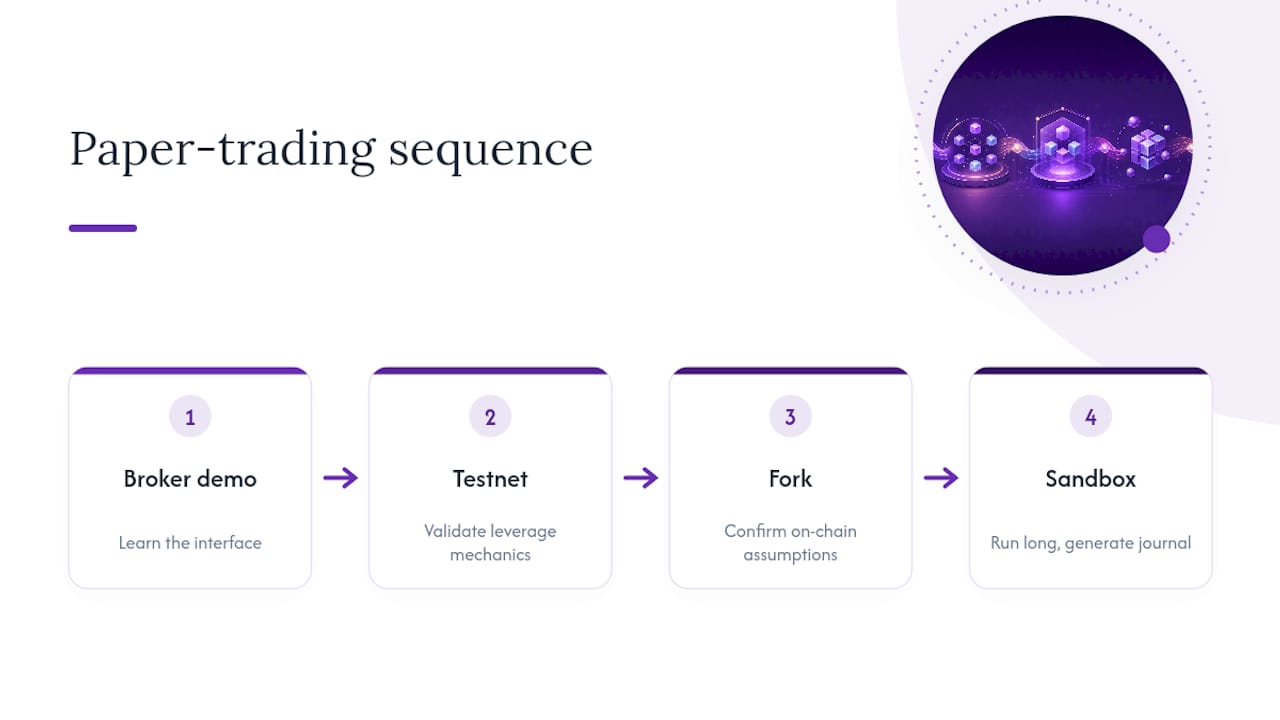
The reader’s priority should be sequencing, not venue selection. Learn the interface on a broker demo, validate leverage mechanics on a testnet, confirm on-chain assumptions on a fork, then run the strategy in a sandbox long enough to generate a real journal. Skipping straight to the “most realistic” tier without the earlier steps just means you’re stress-testing habits you haven’t built yet. The 1 to 2% risk rule and the expectancy and drawdown metrics covered earlier aren’t optional extras. They’re the only reason a paper track record means anything once real money enters the picture.
Move From Simulated Strategies to Automated Execution With Darkbot
Once your journal shows a strategy holds up across calibration and a micro-live test, the next friction point is usually execution consistency, remembering to place every trade, at the right size, without emotional override. That’s the gap Darkbot is built to close.
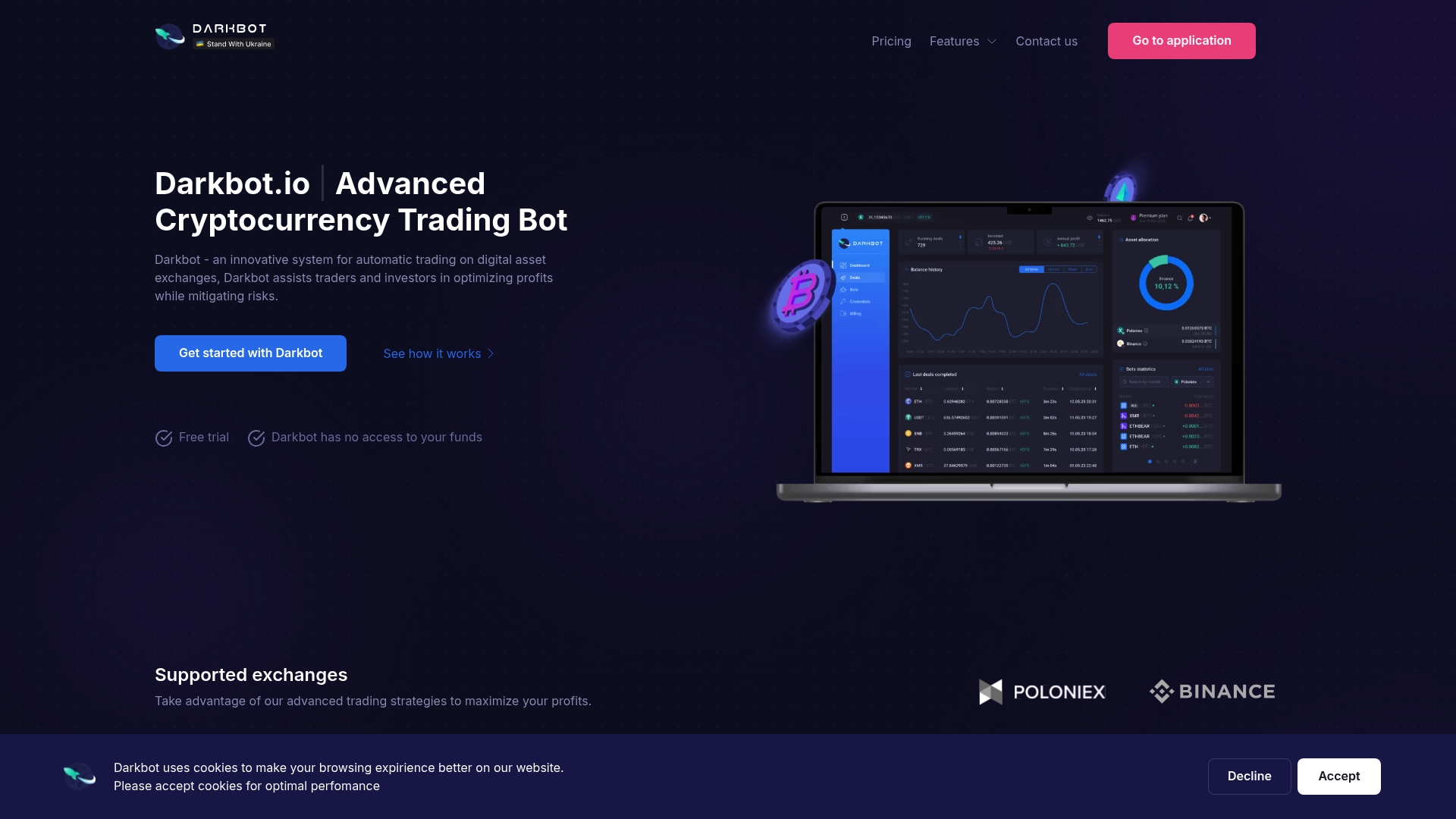
Darkbot runs the same disciplined logic your paper trading roadmap established, position sizing, stop-loss placement, and risk-per-trade limits, and executes it automatically across connected exchanges via API. It doesn’t predict price direction or promise returns. It applies rule-driven logic consistently, which is precisely what a 30-day paper trading process is designed to test in the first place. For traders who’ve already validated a strategy’s expectancy and drawdown profile, Darkbot’s automated trading platform lets you move from manual execution to systematic, repeatable automation without rebuilding your risk framework from scratch. You can review the free and paid tiers on the Darkbot site and start with a plan that matches your current testing stage.
Sources
FAQ
Is Paper Trading Still Available?
Yes. Paper trading remains widely available through broker platforms, exchange testnets, and mainnet forks, and TradingView still offers it free on every plan with $100,000 in virtual funds.
Is Paper Trading a Good Way to Choose a Broker?
Paper trading is better suited to testing your own strategy and habits than to judging a broker. Fill quality on a demo account is often more optimistic than the same broker’s live execution, so use it to evaluate your process, not the platform’s real-world performance.
How Long Should I Paper Trade Before Going Live?
There’s no fixed number, but a 30-day cycle covering setup, baseline runs, stress testing, and review gives enough data to calculate expectancy and drawdown before committing real capital.
Can I Paper-Test an Automated Trading Bot?
Yes, but it requires a testnet, fork, or sandbox rather than a basic demo account, since bots need persistent portfolio state and real API behavior to produce meaningful results. Platforms like Darkbot support this through persistent paper portfolios and real-time analytics.
What’s the Biggest Limitation of Paper Trading Crypto?
Paper trading tends to overstate performance because it skips slippage, exchange downtime, and partial fills that occur in live markets, so results should be treated as an upper bound rather than a prediction.
Recommended

Start trading on Darkbot with ease
Come and explore our crypto trading platform by connecting your free account!
Free plan available • No credit card required