Funding Rate Arbitrage: A Delta-Neutral Guide to Carry Trades
Funding rate arbitrage is a delta-neutral cash-and-carry trade: you buy spot, short an equivalent notional in the perpetual futures contract, and collect the funding payment as your primary source of return. The directional exposure from the long and short positions cancels out, so price movement in either direction should not meaningfully affect your P&L. What actually drives returns is the funding differential paid between longs and shorts on the perp contract.
This trade suits traders who already have accounts (and margin) across multiple exchanges, who can monitor positions across funding intervals, and who have some way to automate rebalancing or at least get alerted when things drift. It is not a passive “set and forget” income stream.
- Core mechanism: equal notional spot long + perp short
- Return source: funding payments, not price appreciation
- Best fit: traders with cross-exchange margin, monitoring tools, and a tolerance for operational detail
Pro Tip: Before sizing a position, check the funding rate history for the last 30 to 60 intervals, not just the current print. A single elevated reading often reverts within a day or two.
Key Takeaways
Funding rate arbitrage generates returns from funding payment differentials while directional exposure is designed to stay neutral, and its viability depends on cost discipline more than on finding the highest available rate.
| Point | Details |
|---|---|
| Core structure | Match spot long and perp short at equal notional so directional risk cancels and funding becomes the P&L driver. |
| Break-even discipline | Model fees, margin opportunity cost, and slippage against expected funding before entering any position. |
| Primary risks | Rate flip, basis risk, and execution costs are the three failure modes that erode or reverse expected returns. |
| Liquidity matters at entry and exit | Thin order books can turn an attractive funding rate unprofitable through slippage on both legs. |
| Automate the monitoring | Darkbot applies rule-based execution, hedge-ratio tracking, and automated rebalancing to run funding-arb positions systematically rather than manually. |
How Funding Rate Arbitrage Works Step by Step
The trade starts with identifying a perpetual contract paying an elevated, positive funding rate, then confirming the exchange’s settlement cadence, which might be hourly, every four hours, or every eight hours depending on the venue. That interval matters because it determines how often you actually get paid, and it changes how you annualize the rate for comparison purposes.
- Scan for elevated funding. Look for perps where funding has stayed positive and above your cost threshold across several consecutive intervals, not just one spike.
- Buy spot at matched notional. Purchase the underlying asset in the spot market for the dollar amount you intend to hedge.
- Short the perpetual for the same notional. This is not a token-for-token match. Because perpetual contracts often use different margin currencies and contract multipliers than the spot asset, you size the short based on notional value, not unit count.
- Collect funding at each settlement. When the funding rate is positive, longs pay shorts. Your short perp position receives that payment while your spot long simply sits there, hedged.
- Monitor and unwind. Close both legs together when funding compresses or costs stop justifying the position.
Settlement timing mismatches are where a lot of traders get tripped up. If your exchange settles funding on the hour and you are comparing it against a venue that settles every eight hours, the raw percentages are not directly comparable until you normalize them to the same time base, a detail confirmed in Binance’s own documentation on funding mechanics.
When Funding Rate Arbitrage Actually Makes Sense
Three conditions need to line up before this trade is worth putting on. First, funding needs to be persistently elevated, meaning it has held above your cost threshold across multiple consecutive settlement intervals, not just one favorable print. Second, the basis between spot and perp needs to be reasonably stable, since a widening basis can erode gains even while funding stays positive. Third, you need the capacity to actually hold the position, which means margin headroom on both legs and no near-term need for that capital elsewhere.
Set your cost threshold before entering, not after. That threshold should include trading fees on both legs, the opportunity cost of capital tied up in margin, and a slippage buffer for entry and exit.
That break-even math only works if the 0.05% rate holds. Watch at least three to five consecutive funding intervals before committing full size. A single strong print tells you almost nothing about durability.
Rate Flip, Basis Risk, and Execution Costs
Three risks dominate this trade, and each one requires a different mitigation.
- Rate flip. Funding can reverse sign with little warning, turning your income stream into an expense. Set an automated alert (or a bot-driven trigger) for when funding drops below your cost threshold or turns negative.
- Basis risk. Spot and perp prices rarely track perfectly. Contract specifications, margin currency conversion, and settlement timing differences all introduce residual exposure that a naive 1:1 hedge does not capture, a point echoed in practitioner guidance on hedge-ratio construction.
- Execution costs. Fees, the opportunity cost of margin sitting idle, and slippage on entry and exit all eat into the funding you collect. Model the full round-trip cost before, not after, sizing the position.
The mitigation playbook is mostly about discipline rather than cleverness. Conservative sizing gives you room to absorb a basis swing without a margin call. Automated rebalancing keeps your hedge ratio close to neutral as prices drift apart. And explicit stop or rebalance rules, triggered by funding sign or magnitude, remove the temptation to hold a position out of hope once the funding rate flips against you.
Pro Tip: Treat a funding flip the same way you would treat a stop loss on a directional trade. Decide the exit trigger before you enter, not while you are watching the position bleed.
Broader risk disclosures on leveraged and derivative positions, including margin and liquidation mechanics, are worth reviewing before scaling size; general risk disclosure guidance covers the failure modes that apply regardless of which exchange you use.
Execution Practicalities: Sizing, Timing, and Automation
Getting the mechanics right on paper is one thing. Running the trade across real exchanges with real fee schedules is where most of the operational friction shows up.
- Compute matched notional carefully. Contract multipliers and margin currencies differ across exchanges, so converting your spot position into an equivalent perp notional takes more than dividing dollars by price. A BIS working paper on crypto carry notes that these structural frictions, not just interest rate differences, are part of why funding differentials persist in the first place.
- Normalize funding intervals before comparing. An hourly funding rate of 0.006% and an 8-hour rate of 0.05% are not directly comparable until both are converted to the same annualized basis.
- Budget for fees and slippage explicitly. Round-trip trading costs on both legs, plus a slippage estimate for entering and exiting during normal volatility, should be subtracted from expected funding before you call a trade profitable.
- Include margin opportunity cost. Capital locked in margin on the perp leg is not earning yield elsewhere, and that cost belongs in your net P&L calculation, not just fees.
Manual monitoring works at small scale, but it does not hold up once you are running multiple positions across several exchanges. Funding-rate scanners can normalize intervals and surface opportunities across venues, and execution bots can handle the actual order placement once thresholds are met.
A practical runbook needs a debounce window, so the system does not react to a single noisy funding print, and a clear manual-intervention path for when basis widens beyond a set tolerance. Darkbot’s arbitrage strategies checklist walks through this operational sequencing in more detail, and the step-by-step arbitrage workflow covers how to structure the handoff between automated monitoring and manual review.
An Operational Perspective on Running This at Scale
Grisha’s writing on Darkbot’s blog treats funding rate arbitrage as an execution problem first and a market-timing problem a distant second. The foundational guide to arbitrage trading frames the whole category this way: the edge exists because of structural frictions, and the job is to capture it reliably, not to predict which direction rates will move next.
Configurable risk controls matter more than most traders expect going in. Automated rebalancing keeps a hedge ratio close to neutral without requiring constant manual attention, and stop rules tied to funding sign or basis widening remove the guesswork from exit timing.
The traders who do well at this treat funding-rate arbitrage as a repeatable operational process: define entry thresholds, define exit triggers, and let the system enforce both consistently rather than relying on judgment calls made in real time.
Start small. Paper trade the mechanics, confirm your notional matching logic is correct, then scale size gradually once the process has run cleanly through a few funding-flip events.
How Funding Rate Arbitrage Compares to Other Arbitrage Strategies
Funding rate arbitrage sits alongside a handful of other arbitrage approaches common in crypto markets, and the differences come down to what drives the return and how much directional risk each one carries.
Cross-exchange spot arbitrage exploits price differences for the same asset across two exchanges. It is simpler conceptually but requires fast execution and enough capital pre-positioned on both venues, since the price gap typically closes within seconds.
Triangular arbitrage works within a single exchange, cycling through three trading pairs to exploit pricing inconsistencies between them. It demands speed and low fees more than capital, and it rarely stays open long enough for manual execution.
Statistical arbitrage bets on the reversion of a price relationship between correlated assets. Unlike funding rate arbitrage, it is not delta-neutral by construction. It carries model risk: the historical correlation can break down.
Funding rate arbitrage stands apart because it is structurally delta-neutral by design, its return source (funding payments) is transparent and observable before you enter, and its holding period tends to be longer, often days or weeks, compared to the seconds-to-minutes window of spot or triangular arbitrage. That longer horizon means the risks (rate flip, basis drift) play out gradually rather than as a snap execution failure, which changes how you monitor and manage the position.
Regulatory Considerations and Compliance Risks
Regulatory treatment of derivatives and perpetual futures varies substantially by jurisdiction, and traders need to check the rules that apply where they and their exchange accounts are based rather than assume a single global standard. Some jurisdictions restrict retail access to leveraged derivative products entirely, while others permit them under specific licensing or disclosure requirements for the exchange.
Exchange-level compliance also matters directly to execution. Know-your-customer and anti-money-laundering requirements can affect withdrawal limits, account verification tiers, and how quickly you can move capital between venues, all of which matter when you need to rebalance a hedge quickly. Some exchanges restrict perpetual futures access for users in specific countries, which limits which funding spreads are actually available to you regardless of how attractive they look on a scanner.
Tax treatment of derivative gains and funding payments also differs by jurisdiction and sometimes by asset classification within the same country. Traders running this strategy across multiple exchanges and jurisdictions should confirm compliance obligations directly with a qualified professional rather than relying on general guidance, since the rules governing margin trading, derivatives access, and reporting change frequently and enforcement varies by regulator.
How Liquidity and Slippage Affect Funding Rate Arbitrage
Liquidity depth on both the spot and perp legs determines whether the trade is executable at the size you want without moving the price against yourself. A funding rate that looks attractive on a thinly traded perp can turn unprofitable the moment you try to enter or exit at meaningful size, because the order book cannot absorb the trade without slippage eating into the funding you would have collected.

This matters more on entry and exit than during the holding period itself. Once both legs are open, the position is largely passive. The risk concentrates at the two moments when you are actually placing orders, particularly during volatile periods when spreads widen and order books thin out.
Larger notional sizes amplify this problem. A position that fits comfortably into a deep, high-volume perp market on a major exchange might cause noticeable price impact on a smaller venue or a less liquid altcoin perp, even if the quoted funding rate is higher there. This is part of why many practitioners favor major pairs on high-volume exchanges for larger positions, reserving smaller altcoin funding opportunities for smaller notional sizes. Modeling expected slippage into your cost threshold, rather than treating it as an afterthought, is what separates a break-even calculation that holds up in practice from one that only works on paper.
Tools and Platforms for Running Funding Arbitrage
Running this strategy manually across multiple exchanges quickly becomes unmanageable once you are tracking more than one or two positions. Funding-rate scanners exist specifically to solve the discovery problem, aggregating and normalizing funding rates across venues so you are not manually checking each exchange’s dashboard and converting intervals by hand.
Discovery is only half the job. Execution and monitoring require a different layer: something that can place matched spot and perp orders quickly, track the hedge ratio as prices move, and flag or automatically respond when funding flips or basis drifts beyond your tolerance. Darkbot’s platform is built around this kind of systematic execution: configurable risk rules, automated rebalancing, and real-time monitoring across connected exchange accounts, all governed by rules you set rather than discretionary calls made under pressure.
Darkbot’s overview of automated arbitrage tools breaks down what to look for in an execution layer, including how debounce windows prevent overreacting to a single noisy print and how hedge-ratio monitoring should factor into any automated rebalancing logic. The right tool for this strategy is less about speed for its own sake and more about consistency: doing the same thing the same way every time a threshold is crossed.
Tax Treatment of Funding Rate Arbitrage Profits
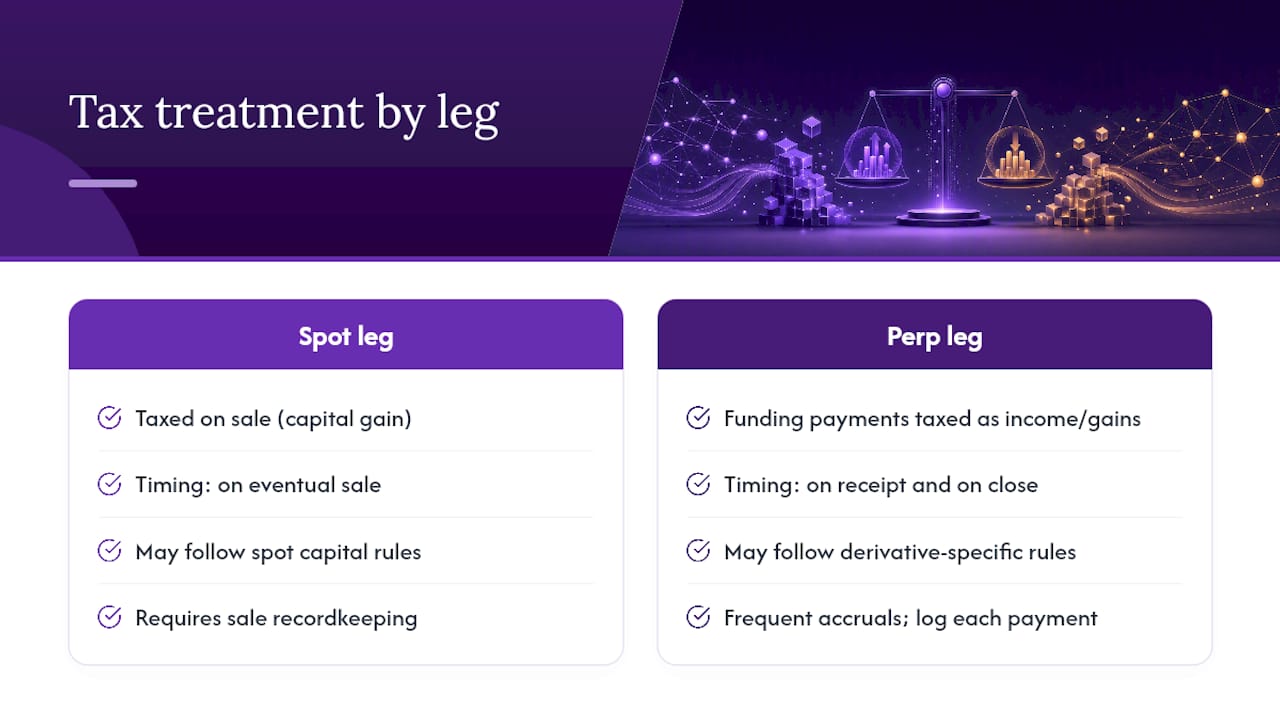
Funding payments received from a short perpetual position are generally treated as taxable income or gains in most jurisdictions that tax cryptocurrency activity, though the specific classification (ordinary income versus capital gain, and the timing of recognition) varies by country and sometimes by how the exchange classifies the instrument.
The delta-neutral structure of the trade does not exempt it from tax reporting. Even though the strategy is designed to minimize directional price exposure, both the spot and perp legs can generate separate taxable events: the spot position on eventual sale, and the perp position on funding receipts and any realized gains or losses when the contract is closed. Some jurisdictions treat derivative gains differently from spot capital gains, which means the two legs of the same arbitrage trade might be taxed under entirely different rules.
Record-keeping becomes more demanding with this strategy than with a simple buy-and-hold position, since funding payments accrue frequently, sometimes multiple times a day, and each one may need to be logged and valued at the time of receipt for accurate reporting. Traders running this at any meaningful scale should maintain detailed transaction logs across every exchange involved and consult a tax professional familiar with derivative and cryptocurrency taxation in their specific jurisdiction, since general guidance cannot substitute for advice tailored to individual circumstances and local law.
What Actually Separates Profitable Funding Arbitrage From Losing Money
The gap between traders who make this work and those who quietly bleed capital rarely comes down to finding a better funding spread. It comes down to whether they modeled costs honestly before entering. A lot of retail guidance on funding rate arbitrage treats the funding rate as the whole story, when in practice the hedge ratio and settlement timestamp mismatches do more damage to real returns than most people expect going in.
The conventional advice, “find high funding and short the perp,” skips the part that actually determines whether the trade survives: what happens when funding compresses to near zero for two weeks, or when the basis widens because one exchange’s spot price lags the other during a volatile stretch. Traders who treat this as a one-time setup rather than a monitored, rules-based position are the ones most likely to give back their gains during exactly the kind of rate flip that a basic alert would have caught.
Prioritize the boring stuff first: get your notional matching exact, confirm your cost threshold before you enter a single trade, and build the automated triggers before you need them, not after a loss teaches you why they matter.
Darkbot: Systematic Execution for Funding Rate Arbitrage
Running funding rate arbitrage by hand means watching funding rates across multiple exchange tabs, manually calculating matched notional, and reacting to rate flips after they have already cost you money. Darkbot replaces that manual monitoring loop with rule-based automation: you define the funding threshold, the hedge ratio tolerance, and the rebalance triggers, and the system executes according to those rules consistently, without the lag of manual checking.
This fits the operational reality of the strategy covered throughout this guide. Funding rate arbitrage rewards discipline and punishes hesitation during a rate flip or a widening basis, and that is exactly the kind of repeatable, rule-driven execution that automation handles better than a trader watching six browser tabs. Darkbot’s real-time analytics and automated rebalancing let you enforce the same cost threshold and hedge-ratio checks on every position, every time, rather than relying on memory or discretion under pressure.
If you are ready to move from manual monitoring to a structured, rules-based approach, explore Darkbot’s platform and start by configuring risk parameters around a single funding-arb position before scaling to multiple exchanges and pairs.
Sources
- Funding rate arbitrage (Kraken Learn)
- Crypto carry (BIS working paper)
- Funding rate mechanics and bot examples (Binance Support)
FAQ
Is Funding Rate Arbitrage Profitable?
It can be, when funding stays persistently above your all-in cost threshold (fees, slippage, and margin opportunity cost), but returns depend on funding differentials that can compress or flip without warning.
Does Crypto Arbitrage Still Work in 2026?
Structural frictions such as convenience yields and limited arbitrage capital, documented in BIS research on crypto carry, mean funding differentials continue to appear, though they require active monitoring and cost discipline to capture reliably.
Is Financial Arbitrage Illegal?
Arbitrage itself is a legal trading activity in most jurisdictions, but access to specific instruments like perpetual futures and the tax treatment of gains vary by country, so traders should confirm local rules for derivatives and reporting.
What Are the Three Types of Arbitrage?
Common categories include spatial or cross-exchange arbitrage (price differences across venues), triangular arbitrage (cycling through currency or token pairs on one exchange), and statistical arbitrage (trading a correlation or relationship expected to revert); funding rate arbitrage is a distinct, delta-neutral variant built around derivative funding payments rather than price gaps.
Can Automation Improve Funding Rate Arbitrage Execution?
Yes. Platforms like Darkbot apply rule-based triggers for hedge-ratio maintenance and rebalancing, which reduces the lag between a funding flip and a risk-control response compared to manual monitoring.
Recommended

Start trading on Darkbot with ease
Come and explore our crypto trading platform by connecting your free account!
Free plan available • No credit card required