Crypto Risk Management Checklist: A Trader's Guide
TL;DR:
- A risk management checklist is essential for cryptocurrency traders to systematically identify, score, and prioritize trading risks. Regular reviews and clear ownership ensure controls are effective, reducing reactionary trading and hidden vulnerabilities in volatile markets. Automating these rules through trading platforms enhances consistent risk control amid rapid market fluctuations.
A risk management checklist is a structured framework that identifies, scores, and prioritizes trading risks so that every exposure has a defined owner, a treatment strategy, and a review date. For cryptocurrency traders, this framework is not optional. Digital asset markets combine extreme price volatility, exchange counterparty risk, regulatory uncertainty, and cyber threats into a single portfolio. Without a systematic checklist for risk assessment, traders react to events rather than anticipate them. The most effective checklists use a 1-to-5 scoring matrix for likelihood and severity, assign clear ownership to each mitigation task, and schedule quarterly reviews to stay current with fast-moving market conditions.
1. What are the essential components of a risk management checklist?
A complete risk management checklist covers five core risk categories: market volatility, liquidity, exchange reliability, cyber threats, and regulatory compliance. Each category requires documented exposures, not just labels. A trader who lists “exchange reliability” without specifying which platforms carry concentrated exposure has not completed the checklist.

Within each category, the checklist records specific risks and scores them. The 1-to-5 scoring matrix multiplies likelihood by severity to produce a priority score. Scores of 15 or higher fall into the high or extreme range and require immediate action. Scores below 8 can be monitored rather than treated urgently.
Controls belong in the checklist alongside each risk. Stop-loss orders, position size limits, and exchange diversification are all controls. Each control entry should state what it does, who owns it, and when it was last verified.
- Market volatility: Document maximum drawdown tolerance per asset and per portfolio.
- Liquidity risk: Record minimum acceptable 24-hour trading volume thresholds for each position.
- Exchange reliability: List exchanges used, their custody model, and the percentage of funds held on each.
- Cyber threats: Confirm two-factor authentication, API key restrictions, and withdrawal whitelist status.
- Regulatory compliance: Track jurisdiction-specific reporting requirements and flag assets with unclear legal status.
Pro Tip: Assign a named owner and a resolution deadline to every risk line item. A living risk register with clear owners converts documentation into decisive action and prevents analysis paralysis.
2. How to use risk scoring and treatment strategies
The scoring matrix produces a ranked list of risks. Traders should address every risk scoring 15 or higher before executing new positions. Risks scoring 8–14 require a defined treatment plan but not necessarily immediate suspension of trading. Risks scoring below 8 move to a watch list with a scheduled review date.
Four treatment strategies apply to every scored risk. Avoidance, reduction, transfer, and acceptance each serve a different purpose, and mitigation through reduction is the most commonly applied method for maintaining trading continuity.
Avoidance means exiting or refusing to enter a position entirely. A trader who identifies a token with no verifiable liquidity data avoids that asset. Reduction applies controls that lower either the likelihood or the severity of a loss. Stop-loss orders, position sizing based on the 1–2% rule, and portfolio rebalancing all reduce risk. Transfer shifts exposure to another party. Limiting funds on any single exchange, using insured custody solutions, or distributing holdings across wallets transfers platform concentration risk. Acceptance is a deliberate decision to hold a risk without active treatment, but it requires predefined trigger points that escalate the risk back to active mitigation if conditions worsen.
| Treatment strategy | Best applied when | Crypto trading example |
|---|---|---|
| Avoidance | Risk exceeds tolerance entirely | Exiting an illiquid altcoin position |
| Reduction | Risk is manageable with controls | Setting stop-loss and position size limits |
| Transfer | Exposure can be distributed | Splitting funds across multiple exchanges |
| Acceptance | Risk is low and cost of control is high | Holding minor regulatory uncertainty on a small position |
Pro Tip: After applying any control, calculate the residual risk score. Ignoring what remains after mitigation leads to unexpected losses even when automated controls are active.
3. What is the recommended review cycle for a crypto risk checklist?
Quarterly reviews are the minimum standard for maintaining a risk management plan in cryptocurrency trading. Quarterly cycles capture evolving threats such as exchange vulnerabilities, asset liquidity changes, and new regulatory guidance. Markets move faster than annual reviews can track.
Ad-hoc reviews are equally important. Any major market event, such as a sharp drawdown exceeding your documented tolerance, a protocol exploit, or a regulatory announcement affecting held assets, triggers an immediate checklist update. Waiting for the next scheduled cycle after a significant event compounds exposure.
Post-trade reviews feed directly into the checklist. Failing to reset stops or rebalance after a period of high volatility leads to compounding, unaccounted losses. Each completed trade cycle should produce at least one checklist update: a revised score, a changed control, or a confirmed owner.
- Review all risk scores and confirm they still reflect current market conditions.
- Verify that every control is still active and functioning as intended.
- Confirm ownership assignments are current, especially after any change in trading team structure.
- Update regulatory compliance entries to reflect any new jurisdiction-specific guidance.
- Document the rationale for any score or control change made during the review.
Pro Tip: Documenting the rationale behind each risk control decision is not administrative overhead. Without clear reasons on record, traders abandon sound rules during high-stress periods, which increases net exposure precisely when discipline matters most.
4. Common pitfalls that undermine checklist effectiveness
The most common failure in risk management is a checklist that grows too long to use. A risk analysis checklist with 40 line items and no priority ranking gets ignored. Traders should cap active risk items at a number they can genuinely review in one session, typically 10–15 high-priority entries, and move lower-priority items to a separate watch list.
Ownership gaps are the second major failure. A risk with no named owner has no accountability. When market conditions shift, unowned risks receive no response. Every line item needs a person responsible for monitoring it and a date by which the treatment action must be completed or reviewed.
Over-mitigation is a less obvious but real problem. Applying controls to every low-impact risk consumes time and capital that could be directed at genuine exposures. A trader who sets stop-losses so tight that normal volatility triggers exits repeatedly is not managing risk. That trader is creating a new operational risk through excessive friction.
Monitoring digital asset market risk continuously, rather than only at review intervals, closes the gap between scheduled updates and real-time conditions. Automated alerts tied to price thresholds, volume drops, or exchange status changes give traders the data needed to trigger ad-hoc checklist reviews without constant manual monitoring.
Integrating checklist findings into an automated trading platform enforces discipline at the execution layer. When stop-loss levels and position size limits from the checklist are programmed directly into a trading bot, the rules execute without requiring a trader to act under pressure. That separation of decision-making from execution is where systematic risk control produces its most consistent results.
Key takeaways
A crypto risk management checklist works only when it combines scored priorities, named owners, defined treatment strategies, and a disciplined review cycle.
| Point | Details |
|---|---|
| Use a scoring matrix | Multiply likelihood by severity on a 1-to-5 scale; treat scores of 15 or higher immediately. |
| Apply four treatment strategies | Avoidance, reduction, transfer, and acceptance each fit different risk types and tolerance levels. |
| Review quarterly at minimum | Ad-hoc reviews after major market events keep the checklist current between scheduled cycles. |
| Assign ownership and deadlines | Every risk line item needs a named owner and a resolution date to drive actual action. |
| Evaluate residual risk | After applying controls, recalculate the remaining exposure to confirm it fits within your tolerance. |
Why I treat the checklist as a trading instrument, not a compliance form
Most traders build a risk checklist once and file it. That is the wrong mental model. A checklist that does not change after a losing trade or a market disruption is not a risk management tool. It is a record of what you thought the risks were before you had real data.
The most useful thing I have seen traders do is write one sentence next to each control explaining why that specific rule exists. Not what it does, but why it was chosen over alternatives. That sentence is what keeps the rule in place when a position is moving against you and the temptation to override the stop is real. The rationale behind each control is the discipline mechanism, not the control itself.
AI-powered automation adds a layer that manual checklists cannot replicate: consistent execution under conditions where human judgment degrades. When a bot enforces position size limits and stop-loss levels derived from your checklist, those rules apply identically at 2:00 AM during a flash crash as they do during calm trading hours. That consistency is not about removing trader judgment. It is about protecting the decisions you made when your judgment was clear from the decisions you might make when it is not.
The checklist and the automation system are not separate tools. The checklist defines the rules. The automation enforces them. Traders who treat those two elements as one integrated risk management framework tend to maintain more consistent exposure control across market cycles than those who rely on either tool alone.
— Grisha
How Darkbot supports systematic risk control in crypto trading
Structured risk rules only produce consistent results when they are enforced at the execution layer, not just documented in a spreadsheet.
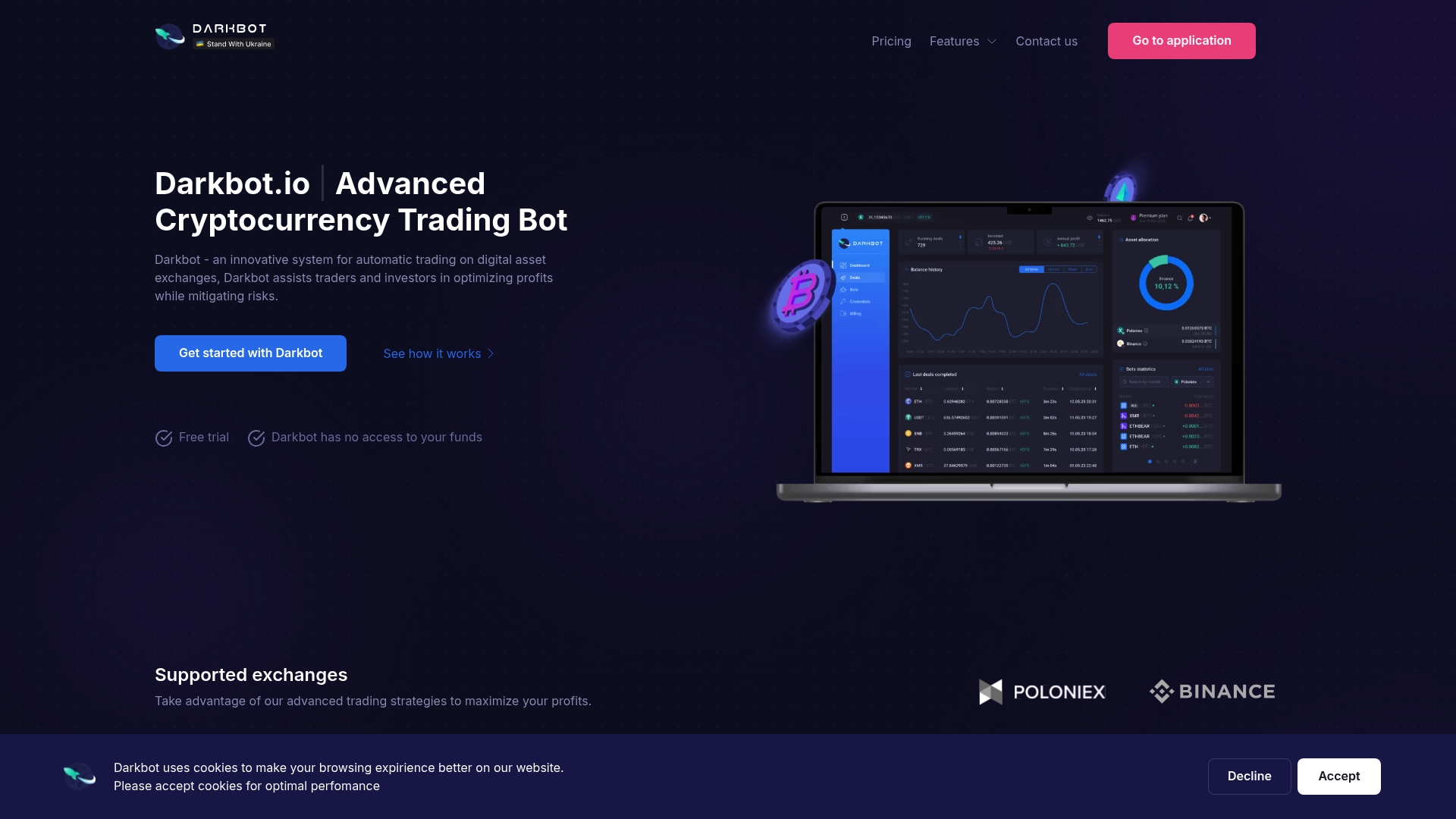
Darkbot is an AI-powered cryptocurrency trading automation platform built around systematic execution and rule-driven risk control. Traders configure stop-loss thresholds, position size limits, and rebalancing triggers directly into the platform, and the system applies those parameters across every trade without manual intervention. The AI layer evaluates patterns and adapts execution logic within the boundaries you set, maintaining consistency across sessions and market conditions. For traders who have built a structured automated trading checklist, Darkbot provides the execution infrastructure to enforce it. The platform supports multiple exchanges via API integration and offers portfolio management tools designed for traders who prioritize repeatable process over reactive decision-making. Learn more at Darkbot.
FAQ
What is a risk management checklist in crypto trading?
A risk management checklist is a structured document that identifies specific trading risks, scores them by likelihood and severity, assigns treatment strategies, and tracks ownership and review dates. It converts risk awareness into repeatable, auditable action.
How often should a crypto risk checklist be reviewed?
Quarterly reviews are the recommended minimum, with ad-hoc updates triggered by major market events, exchange incidents, or significant changes in portfolio composition.
What does residual risk mean for crypto traders?
Residual risk is the exposure that remains after controls such as stop-losses or position limits are applied. Traders must verify that residual risk stays within their defined tolerance before continuing to trade.
How many risks should a crypto checklist include?
Active checklist items should stay within a range that one trader can review in a single session, typically 10–15 high-priority entries. Lower-priority risks move to a watch list with scheduled review dates rather than cluttering the active register.
How does automation support a risk management plan?
Automation enforces checklist-defined rules at the execution layer, applying stop-loss levels and position size limits consistently across all market conditions without requiring real-time manual decisions.
Recommended

Start trading on Darkbot with ease
Come and explore our crypto trading platform by connecting your free account!
Free plan available • No credit card required