10–20 Minute TWAP for Crypto Traders: How Darkbot Runs It
A TWAP bot splits a large crypto order into smaller pieces executed at regular intervals over a set time window, so the average fill price tracks the time-weighted average price rather than moving the market with one block trade. It fits traders who need systematic, repeatable execution on sizable or recurring orders. It fits less well in thin or highly volatile markets unless paired with added risk controls.
TL;DR:
- TWAP is best suited for large orders relative to order book depth, with typical durations of 10-20 minutes and 10-20 slices for liquid crypto pairs.
- Market volatility, fee structures, and order book thinness significantly influence optimal slice size, timing, and risk controls.
- Implementing strict data quality monitoring, adaptive pause rules, and fee-aware sizing helps mitigate common crypto-specific execution risks.
- Using randomization in slice timing and size reduces pattern detection, while backtesting and paper trading are essential before live deployment.
- Limited benefit exists in complex variants like VWAP for most crypto pairs, making TWAP the default choice for predictable, repeatable execution horizons.
What TWAP Does and Why Traders Use It
TWAP (time-weighted average price) divides a parent order into equal child orders spaced evenly across a chosen duration. The simplest version is a straight division: order size divided by the number of intervals, submitted at each tick regardless of volume or price.
The point of slicing is market impact. A single large order can move a thin order book and generate slippage against the trader’s own position. Spreading that order over time lets liquidity replenish between fills.
TWAP suits specific conditions in crypto markets:
- Order size that is large relative to visible order book depth on the target exchange.
- A trader who wants a predictable, benchmarkable execution rather than an opportunistic one.
- An execution horizon measured in minutes to hours, where waiting for better prices is less important than consistent exposure building.
TWAP Settings and Parameters Traders Must Choose
A TWAP bot’s behavior comes down to a handful of parameters, and each one trades off against another.
- Total duration: how long the parent order runs. Longer windows reduce per-slice market impact but increase exposure to price drift.
- Slice interval or child count: how often orders fire. More, smaller slices reduce footprint but raise the number of fee events.
- Child order size: usually total size divided evenly, though some implementations randomize size slightly.
- Order type and time-in-force: limit versus market, and whether unfilled slices use immediate-or-cancel (IOC) or fill-or-kill (FOK) policies.
- Price variance or limit band: a ceiling or floor beyond which a slice pauses rather than fills at a bad price.
Duration versus exposure is the central trade-off. A 30-minute TWAP on a volatile asset accepts more price drift risk than a 5-minute one, but a 5-minute window on a large order risks more impact. Slice size versus fees matters because exchanges charge per trade. Too many tiny slices can erode the benefit of reduced impact through added taker fees. Limit orders reduce slippage risk but introduce fill risk if price moves away from the limit band.
A reasonable starting point for liquid pairs is a 10 to 20 minute duration with 10 to 20 slices, tightened for high realized volatility and widened for calmer conditions.
Pro Tip: Size your variance band to recent realized volatility rather than a fixed percentage, so the bot tightens automatically when the market gets choppier.
Implementation Architecture for a Crypto TWAP Bot
Building or auditing a TWAP bot means thinking through the full execution pipeline, not just the slicing math.
- Market data layer: a WebSocket feed for live prices and order book depth, with REST polling as a fallback when the socket disconnects.
- Order manager: tracks parent order state, child order status, and remaining size across the execution window.
- Risk engine: enforces price variance bands, position limits, and kill-switch conditions independently of the execution loop.
- Execution loop: fires child orders on schedule, checks fill status, and retries or cancels based on configured logic.
- Logging and metrics: records every slice, fill price, latency, and fee for later analysis.
Data quality controls matter as much as the execution logic. Stale-data detection should flag when a feed has not updated within an expected window, and reconciliation should cross-check exchange order book data against any secondary price reference before firing a slice.
On execution tactics, adding small randomization to slice timing and size (jitter) reduces the chance that other market participants detect and trade against a predictable pattern. Latency budgets should be set per exchange, since a slow submit loop on a fast-moving order book increases slippage. Fee-aware sizing adjusts slice count downward when per-trade fees would outweigh the impact reduction from finer slicing. Retry and cancel logic needs explicit rules for partial fills rather than assuming each slice fills completely.
Pro Tip: Test the execution loop against a simulated matcher with injected latency before running it against a live exchange, since real network conditions rarely match a clean backtest.
TWAP vs VWAP: How They Differ and When to Prefer Each
TWAP slices an order evenly across time.
- TWAP is simpler to implement and more robust when volume patterns are unpredictable, which is common across many crypto pairs outside the largest ones.
- VWAP can track the market more closely when volume forecasts are accurate, but crypto volume curves are often noisy, especially on pairs without consistent daily patterns, which weakens VWAP’s advantage in practice.
- Advanced methods: research on optimizing VWAP execution directly with deep learning shows that models optimizing the execution objective directly can reduce slippage compared with traditional volume-curve forecasting, particularly across diverse crypto assets and longer horizons. These approaches require more data infrastructure and ongoing validation than TWAP, so the added complexity is justified mainly for larger, recurring execution programs.
Execution Risks and Mitigation Strategies
A TWAP bot inherits several crypto-specific failure modes beyond the slicing logic itself.
- Data or oracle lag: a delayed price feed can cause a slice to fill at a stale reference price.
- Thin order books: even sliced orders can move price on low-liquidity pairs, especially during low-volume hours.
- Pattern detection: predictable, evenly spaced orders can be identified and traded against by faster participants.
- Fee and rebate erosion: excessive slicing on fee-heavy exchanges can offset the market-impact savings.
- Partial fills and API errors: unfilled or partially filled slices need explicit handling or the parent order drifts from its intended size.
Mitigations map directly to these risks: kill-switch thresholds that halt execution when price moves beyond a set band, stale-data detection that pauses the bot rather than trading on an old quote, adaptive pause rules tied to realized volatility, and fee-aware cost calculus built into the slicing logic itself. Partner research on slippage estimation provides models for quantifying price impact that apply directly to sizing these thresholds.
Regulators have flagged that crypto trading platforms may lack standard investor protections, and the SEC’s Investor Bulletin on crypto exposure advises caution given the speculative nature of these assets. That makes independent monitoring, not platform trust alone, a necessary layer of any execution system. Our guide to key risks in automated trading covers these operational failure points in more detail.
Monitoring should track fill rate against expected slices, realized slippage against the TWAP benchmark, latency percentiles per exchange, and profit and loss attributed specifically to execution quality rather than market direction.

Best-Practice Checklist: Metrics, Tests, and Operational Controls
A TWAP bot is only as reliable as the testing and controls behind it.
- Track implementation shortfall: the gap between the decision price and the actual average fill price.
- Measure realized slippage against the TWAP benchmark itself, not just against arrival price.
- Monitor fill rate: the percentage of slices that complete as intended versus those that require retries.
- Watch latency percentiles, since tail latency on a handful of slices can disproportionately affect total execution cost.
- Run scenario backtests across different volatility regimes before deploying a new parameter set.
- Paper trade under realistic latency and fee models, not idealized fills, before going live.
- Use versioned configs and role-based API keys so changes to execution parameters are tracked and access is limited.
- Conduct routine post-mortems after any execution that deviates meaningfully from the benchmark.
Our guide to automating crypto trading walks through platform setup steps that support this kind of structured testing.
How Darkbot Operationalizes TWAP
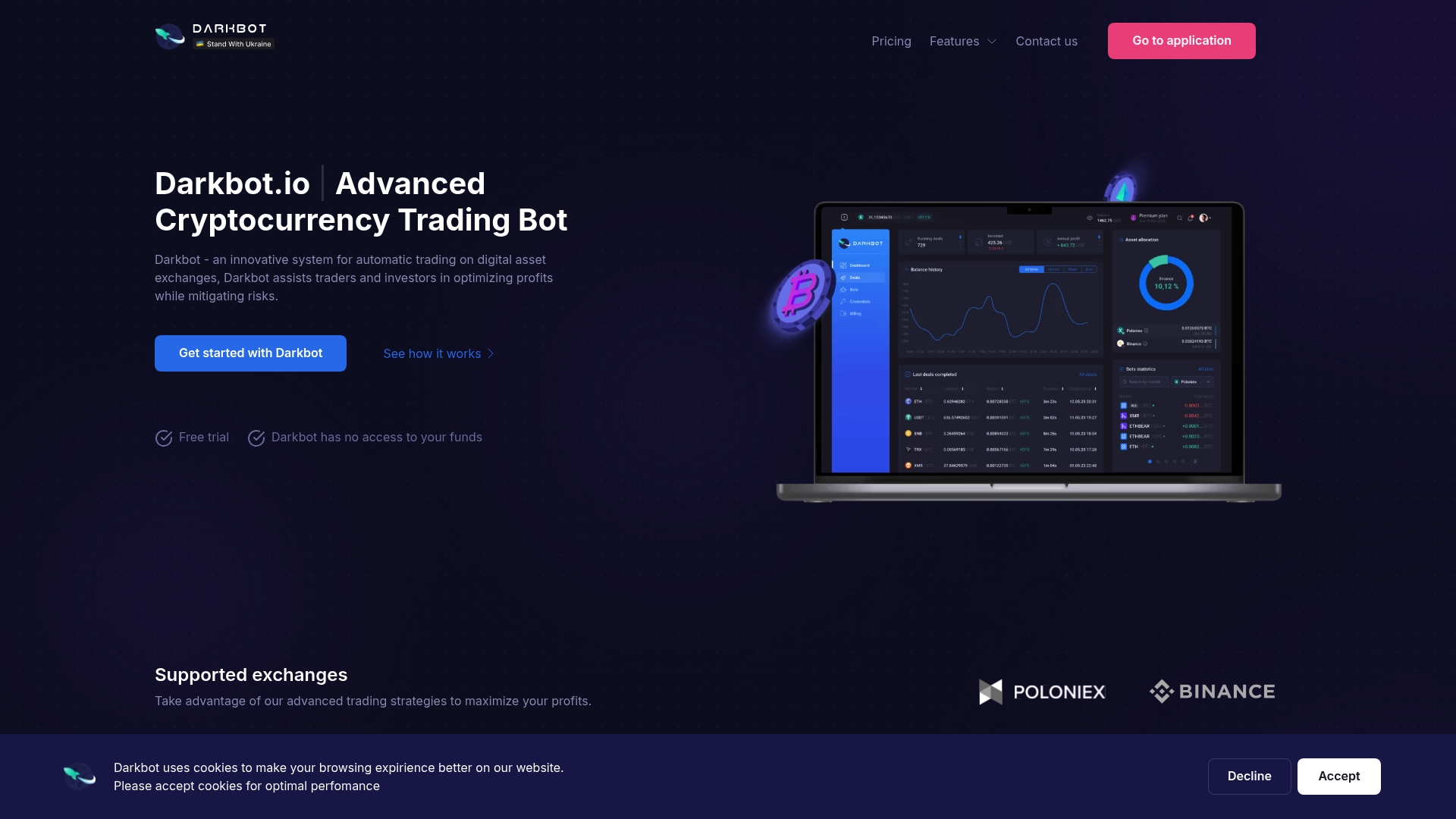
Our platform is built around execution discipline as described in this checklist, applied through a managed interface rather than custom code. API integration connects to digital asset exchanges for direct order routing, and backtesting and paper trading tools let traders validate a TWAP configuration against historical and simulated conditions before committing capital.
- The platform supports running multiple simultaneous bots, allowing a TWAP strategy to operate alongside other automated positions under shared portfolio oversight.
- A risk engine applies configurable thresholds, including stale-data checks and fee-aware sizing, consistent with the mitigations described above.
- Real-time analytics and audit logging provide visibility into every slice and fill, with human oversight retained at each stage rather than full automation without review.
A practical starting sequence is to paper-trade a TWAP configuration, validate the fill pattern against expectations, enable kill-switches, and only then move to a small live campaign. Our risk management guide details how these controls fit into a broader risk framework.
Practitioner Perspective: When TWAP Still Makes Sense in 2026
TWAP remains the right default for execution horizons that are clear and repeatable, and for traders who weigh fee structure as heavily as price impact. Hybrid or machine-learning approaches earn their added complexity mainly on long horizons or when cross-exchange signals meaningfully improve fills, as reinforcement-learning research on optimal execution suggests. Absent that, incremental rollout and careful measurement beat a more complex system that is harder to audit.
— Grisha
How to Try Darkbot: Pricing and Getting Started
We offer a free tier alongside our Standard Plan at $12.50 per month and Premium Plan at $25.00 per month, with Enterprise pricing available on request.
- Backtest a TWAP configuration against historical data before committing any capital.
- Enable paper trading to confirm fill behavior under realistic conditions.
- Turn on risk controls, including stale-data detection and kill-switch thresholds, before running live.
Support is available for onboarding questions as users move from backtest to live execution.
This article is general information, not a substitute for advice from a qualified financial advisor. Consult a qualified financial professional about your own circumstances before acting on anything here.
FAQ
Which crypto bot is most profitable?
No independent, verified data supports naming a single most profitable crypto bot, since results depend on strategy, market conditions, and risk settings rather than the bot itself. Evaluate any bot by execution quality metrics like slippage and fill rate rather than profitability claims.
Is TWAP a good indicator?
TWAP is an execution benchmark and method, not a predictive indicator. It measures and targets the average price over a time window, which makes it useful for assessing execution quality rather than forecasting price direction.
What does TWAP mean on Coinbase?
On exchanges that offer it, TWAP refers to an order type that splits a larger order into smaller pieces executed at set intervals over a chosen duration, aiming to approximate the time-weighted average price rather than filling all at once.
Is TWAP or VWAP better?
Neither is universally better: TWAP is simpler and more robust when volume patterns are unpredictable, while VWAP can track the market more closely when volume forecasts are accurate. In many crypto pairs, noisy volume curves favor TWAP’s simplicity over VWAP’s added forecasting complexity.
Sources
These academic papers, regulatory guidance, and developer resources informed the execution and risk details above.
- Deep Learning for VWAP Execution in Crypto Markets
- Exchange-Traded Products (ETPs) Providing Exposure to Bitcoin and Ether – Investor Bulletin
Recommended

Start trading on Darkbot with ease
Come and explore our crypto trading platform by connecting your free account!
Free plan available • No credit card required