What is a crypto bot? A complete guide to automated trading

Most traders assume a crypto bot is a money-printing machine. Set it up, walk away, and watch profits roll in. That assumption is wrong, and it costs people real money. Crypto bots are sophisticated automation tools that execute trades based on logic, not luck. They remove emotion from the equation, keep you active in markets around the clock, and enforce discipline that most manual traders struggle to maintain. Whether you’re just starting out or running complex multi-exchange strategies, understanding how these bots actually work is the foundation for using them well.
Key Takeaways
| Point | Details |
|---|---|
| Crypto bots automate trades | They use algorithms to execute buys and sells based on set rules or strategies. |
| Strategy and risk matter | Success with bots depends on the strategy chosen and having robust risk controls in place. |
| Expect realistic results | Bots can boost efficiency but do not guarantee profits, and market risks remain. |
| Start simple and secure | Beginners should begin with basic strategies, paper trading, and strong security measures. |
What is a crypto bot?
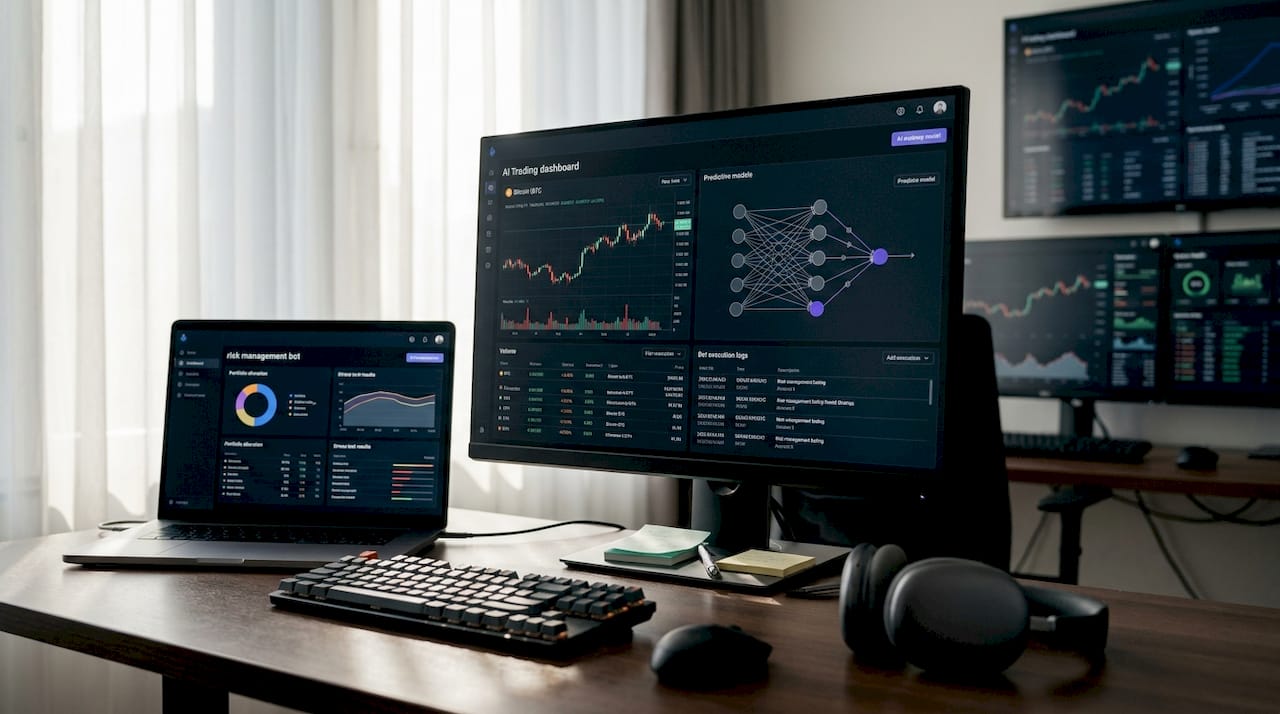
A crypto trading bot is software that automatically executes trades on cryptocurrency exchanges based on predefined rules, strategies, or signals. Think of it as a tireless trading assistant that never sleeps, never panics, and never second-guesses itself at 3 a.m. when Bitcoin drops 8%.
“A crypto trading bot is software that automatically executes trades on cryptocurrency exchanges based on predefined rules, strategies, or signals.”
Bots follow logic you define. That logic can be built on technical indicators like moving averages or RSI, external price signals, or even machine learning models. The core goal is consistent, emotion-free execution across any market condition. Individual retail traders use them, and so do institutional desks managing millions. The crypto trading bot advantages go beyond convenience. They include enforced discipline, faster execution than any human, and the ability to run multiple strategies simultaneously without fatigue.
How do crypto bots work?
Bots connect to your exchange account through API keys, which act like a secure handshake between the bot software and the exchange. They never need your password. Once connected, the bot enters a continuous operational loop.
Here is what that loop looks like in practice:
- Monitor: The bot pulls real-time price data, order book depth, and volume from the exchange.
- Analyze: It runs that data through your chosen indicators or strategy rules.
- Signal: When conditions match your criteria, it generates a buy or sell signal.
- Execute: The order is placed automatically, often in milliseconds.
- Manage risk: Position size limits, stop-losses, and leverage caps are applied per your settings.
Bots operate in a loop: monitor data, generate signals, execute orders with risk management, then repeat. This cycle runs continuously, adapting to new price data without you lifting a finger. You can learn more about the full process in this guide on how to automate crypto trading for maximum efficiency, and explore the crypto trading optimization process that experienced traders use to push returns higher.
Common crypto bot strategies
Not every strategy works in every market. Choosing the right one is as important as choosing the right bot. Here is a breakdown of the most widely used approaches.
| Strategy | Best market condition | Risk level | Skill required |
|---|---|---|---|
| Grid trading | Sideways/ranging | Low to medium | Beginner |
| DCA (Dollar-Cost Averaging) | Any, long-term | Low | Beginner |
| Arbitrage | Any | Medium | Intermediate |
| Trend-following | Strong directional | Medium to high | Intermediate |
| Mean reversion | Ranging | Medium | Advanced |
| AI-enhanced models | Any | Variable | Advanced |
Grid trading, DCA, arbitrage, trend-following, mean reversion, and AI-enhanced models are all common strategies deployed by bots today. Grid trading places buy and sell orders at fixed price intervals, profiting from natural price oscillation. DCA invests a fixed dollar amount at regular intervals, smoothing out your average entry price over time. Arbitrage bots scan multiple exchanges simultaneously and exploit tiny price differences before they close.
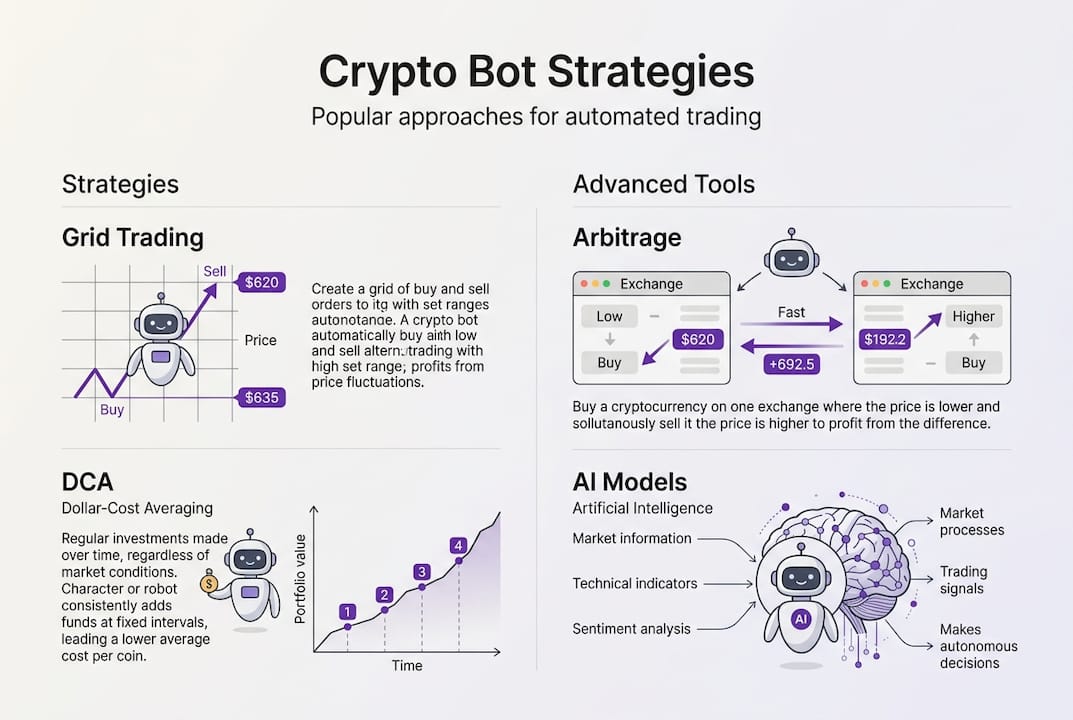
Trend-following bots ride momentum, entering long positions in bull runs and short positions in downtrends. Mean reversion bets that prices will snap back to their historical average after an extreme move. AI-enhanced bots use statistical models and pattern recognition to adapt their behavior as market conditions shift.
Pro Tip: Start with grid or DCA bots if you’re new. They are simpler to configure, easier to monitor, and less likely to blow up your account during unexpected volatility. Explore popular automated trading strategies and the types of trading bots to find the right fit for your goals.
Performance: Returns, risks, and realities
Here is where expectations need a reality check. Bot performance data exists, and some of it is impressive. But context matters enormously.
| Platform/Study | Reported return | Timeframe | Notes |
|---|---|---|---|
| Pionex grid bot | +112% | 12 months | Bull market conditions |
| 3Commas | +98% | 12 months | Strategy-dependent |
| AI model studies | Up to 193% ROI | Selective periods | Highly curated results |
These empirical benchmarks are real, but they come with important caveats. Returns are net of fees and slippage only in the best-case scenarios. Many studies cherry-pick favorable periods. A bot that returned 112% in a bull market may lose 40% in a prolonged bear market using the same settings.
Volatility is a double-edged sword. It creates the price swings bots profit from, but it also amplifies losses when a strategy breaks down. Review crypto bot benchmarks and performance across platforms before committing capital.
The biggest risks to watch for include:
- Market shocks: Flash crashes or sudden regulatory news can trigger cascading losses.
- Strategy decay: A strategy that worked last quarter may stop working as market dynamics shift.
- API failures: Exchange outages or API rate limits can leave orders stuck or unexecuted.
- Fee drag: High-frequency bots can rack up significant trading fees that eat into returns.
Pro Tip: Always backtest your strategy on historical data before going live. Then forward-test with small capital. Strategy optimization with automation is an ongoing process, not a one-time setup. Understanding why automate crypto strategies also helps you set realistic expectations from day one.
Risks, security, and risk management best practices
Using a bot does not eliminate risk. It shifts where the risk lives. Instead of emotional trading mistakes, you now face technical and configuration risks. Here is how to manage both.
Security is the first priority. Always generate API keys with trading permissions only. Disable withdrawal permissions entirely. This means even if your API key is compromised, an attacker cannot move your funds off the exchange. Use two-factor authentication on both your exchange account and your bot platform.
Key risk management rules every bot trader should follow:
- Limit risk to 1-3% of total capital per trade, never more.
- Use non-custodial bots where possible, meaning the bot never holds your funds directly.
- Set hard stop-losses at the strategy level, not just per trade.
- Diversify across strategies and assets rather than concentrating in one bot.
- Review bot mistakes to avoid before you go live.
Pro Tip: Paper trading (simulated trading with fake money) is your best friend before risking real capital. Most reputable platforms offer it. Use it for at least two to four weeks to validate your strategy under real market conditions. Explore smart crypto risk management and dedicated risk management for trading bots to build a solid safety framework.
How to get started with a crypto bot
Getting started is simpler than most people expect. The key is sequencing your steps correctly so you build confidence before risking real money.
- Choose a reputable platform. Look for platforms with strong security track records, transparent fee structures, and active user communities. Avoid anything promising guaranteed returns.
- Connect your exchange via API. Generate a restricted API key on your exchange. Grant trading permissions only. Never enable withdrawals.
- Start with paper trading. Run your chosen strategy in simulation mode. Novices should start with simple DCA or grid bots and paper trade first before committing real funds.
- Pick a strategy that matches your market view. If you expect sideways price action, grid trading fits. If you want long-term accumulation, DCA is your tool.
- Set strict position limits. Cap each trade at a small percentage of your total capital. Use stop-losses.
- Monitor and adapt. Check performance weekly. Markets change, and your strategy should evolve with them.
Review this trading bot setup tutorial for a step-by-step walkthrough, and bookmark the trading bot basics reference for ongoing learning.
Explore automated trading with advanced crypto bots
If you’ve made it this far, you now understand what crypto bots actually do, how they work, and what realistic expectations look like. The next step is putting that knowledge into practice with the right tools.
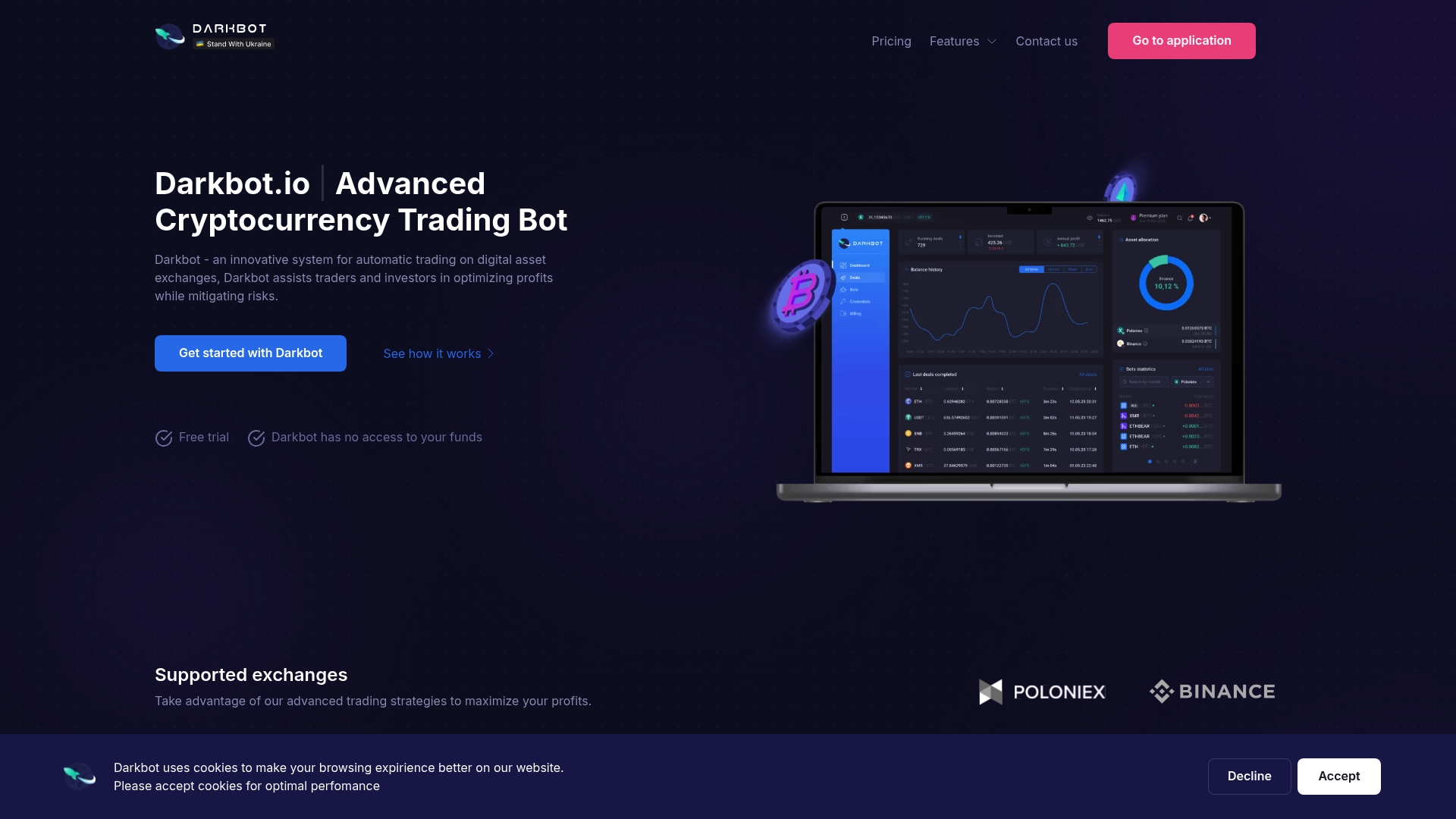
Darkbot.io offers AI-powered automated trading built for both beginners and experienced traders. The platform connects seamlessly to major exchanges via API, supports multiple simultaneous strategies, and includes real-time analytics so you always know how your bots are performing. For traders focused on long-term growth, the crypto portfolio management tools handle automated rebalancing and risk controls so your portfolio stays aligned with your goals. Plans start free, with premium tiers unlocking advanced AI features and priority support.
Frequently asked questions
Are crypto bots legal and safe to use?
Crypto bots are legal in most jurisdictions and safe when used on reputable platforms. Proper API key security and restricted permissions are essential to protect your funds.
Can a crypto bot guarantee profits?
No bot can guarantee profits. Performance claims are often inflated, and actual results depend heavily on market conditions, strategy quality, and risk management.
What strategies do crypto bots typically use?
Grid trading, DCA, arbitrage, and AI strategies are the most common. Each suits different market conditions and risk tolerances, so matching strategy to market context is critical.
Is it possible for beginners to use crypto bots effectively?
Yes. Novices should start with simple bots like DCA or grid strategies, use paper trading to practice, and apply strict risk controls before scaling up with real capital.
Recommended

Start trading on Darkbot with ease
Come and explore our crypto trading platform by connecting your free account!
Free plan available • No credit card required