Crypto Rebalancing Tools: Test First, Disable Withdrawals
Crypto rebalancing tools can combine exchange API integration with rules you can configure, backtest, and paper trade first. We recommend starting with Darkbot.io, where trade-only API keys, portfolio management, and automated rebalancing sit in one platform. This article explains how to choose, set up, and validate a tool before you scale it.
TL;DR:
- Limit API keys to trading or reading, add a second login factor and IP allowlisting, and verify custody, rehypothecation, and insurance terms before connecting.
- Investor.gov cites intervals of six or twelve months, or preset drift thresholds; choose thresholds when volatility and trading costs make calendar trades inefficient.
- Paper trade first, review action logs across several cycles, change one setting at a time, and scale only when orders follow your rules.
- A 2026 study found that models accounting for costs reduced turnover and improved performance adjusted for risk; widen thresholds or pause trades when liquidity thins.
Why Darkbot.io fits the job of automated crypto rebalancing
Rebalancing is a repeatable, rule-driven task, which is exactly what automation does well. Our platform connects to supported exchanges through API keys, while the rebalancing logic runs. The capabilities that matter for this job:
- API exchange integration across major digital asset exchanges
- Automated rebalancing against target allocations you define
- Portfolio management with real-time analytics
- Backtesting and paper trading to examine rule behavior before committing capital
- Risk management tools and several simultaneous bots
We use AI and machine learning as a mechanism for consistent, rule-driven execution and probabilistic pattern evaluation. We are not a signal provider, and nothing here is a prediction of returns.
Our pricing page lists a Free plan, a Standard Plan at $12.50 per month, a Premium Plan at $25.00 per month, and an Enterprise tier. That ladder suits small-scale testers and active managers alike. Current prices are on our pricing page.
Pro Tip: Generate API keys with trade-only permissions and never enable withdrawals. A rebalancing tool has no need to move funds off the exchange.
What rebalancing methods do investors actually use?
Rebalancing means restoring your original allocation after price moves cause holdings to drift. Investor this way and notes that experts generally recommend doing it on a regular interval, such as every six or twelve months, or when an asset drifts beyond a preset threshold. The same agency also describes calendar-based and threshold-based approaches and says rebalancing enforces a buy-low, sell-high discipline.
The methods a tool should support:
- Calendar-based: rebalance at fixed intervals regardless of drift. Simple to audit, but it can trade when nothing needs fixing.
- Threshold-based: rebalance only when an asset’s weight leaves a band you set, for example, a preset drift band around the target allocation.
- Contribution-based: direct new deposits to underweight assets, which avoids selling and reduces taxable events.
- Continuous monitoring: an always-on system that makes smaller, frequent adjustments. It suits actively managed portfolios, provided cost controls are in place.
The trade-off is frequency against turnover. Every trade carries fees and may carry tax consequences, so more frequent rebalancing is not automatically better. For a deeper primer, see our explainer on what rebalancing in crypto means.
How should you evaluate a rebalancing tool?
Rank candidates against a fixed checklist rather than a feature count. In order of priority:
- Exchange integration and permission model. Confirm which exchanges and wallets are supported and that keys can be scoped to trade-only or read-only.
- Supported rule types. Look for calendar, drift-threshold, and contribution-based rules, with custom asset weighting.
- Backtesting and paper trading. You should see how a rule would have behaved and watch it run with no capital at risk.
- Risk controls and trade sizing. Per-trade caps, minimum trade sizes, and the ability to pause the bot.
- Cost transparency. Clear subscription pricing, a free or trial tier, and some account of how execution costs vary with market conditions.
- Usability, logging, and support. Readable action logs and reachable support matter the first time a rule behaves unexpectedly.
Pro Tip: Run the same target allocation through two tools on paper before choosing. Differences in how each handles minimum order sizes and partial fills show up quickly.
Our guide to automated portfolio management covers how backtesting and paper trading fit into this evaluation.
How do you set up automated rebalancing step by step?
Follow a test-first sequence so each stage confirms the one before it:
- Create least-privilege API keys. Enable trade or read access only, restrict by IP address where the exchange allows it, and store the secret in a password manager.
- Start with paper trading or a very small live allocation you can afford to see behave imperfectly.
- Define your target allocation. Pick asset weights, then choose a trigger: calendar interval or drift threshold.
- Set per-trade caps and a minimum trade size so small drifts do not generate fee-heavy orders.
- Backtest the rules where possible and compare the outcome with your expectations.
- Review action logs for several rebalance cycles. If every order matches the rule you wrote, scale gradually.
Pro Tip: Change one parameter at a time. If you alter the threshold and the trade cap together, you cannot tell which change produced the new behavior.
For procedural depth, our walkthrough on portfolio rebalancing for crypto traders goes through each trigger type in detail.
How do transaction costs and market regimes affect rebalancing?
Execution costs are not constant. A 2026 MDPI paper on cryptocurrency portfolio management argues that transaction costs depend on market state and proposes geometry-based cost models and dissipation penalties. In its experiments, accounting for state-dependent costs reduced turnover and improved risk-adjusted performance across multiple crypto assets.
The paper finds that execution costs are state-dependent, and that models accounting for this cut turnover while improving risk-adjusted results. The practical meaning: a rule that is cheap to follow in a calm market can be expensive in a turbulent one.
How to apply this:
- Widen drift thresholds during high-volatility periods so fewer, larger corrections replace many small ones.
- Use a circuit-breaker that delays rebalancing when spreads widen or liquidity thins.
- Prefer contribution-based rebalancing when costs are elevated, since new deposits can correct drift without selling.
- Treat the threshold itself as a cost decision, not only a risk decision.
What should you check on custody and security before automating?
Automation extends trust to a third party, so verify before you connect. Investor.gov’s custody bulletin stresses that crypto assets are highly volatile, that platforms are generally less regulated than traditional securities exchanges, and that investors should ask whether a service rehypothecates client assets. FINRA adds that theft is a significant risk and that you should research custodians, security practices, and insurance disclosures.
Your checklist:
- Use trade-only or read-only API keys, and confirm the vendor never requires withdrawal access.
- Ask about rehypothecation, commingling of assets, and the terms of any insurance.
- Enable multi-factor authentication on the exchange and the tool.
- Use IP allowlisting where available.
- Confirm audit logs exist and that a support channel with defined response times is available.
Our write-up on crypto trading bot security expands on each of these controls.
What does real-world evidence on automated rebalancing show?
Honest evidence is narrower than marketing suggests. We do not cite individual performance results here, because outcomes depend on the assets chosen, the period measured, the thresholds used, and the costs paid. What exists is guidance and research on the mechanism.
Investor.gov’s asset allocation guidance points to target-date funds as an everyday example of automatic rebalancing, and it notes that more frequent rebalancing increases turnover. That is the core real-world lesson: automation removes the discipline problem but not the cost problem. The MDPI research above supports the same conclusion from the crypto side, since turnover reduction was where cost-aware models showed their benefit.
If you want your own case study, build one. Run a paper-trading portfolio for several rebalance cycles, record every order, and compare calendar and threshold rules on identical allocations. Note turnover, fees paid, and how far the portfolio drifted between rebalances. That record tells you more about your own situation than any published headline number.

Investors who also hold longer-term yield positions sometimes look at adjacent approaches, such as the structured strategies OverseasDeFi teaches for generating yield on holdings, and weigh them alongside a rebalancing rule set.
How do machine learning and AI improve automated rebalancing?
Used carefully, machine learning adds consistency to the decision rather than foresight. Three roles are worth understanding:
- Probabilistic pattern evaluation. A model can estimate whether current conditions resemble past periods where rebalancing was costly, and adjust how aggressively rules fire.
- Rule-driven adaptation. Parameters such as thresholds and trade sizes can shift within limits you define, instead of staying fixed in every market state.
- Always-on monitoring. Software watches drift continuously and can act in smaller increments than a person checking weekly.
The research direction matches this. The MDPI paper uses deep reinforcement learning combined with a cost model, and its reported gains came from lower turnover, not from forecasting prices. That distinction matters: AI here is a mechanism for execution quality and repeatable logic, never a promise of profit.
Practitioners moving toward always-on systems generally advise starting with small allocations to verify platform behavior before scaling. We agree, and our portfolio balancing guide for automated trading describes how to set the limits within which any adaptive logic operates.
A conservative rollout beats a clever one
Most rebalancing problems come from skipping validation, not from choosing the wrong tool. Paper trade first, then go live with a small allocation, and read the logs until every action matches the rule you wrote. Only then scale. Put security controls and cost-aware thresholds in place before size, because an error at larger size is the expensive kind. A boring, documented rollout is the whole advantage of systematic execution.
— Grisha
Trial Darkbot.io for automated rebalancing
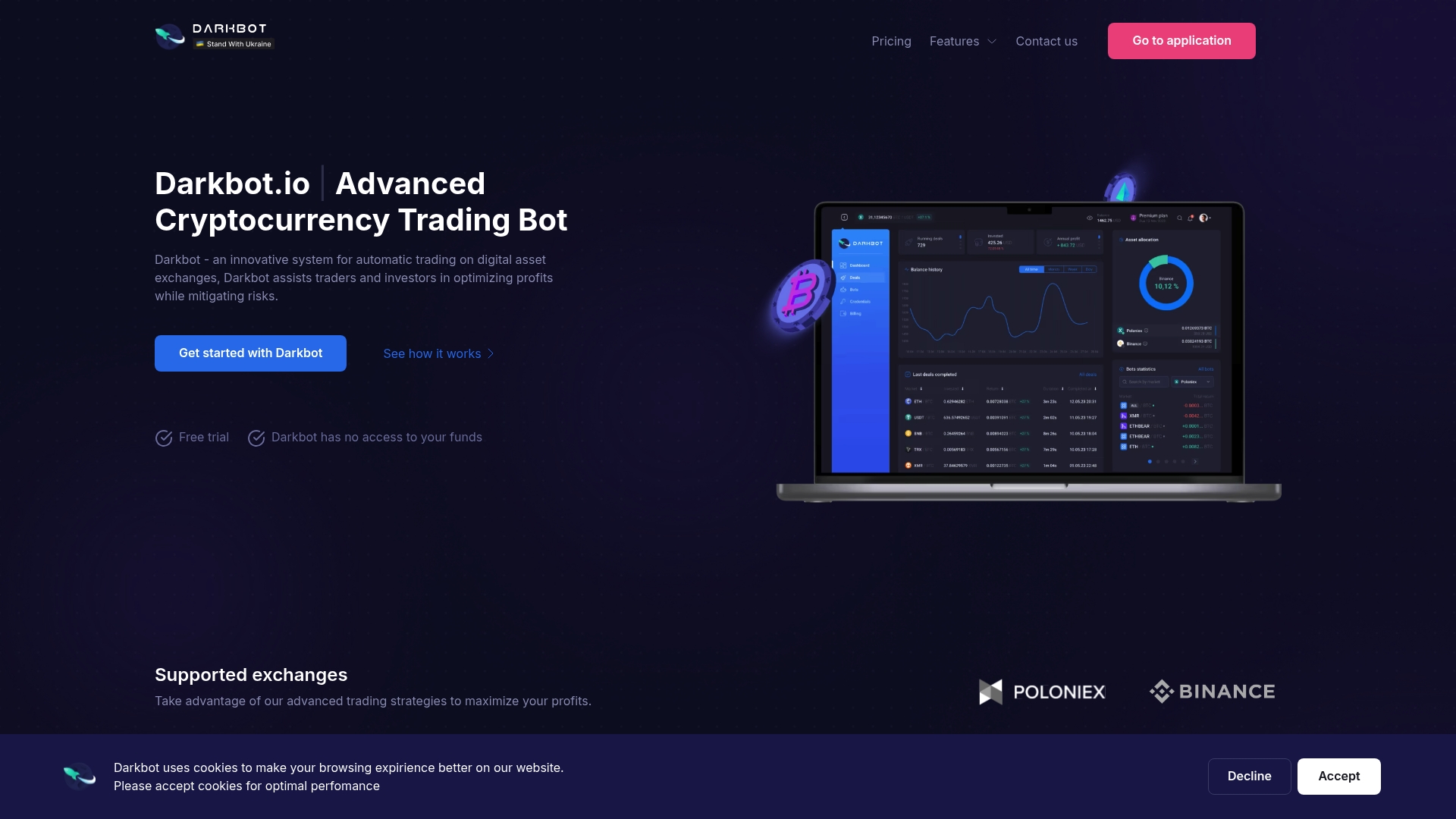
Create an account, connect an exchange with trade-only API keys, and use paper trading to validate your rebalancing rules. When you are ready to compare features, our pricing page lists every plan and the next steps.
FAQ
Which crypto portfolio tracker app is the best?
The best fit depends on whether you need tracking only or automated execution. For rebalancing, prioritize exchange API support, backtesting, and trade-only permissions, then paper trade two candidates before committing.
How often should you rebalance a crypto portfolio?
Investor.gov notes that experts generally recommend a regular interval, such as every six or twelve months, or a preset drift threshold. Crypto volatility often favors threshold rules, balanced against fees and taxes.
Is automated rebalancing safe for my exchange account?
It can be, if you use trade-only or read-only API keys and never grant withdrawal access. Enable multi-factor authentication and IP allowlisting, and confirm the vendor’s custody and insurance terms.
Does rebalancing more often improve results?
Not necessarily. More frequent rebalancing raises turnover, and the MDPI research found that cost-aware models reduced turnover while improving risk-adjusted performance. Match frequency to costs and market conditions.
Sources
- Investor
- Deep Reinforcement Learning for Cryptocurrency Portfolio Management: A Free-Energy Framework with Geometry-Based Transaction Costs and Efficiency Bounds
Recommended

Start trading on Darkbot with ease
Come and explore our crypto trading platform by connecting your free account!
Free plan available • No credit card required