Crypto bot vulnerabilities: What every trader needs to know

TL;DR:
- Crypto trading bots face vulnerabilities beyond strategy, including remote code execution and supply chain risks, which can lead to full system compromise or credential theft. Proper security practices, such as permission isolation, frequent dependency audits, and strict API key management, are essential for resilience against both external attacks and operational failures. Robust monitoring, rate limit handling, and comprehensive recovery plans help traders prevent silent failures and maintain secure, reliable automated trading systems.
Automated trading promises efficiency, discipline, and round-the-clock execution. But most traders focus almost exclusively on strategy performance while underestimating a different category of risk entirely: crypto bot vulnerabilities. A poorly secured bot does not just lose trades. It can expose your API credentials, execute unauthorized orders, or sit silently broken while you assume it is working. This article breaks down the real attack surfaces in automated trading systems, from remote code execution flaws to operational logic failures, and gives you a practical framework for running bots that are resilient against both attackers and their own failure modes.
Key Takeaways
| Point | Details |
|---|---|
| Vulnerabilities go beyond trading logic | Weak access control, credential mishandling, and unvalidated inputs can let attackers hijack funds or bots. |
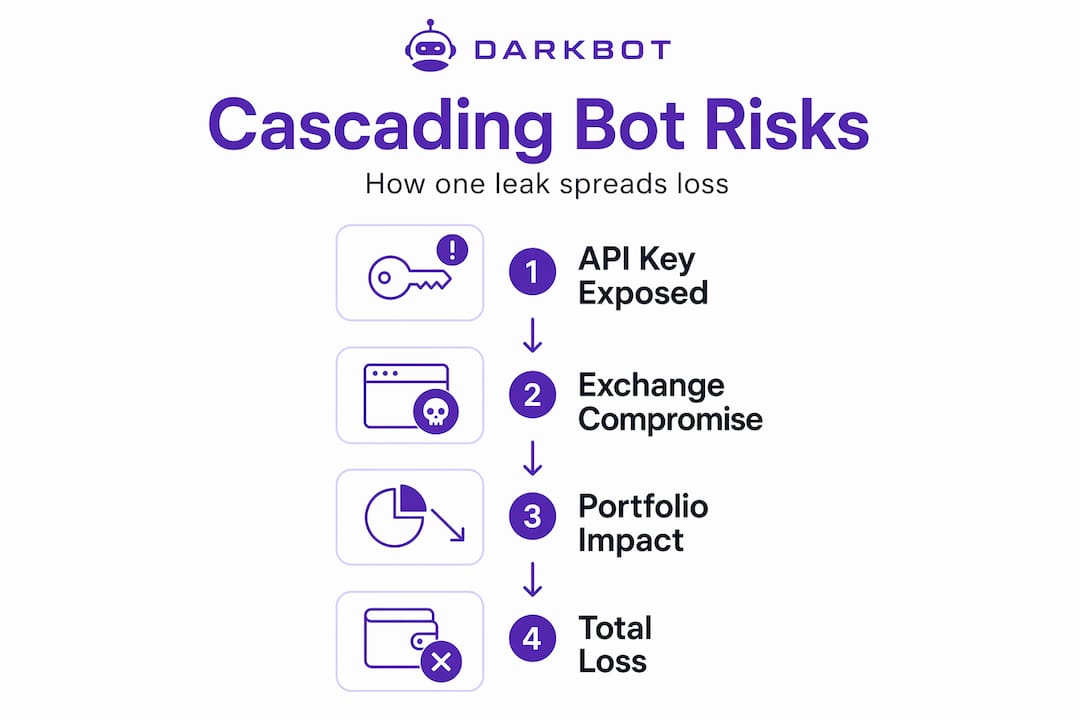
| API key security is critical | A single leaked API credential can cascade into complete account compromise and loss. |
| Operational discipline prevents hidden failures | State corruption, bugs, and unmonitored downtime often cost more than market losses. |
| Bot reliability depends on rate limit handling | Ignoring exchange rate policies results in missed trades and potential bans. |
| Defense-in-depth is essential | Layered permissions, regular audits, and alerts provide resilience no codebase alone can. |
How hackers exploit crypto bot vulnerabilities
Most traders think of key trading risks in terms of drawdowns and liquidation. The attack surface on a trading bot is a different problem entirely. It is not about market conditions. It is about software design, dependency management, and what happens when an attacker finds a single unguarded endpoint.
Command injection and remote code execution
One of the most severe categories of crypto bot vulnerabilities is command injection, where an attacker sends crafted input to an exposed API endpoint and the bot executes it as a system command. A command injection via /restore has been documented to lead to Remote Code Execution (RCE), meaning an attacker with authenticated access could run arbitrary code on the server hosting the bot. That is full machine compromise from a single endpoint.
The reason this matters beyond the obvious is that many self-hosted bots run with elevated system permissions. If the bot process can write files or call shell commands, so can the attacker who exploits it. RCE is not a theoretical risk. It is a documented, reproducible flaw in real trading bot codebases.
Supply chain attacks targeting trading agents
The threat does not always come through your own code. A malicious package via AI-generated commit was reported to target an autonomous crypto trading tool, meaning attackers are now embedding malicious logic into dependencies or even AI-assisted code contributions. This is a supply chain attack, and it is particularly dangerous because the malicious code arrives through a trusted channel: a software update.
For traders running open-source or self-managed bots, every dependency update is a potential attack vector. Most people never audit those updates. That is the gap attackers exploit.
Vulnerability comparison: What breaks and what it costs
| Vulnerability type | Attack method | Potential impact |
|---|---|---|
| Command injection (RCE) | Crafted input to exposed endpoints | Full server compromise |
| Supply chain attack | Malicious package or commit | Credential theft, fund loss |
| Authentication bypass | Weak or missing auth checks | Unauthorized trade execution |
| Input validation failure | Malformed API requests | State corruption or crashes |
| Excessive permissions | Overprivileged bot process | Lateral movement post-compromise |
The pattern across all of these is consistent: a single mistake in authentication, input validation, or permissions is enough. The bot automation risks that come from poor software hygiene compound quickly once an attacker has a foothold.
“The security of algorithmic trading systems depends not just on trading logic but on the full software stack, including endpoints, dependencies, and runtime permissions.” See how algorithmic trading security principles apply beyond just strategy design.
Pro Tip: Isolate your bot’s permissions at the OS and exchange level. The bot should only be able to do exactly what it needs to do, nothing more. Audit every dependency update before applying it, especially in actively maintained open-source projects.
API credential leaks: The silent killer of trading stacks
Software vulnerabilities get attention. Credential leaks are quieter, more common, and often more damaging. Understanding API security in trading is not optional if you are running automated systems.
How a single key becomes a full compromise
A trading bot typically connects to an exchange through an API key. That key authorizes trading, withdrawal (if enabled), and account data access. If that key is exposed, an attacker does not need to break any code. They simply use the key directly. Worse, many bot architectures share credentials across services or store them in plaintext configuration files.

The risk compounds further in multi-service setups. A SQL injection (CVE-2026-42208) in LiteLLM was reported to expose the credential table containing upstream API keys, with a CVSS score of 9.3 out of 10. That is near-maximum severity. One vulnerable gateway, and every connected service’s credentials are potentially in an attacker’s hands.
Cascading failures in interconnected systems
The architecture of modern trading stacks makes this worse. A bot might share an API key with a portfolio tracker, a notification service, and a logging tool. Compromise one, and the attacker has context for all of them. This is why API key integration design matters as much as the key itself.
Best practices for securing API credentials
| Practice | What it does | Priority |
|---|---|---|
| IP whitelisting | Restricts key use to known IP addresses | Critical |
| Least-privilege permissions | Limits key to trade-only, no withdrawals | Critical |
| Key rotation schedule | Reduces exposure window if leaked | High |
| Encrypted storage | Prevents plaintext credential exposure | High |
| Separate keys per service | Contains blast radius of a single leak | Medium |
A few specifics worth knowing: most major exchanges support IP security for API keys, which means you can restrict a key so it only works from your server’s IP address. An attacker who steals the key but cannot spoof your IP gets nothing.
- Never store API keys in version control, even private repositories
- Disable withdrawal permissions on all trading bot keys by default
- Rotate keys after any suspected exposure, no matter how minor
- Use separate keys for each bot or service, never shared credentials
- Monitor for unusual API activity, especially off-hours order patterns
Not just code: Operational and logic failure modes
Not every vulnerability comes from an attacker. Some of the most costly failures in automated trading come from within the bot itself, through logic errors, state corruption, and silent inactivity that nobody notices until real money is gone.
State machines and silent failures
A trading bot is a state machine. It moves between states: waiting, buying, holding, selling. If the bot enters an undefined state due to a network error, an unexpected API response, or a file corruption event, it may do nothing at all. Or worse, it may execute the wrong action repeatedly. These are risk management problems that no amount of strategy backtesting will catch.
One practitioner built a field guide from 17 bugs and 8,000 failed orders in production trading environments. The failures were not exotic. They were rounding errors, fee miscalculations, and order book desyncs that compounded over thousands of trades.
Common failure patterns from production deployments
- Rounding errors in order size calculations leading to rejected orders
- Fee assumptions that do not account for tiered or dynamic fee structures
- Order book desyncs where the bot acts on stale price data
- Silent inactivity: bot appears running but stops placing orders after an error
- State file corruption causing the bot to lose track of open positions
- Reconnection logic that fails silently after a WebSocket drop
The live trading risks that emerge in production are categorically different from what simulations reveal. Backtests assume perfect order fills, zero latency, and stable connectivity. Production assumes none of those things.
Using a trading risk checklist before deployment can catch many of these issues before they become expensive.
Pro Tip: Never trust simulated results alone. Run every new bot or strategy with a small live capital allocation and full monitoring before scaling. Set explicit alerts for inactivity, not just errors. A bot that goes quiet is often a bot that is broken.
The importance of rate limiting and exchange reliability
Even a perfectly written, fully secured bot can fail through its interaction with the exchange. Rate limiting is one of the most underestimated sources of trading disruption and, in some cases, account risk.
What rate limits actually mean for your bot
Exchanges enforce API rate limits to prevent abuse and protect infrastructure. Coinbase Cloud rate limits are documented as rolling 10-second windows: 500 requests per 10 seconds for write APIs and 600 requests per 10 seconds for read APIs. A bot that does not account for these limits will hit HTTP 429 errors, which means requests are rejected. During fast-moving markets, those rejected requests are missed trades.
The security angle is less obvious. A bot that hammers an exchange with excessive requests can trigger automated abuse detection, leading to temporary or permanent API key bans. That is an operational lockout, not a hack, but the result is the same: your bot stops working at the worst possible time.
How to implement safe rate limit handling
- Track your request count per rolling window in real time, not just per second
- Implement exponential backoff: wait longer after each consecutive 429 error
- Queue non-urgent requests and batch where the exchange API supports it
- Separate read and write request pools so market data polling does not crowd out order execution
- Log every rate limit event and review patterns weekly to identify inefficient request patterns
What happens when bots ignore exchange reliability signals
- Cascading 429 errors cause order submission delays during volatile periods
- Repeated limit breaches trigger exchange-side abuse flags on your API key
- Bots retry failed requests without backoff, amplifying the original problem
- Missed fills from failed requests create unintended open positions
- Lack of error logging means the problem goes undetected for hours or days
Proper market data integration design accounts for rate limits at the architecture level, not as an afterthought. The bots that handle exchange reliability well are the ones that stay operational when others go dark. See how institutional trading tools approach this problem for additional context.
Why “safe” bots are still risky: What most traders miss
Here is the uncomfortable reality: most security guidance for crypto bots stops at the code layer. Fix the injection vulnerability, rotate your API keys, and you are done. That framing is dangerously incomplete.
Real-world bot resilience is an end-to-end operational discipline, not a checklist you run once. The traders who survive long-term in automated markets are the ones who treat their bot infrastructure the way a systems engineer treats a production service: with layered defenses, documented failure modes, and explicit recovery procedures.
Consider what “least privilege” actually means in practice. It is not just about exchange API permissions. It is about which processes on your server can read the config file. It is about whether your logging service has write access to the bot’s working directory. It is about whether a compromised notification webhook can trigger a bot action. Most traders never think past the exchange API key.
The same applies to monitoring. Knowing your bot placed orders is not monitoring. Real monitoring means knowing when the bot did not place an order it should have, when latency spiked above a threshold, when a dependency returned an unexpected response. Silent failures are the ones that cost the most, precisely because nobody notices them.
The trading bot security guide covers the technical baseline well. But the mindset shift that separates resilient operators from fragile ones is this: assume every control can fail. Design for recovery, not just prevention. Automated alerts, redundant state backups, and rapid rollback procedures are not paranoia. They are the difference between a recoverable incident and a blown account.
Pro Tip: Build a written runbook for your bot that covers at least three failure scenarios: bot goes silent, API key is compromised, and exchange goes down. If you cannot describe your recovery steps in writing, you do not have a recovery plan.
How Darkbot helps protect your trading automation
Understanding vulnerabilities is the first step. Having infrastructure that addresses them systematically is what makes the difference in practice.
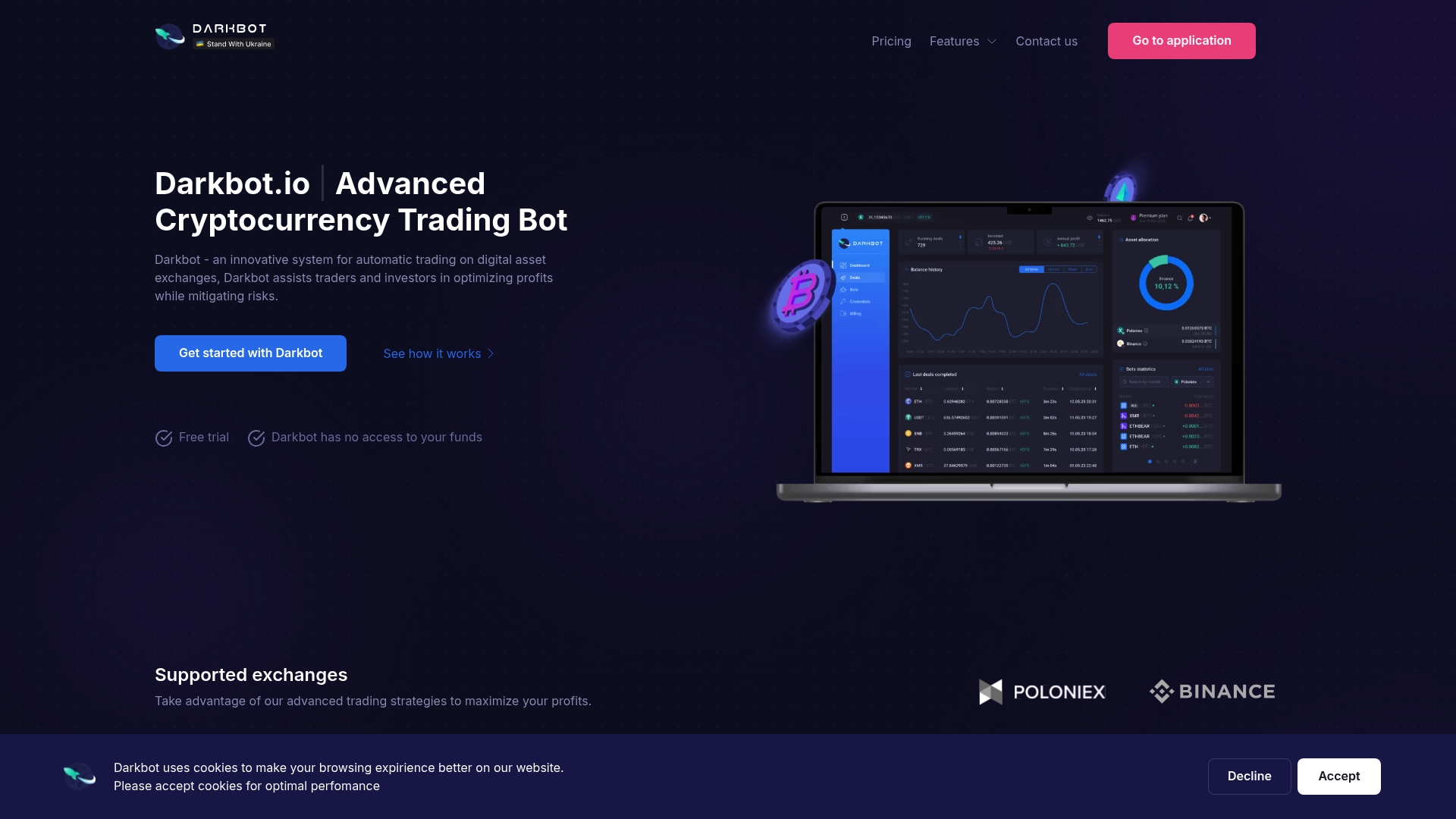
Darkbot is built with these operational realities in mind. The platform integrates permission-scoped API key management, meaning your exchange credentials are handled with access controls that limit exposure at every layer. Live monitoring surfaces bot activity, inactivity, and error states in real time, so silent failures do not go undetected. The portfolio management tools include granular access controls and error reporting designed for traders who need operational visibility, not just performance dashboards. If you are running automated strategies and want infrastructure that treats security as a design principle rather than an afterthought, Darkbot provides the framework to do that without building it yourself from scratch.
Frequently asked questions
What is the most common vulnerability in crypto trading bots?
Credential leaks and endpoint weaknesses are the most frequent and impactful issues. API credential exposure can cascade across entire trading stacks, while command injection flaws can give attackers full control of the bot’s host server.
How can rate limiting affect my trading bot’s performance?
Bots that do not properly manage exchange rate limits face failed trades, missed opportunities, and potential API key bans. Coinbase’s documented limits show how tight these windows are in practice, making proper backoff logic essential.
Are supply chain attacks a real risk for crypto trading bots?
Yes, and they are growing more sophisticated. A malicious package targeting a crypto trading tool was introduced through an AI-generated commit, showing that even trusted update channels can carry malicious code.
How can traders reduce the risk of operational failures in their bots?
Regular live testing with limited capital, explicit state validation, and inactivity alerts are the most effective defenses. A practitioner’s field guide built from 17 bugs and 8,000 failed orders shows that most production failures are predictable and preventable with proper monitoring.
Recommended

Start trading on Darkbot with ease
Come and explore our crypto trading platform by connecting your free account!
Free plan available • No credit card required