How machine learning affects crypto trading and risk

TL;DR:
- Machine learning has become central to crypto trading, shaping execution, risk management, and security strategies. Hybrid models leveraging on-chain data and real-time signals improve accuracy and adaptability in volatile markets. Continuous retraining, interpretability, and disciplined processes are essential for responsible and effective ML deployment.
Machine learning is no longer a background process in crypto. It sits at the center of how trades are executed, how risk is calculated, and how portfolios survive volatility. If you trade or invest in digital assets and you are not thinking about how machine learning affects crypto at a mechanical level, you are making decisions with an incomplete picture. Perpetual futures alone account for over 90% of crypto futures trading volume, and ML is applied end-to-end across those markets. This guide breaks down exactly where that influence shows up and what it means for your strategy.
Key Takeaways
| Point | Details |
|---|---|
| ML drives crypto execution | Machine learning powers over 90% of crypto futures trading volume by enabling fast, automated strategy execution. |
| Hybrid models enhance accuracy | Combining stochastic volatility models with deep learning and blockchain data improves forecast precision and trading performance. |
| Risk management benefits from RL | Reinforcement learning reduces portfolio turnover and drawdowns by adapting to volatile market regimes realistically. |
| ML improves fraud detection | Advanced graph-based ML methods detect suspicious blockchain activity more accurately than rule-based systems. |
| Interpretability is essential | Transparent ML models support regulatory compliance and effective hyperparameter tuning in crypto trading pipelines. |
Machine learning applications in crypto trading strategies
Having established the widespread integration of machine learning in crypto, let us examine its core applications in trading strategies. This is where the role of machine learning in crypto becomes most visible and most actionable for active traders.
ML models do several jobs at once in a modern crypto trading setup. They scan for entry and exit signals in price, volume, and order book data. They forecast short-term volatility to size positions correctly. And they execute trades at speeds no human can match. The combination is powerful, but only when the models are built with the right inputs.
One of the most significant advances in this space is the hybrid modeling approach. Standalone deep learning models like LSTMs are good at spotting patterns, but they miss the probabilistic structure of volatility. Stochastic volatility models like Heston capture that structure but fail on nonlinear dynamics. Combining them solves both problems. Hybrid Heston-LSTM models reduce forecasting error by 43% versus standalone models and deliver better risk metrics in high-frequency trading environments.
What makes this particularly relevant for crypto is the on-chain data layer. Unlike equities, crypto markets generate a continuous stream of blockchain signals that directly affect price behavior. ML techniques process nonlinear patterns and real-time blockchain signals like transaction volume and gas fees to capture crypto market volatility in ways traditional financial models simply cannot. If your machine learning in cryptocurrency setup is ignoring on-chain data, it is missing the most crypto-native signal available.
Key ML applications across trading strategy layers:
- Signal generation: Classification models identify bullish or bearish conditions based on price action, volume patterns, and sentiment data
- Volatility forecasting: Hybrid stochastic and deep learning models estimate short-term volatility for position sizing decisions
- Execution optimization: Reinforcement learning agents determine order timing and size to minimize slippage in thin order books
- Regime detection: Unsupervised clustering identifies market regimes so models can switch between aggressive and defensive configurations automatically
Pro Tip: If you are building or choosing a crypto automation setup, ask specifically whether the system retrains on live data or runs on a static model. Static models degrade fast in crypto.
| Model type | Best use case | Key limitation |
|---|---|---|
| LSTM (deep learning) | Pattern recognition, sequence data | Poor volatility structure |
| Heston (stochastic) | Volatility modeling | Misses nonlinear dynamics |
| Hybrid Heston-LSTM | High-frequency crypto trading | Higher computational cost |
| Reinforcement learning | Execution, portfolio rebalancing | Reward function design is complex |
Risk management and portfolio optimization through machine learning
Beyond signal generation, machine learning also shapes how portfolios manage risk and maintain efficiency amid crypto volatility. This is arguably where the impact is more durable, because a good signal means nothing if poor risk management wipes out the account before it pays off.

Reinforcement learning (RL) is the dominant framework here. Unlike supervised models that predict a single output, RL agents learn by interacting with the market environment, receiving rewards for good decisions and penalties for bad ones. For portfolio management, this means the agent continuously recalibrates position sizes and rebalancing frequency based on current market conditions rather than a static rule set.
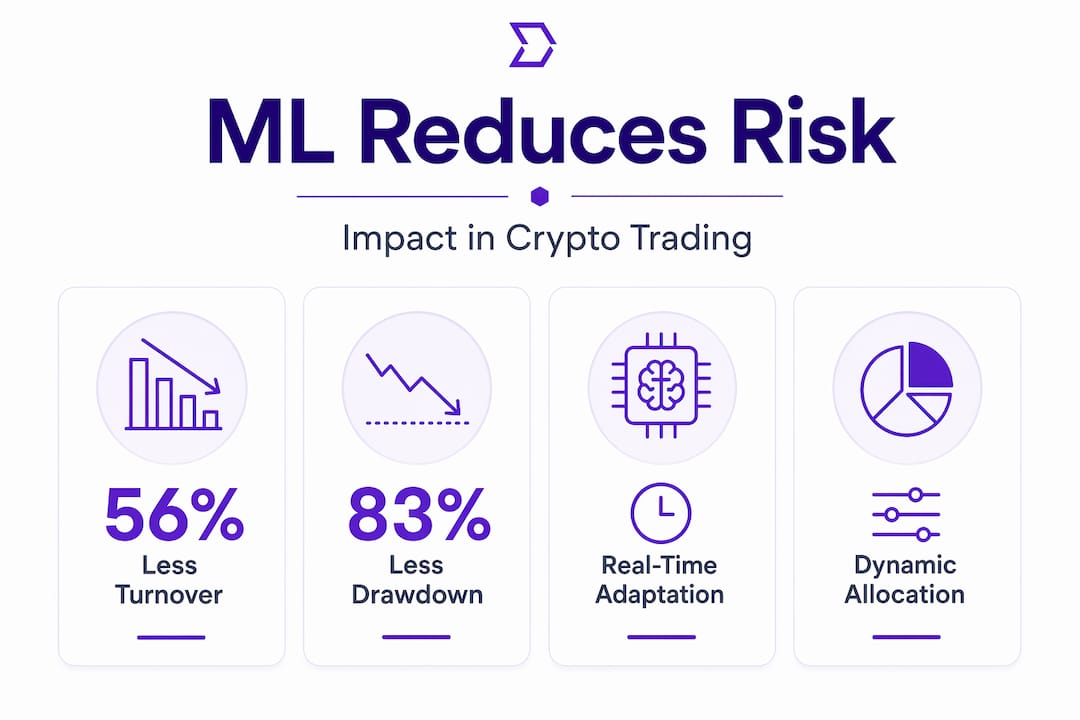
The results are measurable. Deep reinforcement learning frameworks reduce portfolio turnover by 56 to 83% and maximum drawdown by 28 to 38% across multiple crypto assets. That is not a minor efficiency gain. In a market where transaction costs compound quickly and drawdowns can trigger liquidations, those numbers directly affect whether a strategy survives a bear cycle.
One underappreciated detail is how transaction costs are modeled. Most backtesting frameworks assume a flat fee, which severely underestimates real-world friction in volatile conditions. Modeling transaction costs with geometric frameworks reflects crypto market volatility more realistically, improving how strategies perform when deployed live. If you are evaluating a machine learning in crypto investing solution and the backtests assume flat fees, treat those results with skepticism.
How ML-driven risk management frameworks operate:
- Observation layer: The agent ingests price, volume, volatility, and correlation data across all portfolio assets simultaneously
- Cost modeling: Transaction costs are calculated dynamically based on current spread and volatility, not a fixed assumption
- No-trade zones: The framework identifies conditions where the expected gain from a trade does not exceed friction costs, preventing overtrading
- Topological circuit breakers: Drawdown limits trigger position reduction automatically when portfolio risk exceeds predefined thresholds
- Reward function calibration: The agent is penalized for excessive turnover, aligning its behavior with realistic performance goals
Pro Tip: When evaluating any ML portfolio system, ask how it handles a flash crash scenario. A well-designed framework should reduce exposure automatically without requiring manual intervention. If the answer is “you set a stop loss manually,” the ML layer is not doing the risk management work.
| Risk metric | Standard approach | ML-driven approach |
|---|---|---|
| Max drawdown | Fixed stop-loss levels | Dynamic, regime-aware reduction |
| Portfolio turnover | Rule-based rebalancing | RL-optimized with cost penalties |
| Transaction cost modeling | Flat fee assumption | Geometric, volatility-adjusted |
| Regime adaptation | Manual strategy switching | Unsupervised regime detection |
For a detailed breakdown of maximizing trading efficiency with these frameworks, the relationship between observation data completeness and portfolio performance is worth studying closely.
Machine learning for fraud detection and security in cryptocurrency networks
Security and fraud detection represent another critical area where machine learning significantly impacts the crypto ecosystem. Understanding this layer matters for traders and investors because it affects the trustworthiness of the networks you are operating on.
Traditional rule-based fraud detection in crypto has a fundamental weakness: it cannot adapt. Peel chains, coin mixers, and cross-chain laundering schemes are designed specifically to defeat static heuristics. Rule-based systems struggle on peel chains and mixers precisely because these techniques exploit the predictable gaps in rule sets.
Machine learning solves this by learning the behavioral fingerprint of suspicious wallets rather than matching against a fixed list of prohibited actions. Graph embedding techniques treat the blockchain transaction network as a connected map of relationships, identifying clusters of wallets that behave like known fraud patterns even when the specific addresses have never appeared on a watchlist before.
The state-of-the-art example here is ETX2Vec. This algorithm combines temporal biased random walk strategies with graph embeddings to model how wallet activity evolves over time. ETX2Vec achieves 96.04% accuracy in Ethereum node classification, outperforming standard graph neural network models. The key signals it uses are particularly telling.
Key fraud indicators ML models track on-chain:
- Wallet lifetime: Fraudulent wallets tend to have abnormally short or highly concentrated activity windows
- Transaction value distribution: Laundering operations create distinctive patterns in how value is split and reassembled across wallets
- Fan-in and fan-out ratios: The number of incoming versus outgoing connections reveals mixer-style behavior
- Temporal clustering: Fraud patterns often involve rapid, high-volume activity in compressed time windows
- Cross-chain flow mapping: Advanced models now trace multi-hop movement across chains after exchange hacks
“The ability to detect fraud across temporal and relational dimensions simultaneously is what separates modern ML-based blockchain forensics from anything rule-based systems could achieve. It is the difference between matching a face to a photo and recognizing someone by how they walk.”
The AI role in crypto security extends well beyond trading signals. For institutional traders and larger portfolios, the integrity of the underlying network directly affects counterparty risk.
Challenges and best practices in applying machine learning to crypto trading
Understanding these challenges is critical for traders seeking to deploy machine learning responsibly and effectively. The gap between a well-marketed ML system and one that performs in live markets is wide, and the failure modes are specific.
The most fundamental challenge is non-stationarity. Crypto markets change their statistical character constantly. A model trained on a 2023 bull run will behave poorly in a 2024 sideways market and potentially catastrophically in a 2025 liquidity crunch. Non-stationarity and regime shifts cause model failures when static models are not retrained on current data. Continuous retraining is not optional. It is the maintenance requirement of any deployed ML system.
The second major issue is interpretability. When a model generates a trade signal or portfolio adjustment, professional traders need to understand why that decision was made. This is not just about curiosity. The black-box nature of ML models impedes hyperparameter tuning and regulatory transparency, which is why methods like SHAP (SHapley Additive exPlanations) are becoming standard in serious deployments. SHAP assigns each input feature a contribution score, showing you exactly which signals drove a specific decision.
Common failure modes and how to address them:
- Overfitting to historical data: Use walk-forward testing and out-of-sample validation periods that include different market regimes
- API outages and data latency: Build redundancy into data feeds and include staleness detection in model pipelines
- Signal decay: Monitor feature importance scores over time; signals that were predictive six months ago may have been arbitraged away
- Reward hacking in RL systems: Audit reinforcement learning agents for degenerate strategies that maximize the reward metric while violating the spirit of the trading objective
Pro Tip: Before deploying any ML model in live trading, run it through at least one major drawdown period in your backtesting data. A smarter crypto strategy is one that survives stress conditions, not just optimized conditions. If your model has no historical record of navigating a 40% market correction, you do not actually know what it will do when one happens.
For traders building a crypto automation workflow from scratch, governance documentation is worth the effort even if you are operating solo. When a model misbehaves at 3am, written protocols about when to pause, retrain, or revert are worth more than intuition.
Rethinking machine learning’s role in crypto trading: beyond prediction to disciplined execution
Here is an opinion you will not hear from most ML vendors: the goal of machine learning in crypto trading should not be to predict price. It should be to execute a consistent, rules-based process that human traders would execute inconsistently due to fatigue, fear, or greed.
The most common mistake traders make when adopting ML tools is evaluating them entirely on forecasting accuracy. But a model with 55% directional accuracy, applied consistently with proper position sizing, will outperform a model with 70% accuracy that gets switched off every time it has a losing streak. Consistency is the variable that matters most, and it is the one ML does better than humans by design.
The role of AI in trading success is fundamentally about reducing the variance in decision quality, not eliminating uncertainty. Markets are probabilistic. No model resolves that. What ML does is make sure you take the same bet, sized the same way, under the same conditions, every single time. That repeatability is what compounds over time.
Interpretability matters here too, and not just for regulators. A trader who understands why their model is making a specific bet can maintain conviction when it experiences a drawdown. A trader using a black box tends to panic-override the system at exactly the wrong moment. Transparency is not a compliance checkbox. It is a psychological tool that keeps the trader and the algorithm aligned.
The traders who get the most out of ML are the ones who treat it as a process layer rather than a prediction engine. They use model outputs to structure decisions, not to replace judgment entirely. That framing produces more sustainable results than chasing whatever model just had a good three-month backtest.
Explore Darkbot’s AI-powered crypto trading automation
If the research covered in this article reinforced one thing, it is that machine learning in crypto trading demands serious infrastructure, continuous adaptation, and disciplined risk controls. That is exactly what Darkbot is built for.
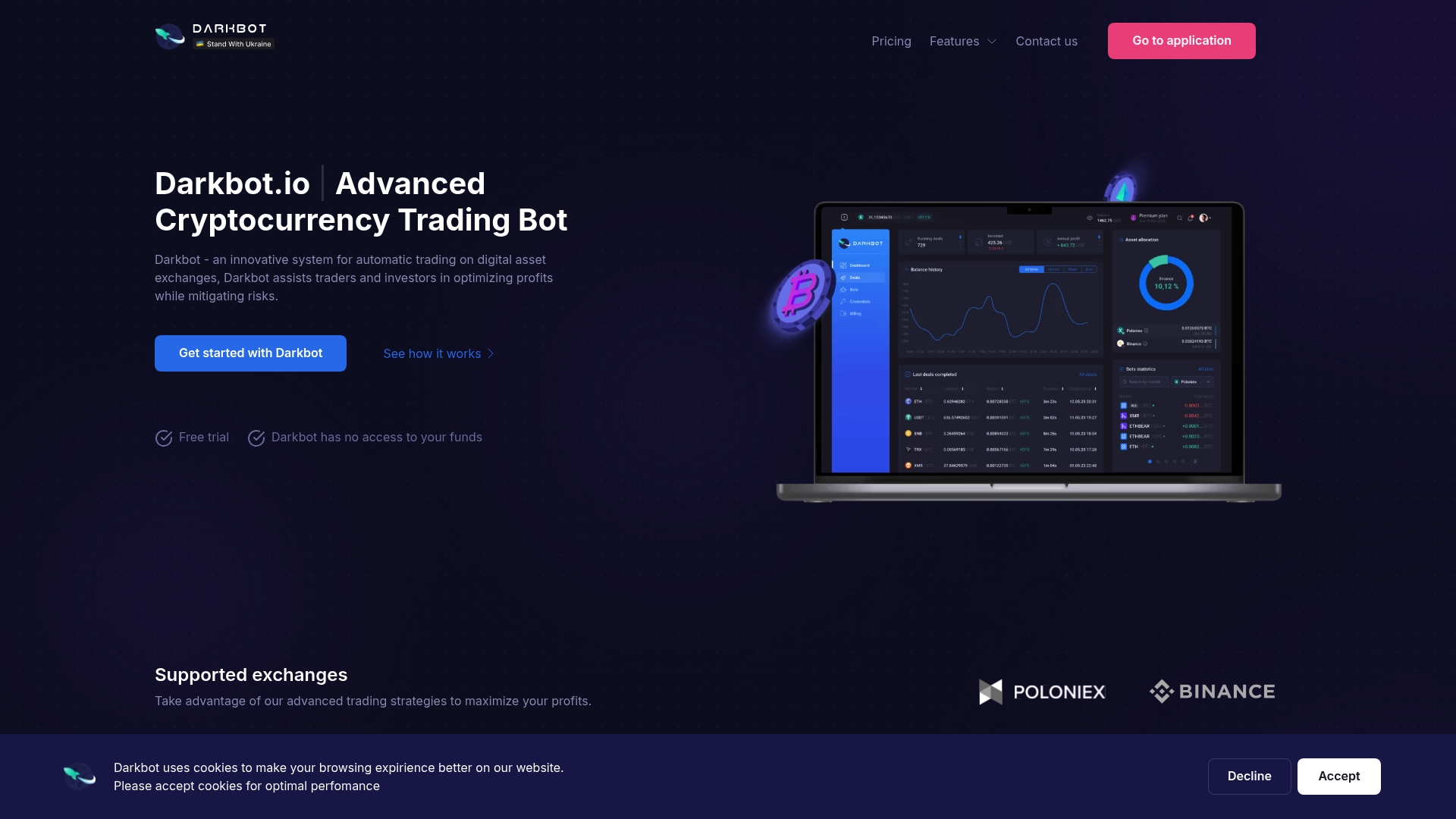
Darkbot’s platform applies AI-driven execution across multiple exchanges, with real-time strategy adaptation and portfolio risk controls built directly into the automation layer. You are not just running a bot. You are running a framework designed around the same principles covered here: regime awareness, transaction cost realism, and interpretable outputs that keep you in control. Whether you are managing a diversified crypto portfolio or running precision execution strategies, cryptocurrency portfolio management through Darkbot gives you the infrastructure to act on what machine learning actually delivers in live markets.
Frequently asked questions
How does machine learning improve cryptocurrency trading strategies?
ML models analyze complex patterns and real-time blockchain data to generate trading signals, forecast volatility, and automate execution with greater speed and consistency than manual methods. ML models process nonlinear patterns and real-time blockchain signals to improve crypto trading accuracy in ways that static, rule-based systems cannot replicate.
What role does machine learning play in managing risk in crypto portfolios?
Machine learning, particularly reinforcement learning, optimizes portfolio allocation by reducing unnecessary turnover and controlling drawdowns dynamically. Deep reinforcement learning reduces turnover by up to 83% and maximum drawdown by up to 38% across crypto assets, producing more capital-efficient portfolios.
Can machine learning detect fraudulent activity on blockchain networks?
Yes. Advanced ML algorithms use temporal dynamics and graph embeddings to identify suspicious wallet behavior with high accuracy, far beyond what rule-based heuristics can achieve. ETX2Vec achieves 96.04% accuracy in Ethereum fraud detection, outperforming other neural network models on this task.
What are the main challenges of applying machine learning in crypto trading?
The core challenges include model overfitting, market regime shifts, data quality issues, and the interpretability gap that creates compliance risk. Non-stationarity and data quality directly affect model accuracy, making continuous monitoring and retraining non-negotiable for production deployments.
Does machine learning guarantee profits in cryptocurrency trading?
No. Machine learning provides probabilistic insights and supports disciplined, repeatable execution, but it does not predict prices with certainty or guarantee returns. Its real value is in reducing decision variance and applying consistent logic across volatile conditions, not in eliminating market risk.
Recommended

Start trading on Darkbot with ease
Come and explore our crypto trading platform by connecting your free account!
Free plan available • No credit card required