Step by Step Swing Trading Guide for Aspiring Traders
TL;DR:
- Swing trading is a short- to medium-term strategy holding positions from two to thirty days, requiring discipline and structured rules. It relies on technical analysis, price action confirmation, and strict risk management, with focus on consistency and routine. Success depends more on following a process than on finding perfect setups or timing the market precisely.
Swing trading is defined as a short- to medium-term strategy that captures price moves by holding positions from 2 to 30 days, requiring structured rules and disciplined execution at every step. This step by step swing trading guide covers everything you need before placing your first trade: the right tools, proven strategies, trade planning mechanics, and the most common mistakes that cost beginners money. Swing trading typically requires 1–3 hours of analysis daily and a minimum capital of about $5,000 for effective risk management. That time and capital threshold sets realistic expectations before you commit. Professional risk standards limit exposure to 1–2% of account capital per trade and require a minimum risk/reward ratio of 1:2 for long-term profitability. Both figures are non-negotiable benchmarks, not suggestions.
What do you need before starting a step by step trading guide?
Preparation determines whether your first trades are structured decisions or expensive guesses. Three elements matter most: the right charts, the right indicators, and the right mindset.
Chart types and timeframes
Swing traders use multiple timeframes to build context. The daily chart sets the primary trend direction. The 4-hour chart identifies the entry zone. The 1-hour chart times the actual entry. Working top-down across these three timeframes reduces false signals and keeps your trades aligned with the dominant move.

Technical tools that actually matter
Five tools cover the majority of swing trading setups:
- 20-day and 50-day EMA (Exponential Moving Average): define dynamic support and resistance in trending markets
- RSI (Relative Strength Index): measures momentum and flags overbought or oversold conditions
- MACD (Moving Average Convergence Divergence): confirms trend direction and momentum shifts
- Support and resistance levels: horizontal price zones where buyers and sellers historically clash
- Volume: confirms whether a price move has conviction behind it
Candlestick patterns like engulfing, hammer, and pin bar are critical for confirming entries and reversals within swing setups. A bullish engulfing candle at a support level, for example, signals that buyers absorbed selling pressure and are taking control. Never use an indicator signal alone. Technical indicators like RSI, MACD, and moving averages should only confirm price action setups, not drive them independently.
Mindset and paper trading
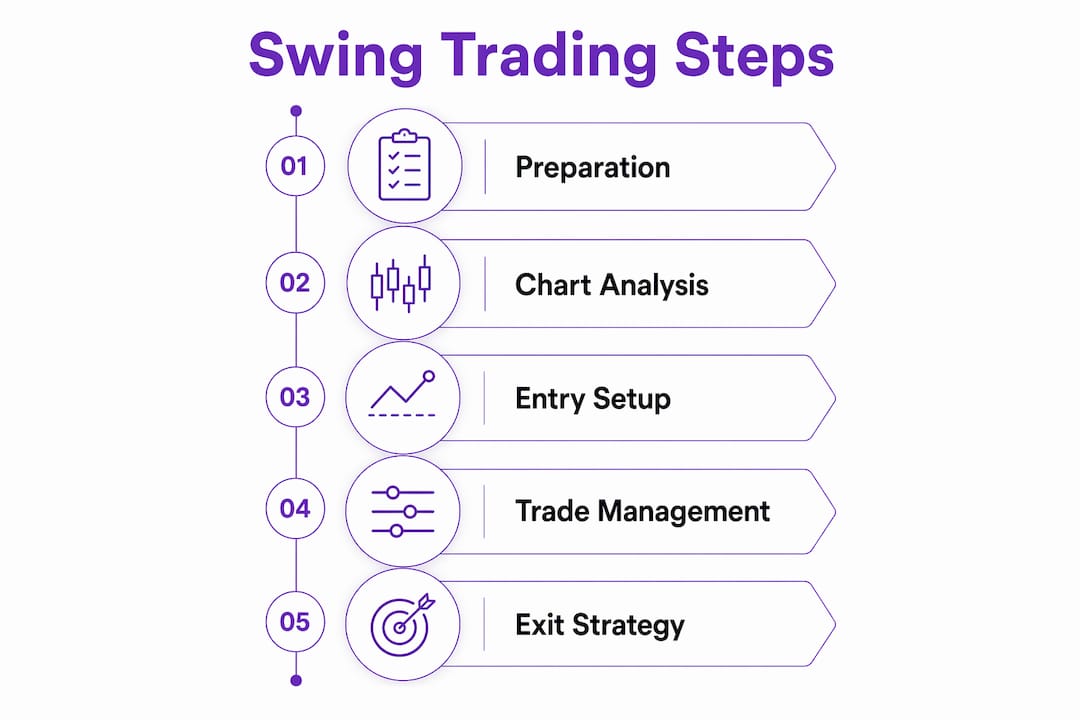
Patience is the most underrated skill in swing trading. Forced trades on unclear setups produce the majority of beginner losses. Paper trading, which means executing trades in a simulated environment without real capital, lets you practice reading setups and managing positions without financial consequences. Spend at least four to six weeks paper trading before committing real money.
Pro Tip: Set a rule that you will only take trades where you can clearly explain the setup in one sentence. If you cannot articulate the reason, the setup is not ready.
What are the best swing trading strategies for beginners?
Three core strategies cover most swing trading opportunities. Each has specific entry criteria, stop placement rules, and exit logic.
Pullback to moving average
This is the most beginner-friendly swing trading strategy. The pullback to moving average approach works as follows: identify a clear uptrend, wait for price to pull back to the 20-day or 50-day EMA, then confirm the entry with declining volume during the pullback and a bullish reversal candle such as a hammer or engulfing pattern. The stop loss goes just below the reversal candle’s low. The profit target is the prior swing high, giving a typical risk/reward ratio of 1:2 or better.
Breakout strategy
A breakout occurs when price closes above a defined resistance level on above-average volume. Volume confirmation is mandatory. A breakout on low volume frequently fails and reverses. Place the stop loss just below the breakout level. Set the initial profit target by measuring the height of the base pattern and projecting it upward from the breakout point.
Mean reversion
Mean reversion targets stocks or assets that have moved far from their average price. When RSI exceeds 70 on the daily chart and price is extended well above the 20-day EMA, a reversion toward the mean becomes probable. Traders short the overextension or wait for a reversal candle before entering. This strategy carries higher risk and suits traders with more experience reading momentum exhaustion.
| Strategy | Entry trigger | Stop placement | Target |
|---|---|---|---|
| Pullback to EMA | Reversal candle at 20/50 EMA | Below reversal candle low | Prior swing high |
| Breakout | Close above resistance with volume | Below breakout level | Measured base projection |
| Mean reversion | RSI >70, extended above EMA | Above recent high | 20-day EMA retest |
Pro Tip: Start with the pullback strategy only. Master one setup before adding others. Complexity does not improve results; consistency does.
Keeping it simple is the core principle: identify the trend, wait for a logical pullback, and apply strict risk management. Simplicity reduces emotional and impulsive errors that destroy accounts.

How do you plan and execute each swing trade?
A swing trade is only valid if fully planned before execution. Every trade requires an exact entry price, stop loss, profit target, risk/reward ratio, and position size defined in advance. Skipping any of these steps converts trading into gambling.
The pre-trade checklist
- Identify the setup: confirm trend direction on the daily chart
- Define entry price: use a limit order at the planned level, not a market order
- Set the stop loss: place it at a technically logical level, below support or a reversal candle low
- Calculate position size: divide your maximum dollar risk (1–2% of account) by the distance to your stop loss in dollars
- Set the profit target: minimum 2x the distance of your stop loss from entry
- Place the trade: enter with a limit order and immediately set the stop loss
Using limit orders protects against slippage and unfavorable fills. Market orders fill at whatever price is available, which can erode your planned risk/reward before the trade even begins.
Managing the trade after entry
Trade management follows a clear sequence once you are in a position:
- At entry: stop loss is active and placed
- After 1R gain (price moves in your favor by the same distance as your initial risk): move the stop loss to breakeven. This removes downside risk and gives you mental clarity to hold for larger targets.
- At 50% of target: consider taking partial profits, typically 25–50% of the position
- Trailing stop: once partial profits are taken, trail the remaining stop below recent swing lows
- Time-based exit: if a trade has not moved in your favor within 5–7 days, exit and redeploy capital
The breakeven rule is one of the most practical tools in active trade management. It converts a live risk into a free trade, which changes how you hold positions under pressure.
For a detailed crypto-specific workflow, the swing trading workflow for crypto traders on Darkbot’s blog covers the full sequence from scan to exit.
What mistakes do swing traders make most often?
Most beginner losses trace back to a small set of repeatable errors. Recognizing them before they cost you money is the practical value of any swing trading tutorial.
- Forcing trades on weak setups: top traders treat “no trade” as an active decision, not a failure. Waiting for clarity is a skill.
- Ignoring risk limits: risking more than 1–2% per trade on a single position is the fastest way to damage an account beyond recovery.
- Using indicators without price action: an RSI reading alone is not a trade. Price must confirm the signal with a reversal candle or breakout before you act.
- Moving stops wider under pressure: widening a stop loss because a trade moves against you violates the original plan and increases risk after the fact.
- No trade journal: without written records of entries, exits, and reasoning, you cannot identify patterns in your own behavior.
Treating swing trading as a business means applying unemotional, process-driven habits at every step. The traders who last are not the ones who find the best setups. They are the ones who execute the same rules consistently, review their trades honestly, and manage risk without exception.
A trade journal does not need to be complex. Record the date, ticker, setup type, entry, stop, target, result, and one sentence on what you learned. Review it weekly. Patterns in your mistakes will become obvious within a month.
Pro Tip: Review your losing trades first each week. Losses teach more than wins because they reveal where your process broke down.
For a structured approach to capital protection, the risk management strategies guide covers allocation and limit techniques directly applicable to swing trading.
Key Takeaways
Swing trading produces consistent results only when preparation, strategy selection, disciplined execution, and structured review work together as a repeatable process.
| Point | Details |
|---|---|
| Define risk before entry | Limit each trade to 1–2% of account capital and require a minimum 1:2 risk/reward ratio. |
| Use multi-timeframe analysis | Confirm trend on the daily chart, find the entry zone on the 4-hour, and time entry on the 1-hour. |
| Confirm with price action | Indicators like RSI and MACD only validate setups; a reversal candle or breakout must confirm first. |
| Apply the breakeven rule | Move your stop to entry after a 1R gain to remove downside risk on open positions. |
| Build a review routine | A weekly trade journal review reveals behavioral patterns that charts alone cannot show. |
Why routine matters more than the perfect setup
Most traders spend their energy searching for better setups. The traders who actually build consistency spend their energy on better routines. A disciplined routine including weekend market scans, nightly trade management, and post-trade analysis is what separates professionals from perpetual beginners. That finding matches what I have observed repeatedly: the process is the edge, not the setup.
The mindset shift that matters most is moving from “I need to find a trade” to “I need to follow my rules.” Those two orientations produce completely different behaviors under pressure. The first leads to forcing trades on mediocre charts. The second leads to waiting, reviewing, and acting only when conditions align.
Successful swing trading requires treating it as a business with process-driven habits rather than temptation-driven decisions. That means doing less, not more. Fewer trades, better quality. Tighter rules, less second-guessing. The traders I have seen improve fastest are the ones who reduced their trade frequency first and focused on executing their best setups cleanly.
Patience is not passive. Waiting for a high-quality setup while the market offers noise is an active, disciplined choice. Make that choice every session, and the results follow.
— Grisha
Darkbot and systematic swing trading execution
Swing trading demands consistency across every step, from scanning to execution to exit management. For traders who want to apply these same principles to cryptocurrency markets, Darkbot provides an AI-driven automation platform built around rule-based execution and structured risk control.

Darkbot runs systematic strategies across multiple exchanges using API integration, applying predefined rules without emotional interference. The platform handles routine tasks like stop management and position sizing, which frees traders to focus on setup quality and strategy review. Darkbot does not predict markets. It executes defined rules with consistency, which is exactly what disciplined swing trading requires. Traders looking to apply structured automation to their crypto strategies can explore Darkbot’s platform and its available tools.
FAQ
What is swing trading and how long do positions last?
Swing trading is a strategy that captures price moves by holding positions from 2 to 30 days. It sits between day trading and long-term investing in terms of time commitment and risk profile.
How much capital do I need to start swing trading?
A minimum of $5,000 is the widely cited threshold for effective risk management in swing trading. Below that level, position sizing becomes too constrained to apply the 1–2% risk rule meaningfully.
What is the best swing trading strategy for beginners?
The pullback to moving average strategy is the most beginner-friendly approach. It requires identifying an uptrend, waiting for a pullback to the 20-day or 50-day EMA, and confirming the entry with a bullish reversal candle.
How do I set a stop loss in swing trading?
Place the stop loss at a technically logical level, just below the reversal candle low or below the support zone that defines your setup. Never set an arbitrary dollar amount as your stop.
How do I know when to exit a swing trade?
Exit at your predefined profit target, after a 1R gain by moving to breakeven, or after 5–7 days if the trade has not moved in your favor. Top stock market indicators can help you read momentum shifts that signal when a trade is losing its thesis.
Recommended

Start trading on Darkbot with ease
Come and explore our crypto trading platform by connecting your free account!
Free plan available • No credit card required