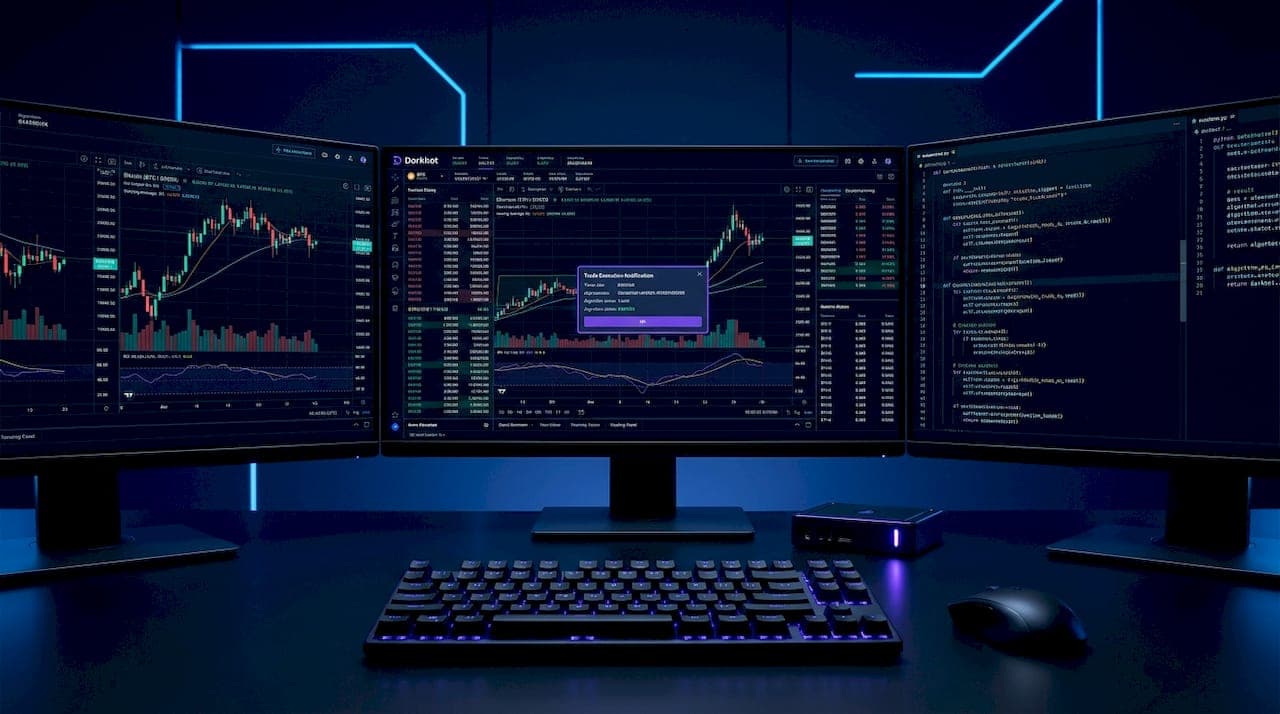
Take Profit Strategies for Crypto: A Rules-Based Guide

A take-profit strategy is a rule, set before you enter a trade, that defines when and how much of a position you close for a gain. The main approaches are fixed price targets, risk-to-reward multiples, scaling out in stages and trailing stops. No single method is best in every market. Each one trades off certainty of capture against exposure to further moves, so the useful question is which approach fits your entry logic, your risk per trade and your execution venue.
This guide covers how each method works, how to set levels without guessing, what fees and slippage do to a planned exit, and how to automate the rules so they execute the same way every time.
TL;DR
- A take-profit is a pre-defined exit level. Setting it before entry replaces in-the-moment judgment with a rule.
- The four common methods are fixed targets, risk-to-reward multiples, scaling out and trailing stops. They can be combined.
- A displayed target price does not guarantee a fill. Limit-style exits can fill partially, and market-triggered exits can slip.
- Exit rules shape average win size, so they matter as much as entry rules. Test them with backtesting or paper trading before committing capital.
- Automation removes timing inconsistency, but only if you understand how each order type behaves on your exchange.
What a take-profit is and why it is set before entry
A take-profit order is an instruction to attempt to close a position once a specified target is reached: above the entry price for a long, below it for a short, as Phantom’s order guide defines it. A stop-loss is the mirror image. It exits when the trade is losing, while a take-profit exits when it is winning. The two are complementary controls: one defines the intended best-case exit, the other limits damage if the trade thesis fails.
The reason to define the exit in advance is procedural. Once a position is open and moving, decisions are made under pressure, and the same chart reads differently depending on whether you are up or down. CoinMarketCap’s trading plan guidance describes a plan that includes analysis, a setup with stop-loss and take-profit levels, position sizing and a check on your emotional state, and notes that planning ahead reduces improvisation. Veteran trader Jim Iuorio makes the same point in a CME Group interview: decide your take-profit and stop-out levels before entering and keep emotion out of it.
The failure case is easy to describe. Without a plan, a trader may hold after a gain out of greed, and a reversal can turn a large open profit into nothing or a loss, according to Phantom. The same logic applies to any asset class, which is why exit planning is treated as a core part of investing generally and not an afterthought.

Why the exit rule matters as much as the entry
Most trading discussion centers on entries. Yet the exit determines the average size of a winning trade. Because average win size interacts with win rate to define expectancy, AlgoGP’s take-profit guide argues the exit strategy is effectively as important as the entry strategy.
A simple worked example shows the mechanism. Suppose a system wins 40% of its trades and loses 60%, risking 1 unit per trade.
- If the average win is 1 unit, expectancy per trade is 0.4 × 1 − 0.6 × 1 = −0.2 units.
- If the exit rule lets the average win reach 2 units, expectancy becomes 0.4 × 2 − 0.6 × 1 = +0.2 units.
The entry signal did not change. Only the exit rule did. This is an illustration of arithmetic, not a forecast of results: real figures depend on fees, slippage and market conditions, which is why exits should be tested on your own data.
The main take-profit methods compared
Binance Academy’s overview of exit strategies lists the standard toolkit: take-profit targets, risk-reward ratios, trailing stops and exits that sell portions at different levels or times. The table summarizes how they differ.
| Method | How it works | Main strength | Main limitation |
|---|---|---|---|
| Fixed price target | Close the full position at one pre-set level | Simple, unambiguous, easy to automate | Caps the gain if the move continues |
| Risk-to-reward multiple | Set the target at a multiple of the distance to your stop (for example 2R) | Ties the exit to the amount risked | Needs a meaningful stop level to anchor on |
| Scaling out | Close portions at several levels | Secures some gain while keeping exposure | Smaller position left for a large move; more orders and fees |
| Trailing stop | Stop follows price at a set distance and triggers after a drop | Designed to stay in a rising trend | Returns part of the open profit before exiting |
| Time-based or DCA exit | Sell fixed portions at set intervals | Removes the need to pick a level | Ignores price structure |
Fixed targets
A fixed target is the simplest rule: one level, one exit. It locks in the gain when price arrives, but it also caps the outcome. AlgoGP notes that fixed targets cap rare large gains, which matters most for strategies whose profits come from occasional outsized moves. Fixed targets suit range-bound conditions and strategies with a stable, tested average win.
Risk-to-reward targets
Here the target is derived from risk. If the stop sits 3% below entry and you require a 2:1 ratio, the target sits 6% above. The method links the exit to position sizing, so every trade is evaluated by the same ratio. It pairs naturally with a fixed per-trade risk limit; our risk checklist built on the 1-2% rule covers that side of the calculation.
Scaling out
Scaling out closes parts of the position at multiple levels, for example one third at each of three targets. The approach is widely considered a way to balance the wish to lock in early gains with the potential of a larger trend, per CryptoCalcs. The cost is that the remaining position is smaller if the move extends, and each partial exit adds a fee. Decide the portion sizes in advance, or the method turns back into discretion.

Trailing stops
A trailing stop moves with price and triggers after a set retracement. It is built to follow a rising market without a pre-set ceiling. AlgoGP points out the trade-off: trailing exits can capture large moves but return part of the open profit before they trigger. The trailing distance is the key parameter. Too tight and normal volatility stops you out. Too wide and a large share of the gain is surrendered.
How to set the levels
A level should come from something measurable, not from a round number you hope for. Common inputs:
- Entry and stop distance. Define the stop first, then apply a risk-to-reward multiple to find the target.
- Technical levels. Prior swing highs, range boundaries and resistance zones are natural places to place partial exits. Binance Academy also mentions Fibonacci extension levels, including 1.618, as a way to project targets.
- Volatility. Use a volatility measure such as average true range to size the distance. A target that is smaller than normal daily noise will be reached or missed at random. A trailing distance should be wide enough to survive typical swings.
- Market regime. A trending market favors trailing or scaled exits. A ranging market favors fixed targets near the range boundary.
- Costs. Include maker and taker fees and expected slippage. A target that barely clears costs is not a meaningful target.
Our guide to optimizing a crypto trading strategy step by step shows how to test these parameters one at a time so you can tell which change actually moved the result.
Execution: what happens when price reaches your target
Reaching the target price and getting filled at that price are different events.
- Limit-style take-profit. It gives price control, but a thin order book can lead to a partial fill or no fill. Phantom cautions that a displayed price does not guarantee a complete fill.
- Market-triggered take-profit. It improves the chance of execution but can suffer slippage in volatile or illiquid conditions, as MEXC’s glossary explains.
The same principle is documented for traditional markets. The U.S. SEC’s investor education page on stop and trailing stop orders states that the stop price is a trigger, not a guaranteed execution price, because the resulting market order can fill away from it. Crypto venues differ in their details, so read your exchange’s order documentation. Binance, for instance, describes how TP/SL orders on Futures close positions automatically when prices reach predetermined levels. Spot and derivatives products do not always offer the same order types, and some require combinations such as stop-limit or OCO bracket orders.
Practical consequences:
- Prefer limit-style exits for planned targets in liquid pairs, and accept that some fills may be partial.
- Expect slippage on protective stops during sharp moves, and size positions with that in mind.
- Test advanced order types with small amounts or a demo account before relying on them, as Phantom recommends.
Choosing a method by trading style
| Situation | Reasonable starting framework |
|---|---|
| Short-term range trading | Fixed target near range boundary, stop beyond the opposite side |
| Swing trade in a trend | Scale out at two or three levels, trail the remainder |
| Small account with fixed risk per trade | Risk-to-reward target so every exit is tied to risk |
| Long-term accumulation | Time- or level-based partial sales set in advance |
These are starting structures, not recommendations for a specific outcome. Run them through backtesting on historical data, then paper trading, before using live capital. Our overview of strategy optimization for automation explains how to evaluate changes without overfitting to past data.
Automating take-profit rules
The weakness of manual exits is inconsistency: the same setup gets closed early on Monday and held too long on Thursday. Crypto trades around the clock, so a rule that depends on you being at the screen will be applied unevenly. Automation applies the same logic every time the condition is met.
A sound automated setup has four parts:
- Written rules. Entry condition, stop, target or targets, and position size, all numeric.
- Verified order behavior. Confirm on your exchange which order types it supports and how it handles partial fills.
- Risk limits. Maximum loss per trade, maximum concurrent positions and a daily drawdown limit.
- Monitoring. Review fills against intended levels, so you can see actual slippage and fees rather than assumed ones.
For more on the mechanics, see our pieces on automated trading strategies and algorithmic trading for crypto.
Perspective
We build Darkbot around one idea: a trade is the execution of a rule, not a moment of judgment. The take-profit is the clearest example. A trader can write a good exit plan and still break it because the position is up, the market is moving and the plan feels abstract.
Our view is that AI in this setting is a mechanism for consistency. It evaluates patterns probabilistically and applies rule-driven adaptation within limits the user defines. It does not predict prices and it is not a signal service. Execution stays inside parameters you set, with human oversight, and orders are routed directly to your exchange through API keys.
That is why we put weight on backtesting, paper trading and risk controls before capital is committed. An exit rule that has been measured against historical data, including fees and slippage, is a decision framework. One that has not is a hope. Systematic execution does not remove risk, but it makes the process repeatable and reviewable.
Grisha
Putting the rules into practice with Darkbot
Darkbot is an AI-based crypto trading automation platform that connects to supported exchanges through API keys and runs strategies according to rules you configure. It offers backtesting, paper trading, multiple simultaneous bots, risk management tools and real-time analytics, so an exit plan can be tested and then executed consistently.
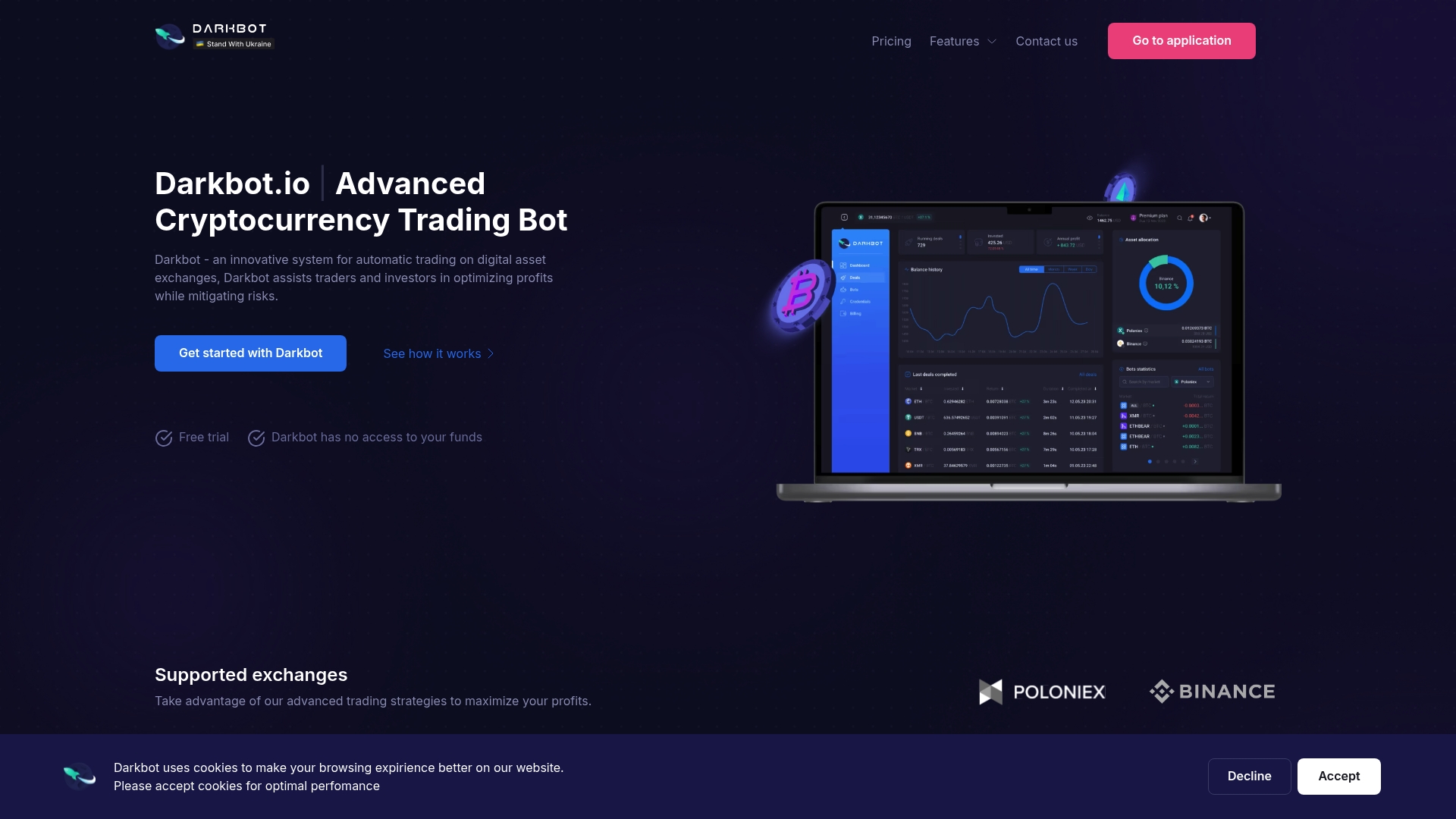
Plans start with a Free tier with limited features. Standard is $12.50 per month and Premium is $25.00 per month, with an Enterprise option also listed, and a 14-day money-back guarantee applies. See the Darkbot pricing page for what each plan includes. Before choosing, check which strategy and exit parameters you need and confirm them on that page.
Common mistakes in take-profit planning
- Targets chosen after entry. Moving a target because the trade is going well or badly reintroduces discretion.
- Ignoring costs. Fees and slippage can erase the edge of small targets.
- Over-fitting. Tuning exit parameters until a backtest looks perfect usually produces rules that fail on new data.
- Mismatch with the entry. A mean-reversion entry paired with a trend-following trail rarely behaves as intended.
- No stop-loss. A take-profit only defines the upside. Without a protective stop, risk per trade is undefined. Our beginner strategy examples show entries and exits paired as one unit.
FAQ
What is the difference between a take-profit and a limit order?
A limit order attempts to fill at a specified price or better, and it can be used for entries or exits. A take-profit is a purpose: closing a position at a gain. It is often implemented as a limit order, or as a trigger that sends a market order. The distinction affects fills, since limit-style exits control price but may not fill completely.
Should I take profit all at once or in stages?
It depends on your strategy’s profile. A single exit is simpler and easier to test. Staged exits secure part of the gain while leaving some exposure, at the cost of more orders and fees. Backtest both against your own entries to see which matches the way your strategy actually earns.
Do take-profit orders work on spot markets?
Often yes, though the implementation varies by exchange. Some venues offer dedicated take-profit orders, while others require a limit sell or a stop-limit order. Check the order types your exchange lists for spot trading and test with a small amount first.
How do I choose a trailing stop distance?
Base it on the instrument’s typical volatility rather than a round percentage. The distance should be wide enough to avoid being triggered by normal swings and narrow enough that giving back profit remains acceptable. Test several distances on historical data and compare how much open profit each one returned.
Sources
- What is a take profit order in trading? (Phantom)
- How To Make a Crypto Trading Plan (CoinMarketCap)
- Q&A: Lessons From a 30+ Year Trading Career (CME Group OpenMarkets)
- Take Profit Strategies Guide (AlgoGP)
- 5 Exit Strategies for Traders (Binance Academy)
- Take Profit Strategies: Maximizing Your Gains (CryptoCalcs)
- Take Profit Definition (MEXC)
- Stop, Stop-Limit, and Trailing Stop Orders (Investor.gov)
- How Take-Profit and Stop-Loss Orders Work (Binance Blog)
Recommended

Start trading on Darkbot with ease
Come and explore our crypto trading platform by connecting your free account!
Free plan available • No credit card required