How to Trade Crypto With Small Capital: A Systematic Approach

A small account can trade crypto, but it behaves differently from a large one. Exchange minimums, fees, spreads and position size take a bigger share of every trade, so the outcome depends more on process than on any single call. The practical answer is a defined risk per trade, a short list of liquid markets and execution that follows written rules. That is the case for automating a small account with a platform such as Darkbot, which runs rule-based strategies across exchanges through API keys and offers a free plan to start with.
This guide is for traders working with roughly $100 to $1,000, risking $5 to $50 per trade, often part-time. It covers what the constraints are, how to size positions, which risks matter, and what to check before connecting any bot.
TL;DR
- Exchange minimums are low, but fees, spreads and minimum order sizes consume a larger share of a small trade. Plan around them before choosing a strategy.
- Define risk per trade as a fixed fraction of the account. Position size follows from that number, not from the amount you feel like committing.
- Automation helps a small account mainly by applying the same rules every time, without needing you at the screen.
- No bot, AI-based or otherwise, can predict markets. Regulators treat guaranteed-return claims as fraud red flags.
- Darkbot offers a free plan, a Standard plan at $12.50 per month and a Premium plan at $25.00 per month, plus paper trading and backtesting to work out rules before real funds are used.
What “small capital” means in practice
Small capital is not defined by a single number. It is the point where the exchange’s rules start to shape what you can do. Three limits matter most: minimum order sizes, fees, and the gap between the buy and sell price.
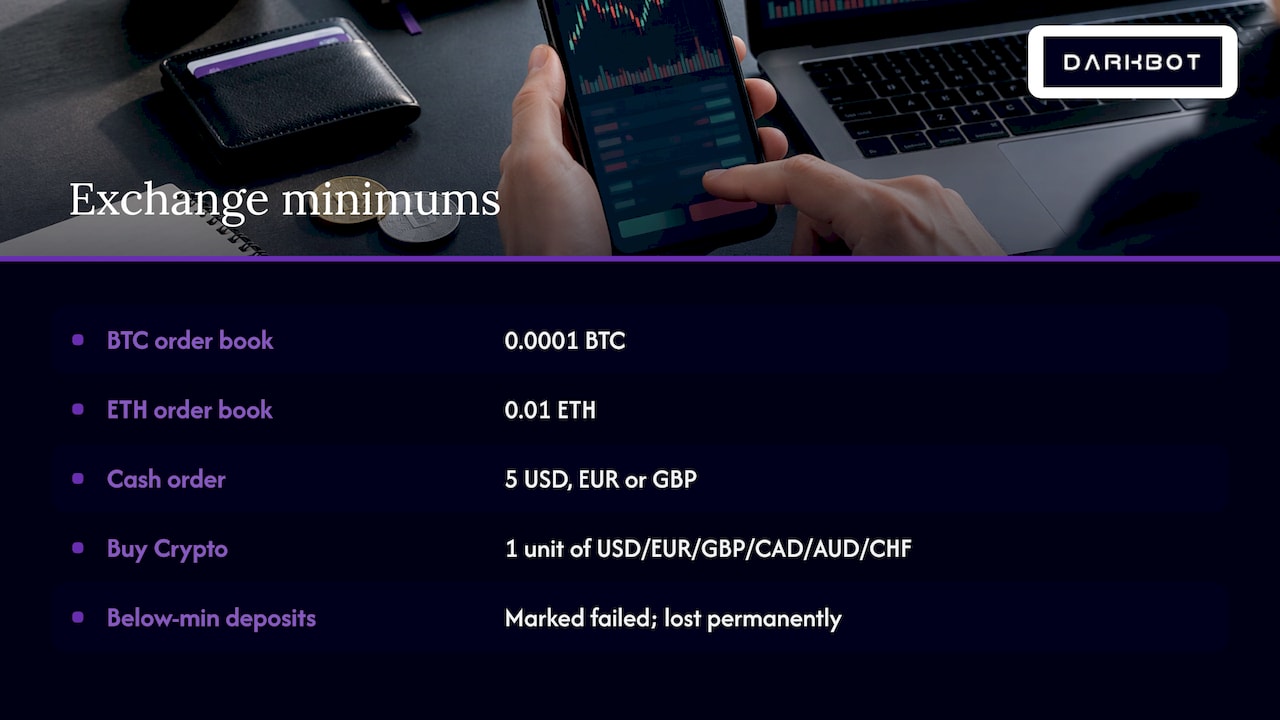
Minimums are lower than many beginners expect. Kraken, for example, lists order-book minimums of 0.0001 BTC or 0.01 ETH, a cash order minimum of 5 USD, EUR or GBP, and a Buy Crypto minimum of one unit of USD, EUR, GBP, CAD, AUD or CHF, according to its cryptocurrency minimums page. The same page notes that crypto deposits below the minimum are marked “Failed” and lost permanently. That matters for small traders who move funds between wallets and exchanges: check the minimum for the specific asset and network before sending anything.
So what can $5 do? It can buy a fraction of a coin on an exchange with a $5 cash minimum. It cannot support a strategy with several positions, stop distances and fees. A $5 purchase is a purchase, not a trading system. The more useful question is how much capital a rule set needs to run without minimums and fees dominating the result.
Fees, spreads and minimum sizes
Fees are the first cost that scales badly. Kraken’s exchange trading rules state that maker fees apply to orders that add liquidity, such as limit orders, while taker fees apply to orders matched immediately. Fees must be covered by your available balance, and every order is subject to a per-asset minimum size. Coinbase’s markets trading rules describe the same structure: minimum order sizes listed per market, and maker and taker fees charged in the quote asset as a percentage of order quantity.
The cause-and-effect is simple. A percentage fee costs the same proportion on a $20 trade and a $20,000 trade, but any fixed minimum, such as a minimum order size or a withdrawal charge, is a larger proportion of the small trade. Several practical consequences follow:
- Prefer limit orders where the strategy allows. Orders that add liquidity are charged maker fees, which on most fee schedules are lower than taker fees. Check your exchange’s current schedule.
- Count both sides. A round trip pays fees on entry and exit. A strategy that targets small price moves needs those moves to clear both fees plus the spread.
- Watch the spread. Kraken’s rules describe Market Price Protection, which rejects market orders when the bid/ask spread is typically 2.5% to 20% of the market price. Thinly traded tokens can have spreads that make a small account’s entry cost larger than the whole expected move.
- Trade liquid pairs. Deep order books mean tighter spreads and fewer surprises in fill price. Coinbase’s rules also describe a Price Protection Point that partially fills and cancels orders which would fill too far from the mid-price, a reminder that fill quality is a feature of the market, not a guarantee.
A worked example
The figures below are illustrative, not any exchange’s published rates. Suppose an account of $500 and a rule that no single trade risks more than 2% of the account, which is $10.
A setup has an entry at $100 and a stop at $97, a $3 distance per unit. The position size is the risk divided by the distance: $10 / $3 is about 3.3 units, a position of roughly $333. If the combined fees on entry and exit are 0.5% of the position, that is about $1.67, or one sixth of the amount at risk. A trader who ignores this sees the stop-loss as a $10 loss when the actual cost is closer to $11.67, and a winning trade as smaller than it looks.
Now raise the stop distance to $6 for a more volatile asset. The same $10 risk gives about 1.7 units, a position of about $167. The fees fall in dollar terms, but the position may fall below the exchange’s minimum order or leave little room to scale out. The lesson is that risk per trade, stop distance and minimum sizes have to be solved together.
Position sizing is the core of a small account
With a small balance, the fastest way to end the experiment is to risk too much on a few trades. A fixed-fraction rule keeps the sequence of losses survivable. Many systematic traders use a small fixed percentage of the account per trade. The exact figure is a personal choice that depends on your tolerance and strategy, but the structure stays the same:
- Decide the maximum loss per trade as a percentage of the account.
- Set the stop distance from the market’s volatility, not from the amount you want to commit.
- Derive the position size from those two numbers.
- Cap the number of open positions so that correlated losses do not stack. Most large crypto assets move together in sharp sell-offs.
- Set a daily or weekly loss limit after which trading stops until you review.
Leverage deserves its own caution. It raises position size relative to the account, which magnifies both the result and the speed at which a small balance can be depleted. A small account with high leverage has almost no room for the normal variation in price.
The risks that remove small balances
The common causes are not exotic. Oversized positions, low-liquidity tokens, leverage, and chasing results after a loss account for most of the damage. A second category is fraud presented as automation.
The U.S. Commodity Futures Trading Commission issued a customer advisory on January 25, 2024, titled AI Won’t Turn Trading Bots into Money Machines. It warns that AI cannot predict the future or sudden market changes and that claims of high or guaranteed returns are red flags of fraud. It cites the Mirror Trading International case, in which an operator in South Africa took over $1.7 billion in bitcoin from at least 23,000 people using a bot that promised returns of at least 10% monthly for as little as $100 in bitcoin.
The takeaway for a small trader is a standard for evaluating any tool: the legitimate use of a bot is to execute your rules consistently, not to produce returns. Any vendor that promises a percentage per month is describing something no trading process can guarantee. We cover the operational side in more detail in our pieces on key risks in automated trading and the risks of crypto bot automation.
Where automation helps a small account
A small account usually belongs to someone with limited time: a student, a freelancer, someone with a day job. Their constraint is attention, not only capital. Crypto trades around the clock, and a manual trader who is asleep, at work or in class misses the exit that the plan called for. Discretionary decisions also drift: a rule written on Monday gets bent on Thursday after two losses.
Automation addresses these two problems directly:
- Consistency. The same entry, exit and sizing rules run every time, so results reflect the rules rather than your mood.
- Coverage. Stops, take-profit levels and rebalancing run when you are not watching.
- Measurement. A defined rule set can be backtested against historical data and run in paper trading, so you see how it behaves, including its losing stretches, before real funds are at risk.
The role of AI here is limited and specific. In a platform like ours, machine learning is used for probabilistic pattern evaluation and rule-driven adaptation, which means weighing conditions against defined criteria and adjusting within the limits you set. It is a mechanism for consistent decisions, not a forecast. Our articles on the role of AI in crypto trading and algorithmic trading with AI go further into the mechanics.
A setup sequence for a small account
Follow this order. Each step removes one source of avoidable loss.
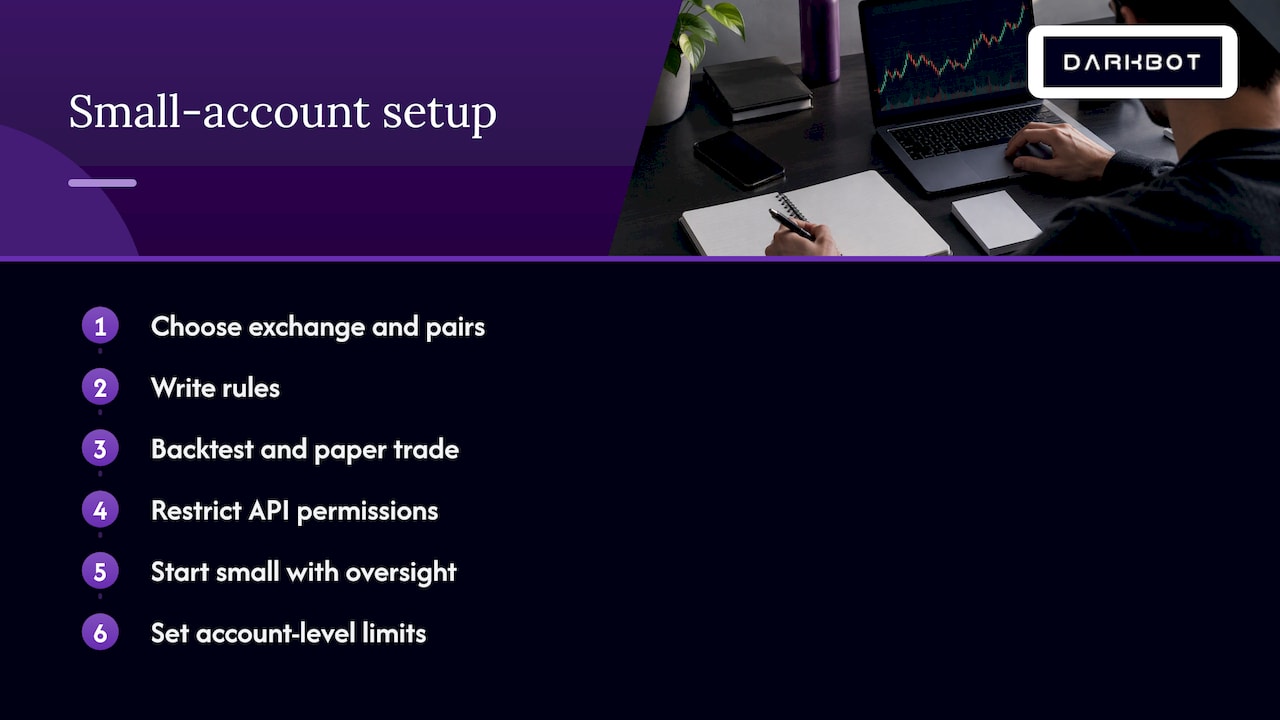
1. Choose the exchange and pairs
Pick an exchange whose minimums and fee schedule fit your account, and limit yourself to a few liquid pairs. Darkbot connects to supported exchanges through API keys, and it supports multiple exchanges, so the exchange choice stays yours. See our note on multi-exchange integration for how that works.
2. Write the rules before touching the bot
State the entry condition, the stop, the exit, the maximum risk per trade and the maximum number of open positions. If you cannot write the strategy in a few lines, it is not ready to automate.
3. Backtest, then paper trade
Backtesting applies the rules to historical data. Paper trading runs them on live prices with simulated funds. Both are available in Darkbot, and together they show how the rules handle fees, spreads and losing streaks. Treat the results as information about the rules’ behavior, not as a prediction of future returns.
4. Connect with restricted permissions
An API key lets software place orders on your behalf. Create a key that is limited to what the bot needs, and keep withdrawal rights switched off where the exchange allows that setting. Store the key securely and rotate it if you suspect exposure. Darkbot’s approach to order handling is direct order routing, which we designed with security in mind; our overview of crypto trading bot security explains the considerations.
5. Start small and keep human oversight
Begin with the smallest size that respects exchange minimums, and review the logs and fills regularly. A transparent, human-oversight approach means you can see what the bot did and why. Increase size only after the live fills match what paper trading suggested.
6. Set account-level limits
Define the loss at which you pause the system. Our guide to risk management in crypto trading bots covers stop levels, exposure caps and rebalancing.
What to look for in a bot for a small portfolio
The features that matter to a small account differ from those that matter to a fund.
| Criterion | Why it matters at $100 to $1,000 |
|---|---|
| Risk controls | Stops, exposure caps and position limits protect a balance that cannot absorb large drawdowns |
| Backtesting and paper trading | Lets you validate rules without risking the balance |
| Exchange integration via API | Keeps funds on your exchange account rather than with the bot provider |
| Strategy customization | Lets you set size and stop distance to fit exchange minimums |
| Multiple simultaneous bots | Lets you separate strategies or pairs with their own limits |
| Transparent pricing | A predictable monthly cost is easier to plan around than a share of profits |
| Support | Questions about setup and permissions come up early for first-time users |
On pricing, Darkbot’s plans are a Free plan with limited features, a Standard plan at $12.50 per month and a Premium plan at $25.00 per month, with an Enterprise option as well. Subscriptions are monthly or annual, and a 14-day money-back guarantee applies.
We build Darkbot as an automation platform, not a signal service. The distinction matters most for small accounts. A signal tells you what someone thinks will happen. A platform executes what you decided in advance, under limits you set.
For a trader with $200 or $800, the edge available is mostly procedural. Position size derived from a fixed risk fraction, orders placed at the levels the plan called for, exits that do not depend on whether you are awake. These are repeatable, and they are the parts a rule-driven system handles well.
This is also why we describe AI in modest terms. Machine learning in our platform evaluates conditions probabilistically and adapts within rules you define. It does not predict prices, and we make no performance promises. What we aim to offer is dependability, security, ease of use and human oversight: you can see what the system is doing and change it.
Our free plan, paper trading and backtesting exist so that a new trader can study how a rule set behaves before committing real funds. We think that is the right order of operations for any account, and especially a small one.
Grisha
Starting with Darkbot
If you want to automate a small account, the lowest-friction path is to begin on the Free plan, build the rule set in backtesting and paper trading, and move to a paid tier when you need more bots or features. Standard is $12.50 per month and Premium is $25.00 per month. You can compare the tiers on the Darkbot pricing page.
Whatever you choose, keep the same discipline: fixed risk per trade, liquid pairs, restricted API permissions and regular review.
FAQ
What is the minimum capital for crypto trading?
Exchanges set their own minimums. Kraken, for example, lists a $5 minimum for cash orders and 0.0001 BTC for order-book trades. A workable trading system needs more than the minimum, because fees, stops and several positions all have to fit inside the balance.
Can a crypto trading bot work with a small account?
Yes, provided the strategy’s position sizes respect the exchange’s per-asset minimums and the expected moves clear fees and spreads. A bot executes rules, so the rules must be sized for the account. Paper trading lets you confirm that before real funds are used.
Is trading crypto with a small account safe?
It carries the same market risk as any crypto trading, and small accounts are exposed to over-sizing and leverage. Keep risk per trade to a fixed fraction, avoid leverage, and treat any promise of guaranteed returns as a warning sign, as the CFTC advises. Only trade funds you can afford to lose.
Where can I trade crypto at low cost?
Compare the maker and taker fee schedules and the minimum order sizes of the exchanges available in your region. Using limit orders that add liquidity typically costs less than market orders. Total cost also includes the spread, so liquid pairs matter.
Which Darkbot plan suits a small account?
The Free plan has limited features and works as a starting point. Standard at $12.50 per month and Premium at $25.00 per month add capacity and features. The pricing page lists what each tier includes.
Sources
- Overview of cryptocurrency minimums, Kraken
- Exchange Trading Rules, Kraken
- Coinbase Markets Trading Rules
- CFTC Customer Advisory: AI Won’t Turn Trading Bots into Money Machines
Recommended

Start trading on Darkbot with ease
Come and explore our crypto trading platform by connecting your free account!
Free plan available • No credit card required