VAR Crypto Portfolio: What VAR Is and How to Manage It
A “VAR crypto portfolio” most often means a portfolio that holds VAR, the token of Variational, a decentralized derivatives protocol. It is not VARA, the Dubai regulator, and it is not Vara Network’s VARA token. The practical question is the same for any new, concentrated position: how large should it be, how do you track it, and what rules govern changes to it? This article covers what is known about the token, how to inspect what a portfolio holds, and how to apply rule-based sizing and rebalancing.
TL;DR
- VAR refers to the Variational token. VARA is the Dubai Virtual Assets Regulatory Authority, a different thing entirely.
- Announced allocations are 32% genesis airdrop, 18% ecosystem reserve and 50% team and investors. Launch timing and total supply were not final in the sources we reviewed.
- Treat VAR as one position inside a target allocation, with a written maximum weight and a review rule, not as a standalone thesis.
- Track holdings with exchange, wallet or portfolio tools, and reconcile them against an independent source.
- Automation executes a defined rule set. It does not predict prices and does not remove concentration, liquidity or custody risk.
What VAR means, and what it does not
Search results for this phrase are mixed, which reflects how many unrelated assets share similar tickers. Three names are worth separating.
| Name | What it is | Relevance to a portfolio |
|---|---|---|
| VAR (Variational) | Token associated with a decentralized derivatives protocol | The asset this article discusses |
| VARA (Dubai) | The Virtual Assets Regulatory Authority, which regulates virtual assets and VASPs in Dubai, excluding the DIFC (VARA Rulebook) | A regulator, not an asset |
| VARA (Vara Network) | A separate crypto asset with its own market listing | Different project, different risk |
There is also a statistical meaning of VaR, value at risk, which is a loss estimate rather than an asset. The sections below use the token meaning.
Variational and the VAR token in brief
Variational is a decentralized derivatives protocol on Arbitrum. It lets users trade perpetual contracts on crypto, equities, commodities and forex through a request-for-quote (RFQ) network. Its infrastructure has two main applications: Omni, a zero-fee retail perpetuals platform, and Pro, an institutional settlement layer for OTC derivatives (Whales Market overview). The RFQ design is aimed at liquidity problems in long-tail assets, which separates it from orderbook-based perpetual exchanges.
For a portfolio, the protocol matters because a token’s value depends on usage, fee flows and supply schedule. Those are inputs you can check. Price targets are not.
What is known about supply and allocation
The published allocation splits 32% of total supply to a genesis airdrop for point holders, 50% to team and investors, and 18% to the Variational Foundation ecosystem reserve (Alea Research). The project’s own dashboard describes the token launch as set for Q4 2026 with no exact date, and total supply as unannounced (Variational dashboard).

Secondary sources disagree on details, and some third-party pages describe the community share differently. That is a reason to verify allocation against the project’s own materials before sizing anything. Market data pages for newly listed or pre-market tokens can also show very thin trading and very concentrated holdings, so a quoted price or market capitalization tells you little about how easily a position can be exited.
What to evaluate before adding VAR
A useful frame is cause and effect: which features of the token change the risk of holding it?
Unlock structure. The airdrop portion is described as unlocked at launch. Team and investor tokens carry a 12-month lock after the token generation event (TGE), then release over at least three years, and team members also have individual vesting (Variational dashboard). Effect: early supply in circulation is weighted toward airdrop recipients, and later supply arrives on a schedule that can be modeled. Messari’s analysts note that the large airdrop share relative to the locked allocation moves meaningful day-one ownership to the community (Messari). A large unlocked share held by recipients with no cost basis can produce selling pressure at launch. That is a mechanism, not a forecast.
Value accrual. Treasury revenue is assigned to buybacks and burns (Alea Research). Effect: token demand is linked to protocol revenue, which depends on trading volume. Volume in derivatives venues is cyclical and competitive.
Valuation anchors. Pre-market pricing on prediction markets put the market capitalization near $1.51B a day after launch, per the same research. Pre-market indications are thin and revisable. They are a reference point for position sizing, not a fair value.
Liquidity. New tokens often trade with wide spreads and shallow books. A position that looks small by value can be expensive to exit. Measure it by what slippage you would accept on a full exit, not by its notional value.
Concentration. Holder distribution and top-holder share matter for a new token. Check them on a block explorer, not on a price page alone.

Sizing VAR inside a target allocation
The most defensible way to hold a high-uncertainty asset is to decide its maximum weight before buying it. A simple framework:
- Define the portfolio’s purpose and loss tolerance. State the largest drawdown you would accept on the whole portfolio.
- Assign risk budgets by asset. Instead of equal dollar amounts, give each position a share of total risk. Volatile assets receive smaller weights. The idea is developed in risk budgeting portfolios, where position sizes follow each asset’s contribution to portfolio risk.
- Cap the position. Write a maximum weight for VAR, for example a small single-digit share of the portfolio. The exact number is a personal decision.
- Define what changes the cap. Examples: the unlock schedule, a change in protocol revenue, a change in exchange liquidity. Use conditions, not feelings.
- Define exits in advance. Decide the rule for trimming when the weight exceeds its cap.
Worked example with round numbers: a $5,000 portfolio with a 4% cap on VAR allows $200. If other holdings fall and VAR rises so it reaches 6%, a threshold rule trims it back toward 4%, regardless of how the position feels. The rule exists so the decision is made once, in calm conditions.
This is general education, not individualized advice. For decisions about taxes or suitability, a licensed financial adviser or tax professional can look at your full situation.
How to check what the portfolio holds and how it performs
Performance tracking starts with an accurate record of holdings. Three common routes, depending on where the assets sit:
- Coinbase. A beta performance feature, available only to US customers, lets you select total balance from Home, pick a date range, and view asset costs, portfolio value breakdown, assumed returns, and realized, unrealized and total returns. It covers Coinbase.com and mobile app transactions, not Coinbase Wallet (Coinbase Help). Coinbase defines unrealized return as gains or losses on assets still held and realized return as gains or losses from assets sold, sent or withdrawn.
- On-chain wallets. Matcha’s Portfolio page shows a connected wallet’s total value, 24-hour change, historical charts, and allocation by token or supported network. Its token table includes average entry, return percentage and unrealized profit or loss, with cost basis derived from on-chain inflows and FIFO accounting (Matcha Help).
- Multi-asset trackers. TradingView’s portfolio documentation describes viewing active holdings, optionally including sold positions, reviewing full transaction history with commissions and cash movements, and analyzing performance with measures such as beta, Sharpe ratio and Sortino ratio (TradingView Support).
Note what these tools define differently. FIFO cost basis, assumed returns and included yield can produce different numbers for the same wallet. Choose one method and keep it consistent so period-to-period comparisons mean something.
Monitoring, diversification and rebalancing
Diversification decays on its own. Price movements push weights away from targets, so a position that performs well becomes a larger share of risk. Vanguard notes that diversification requires ongoing maintenance because of this allocation drift, and reports that advisers commonly recommend an annual review and rebalancing when an asset class deviates 5% to 10% from target (Vanguard on diversification). Vanguard also says annual rebalancing is optimal for many investors (Vanguard on rebalancing). Those figures are guidance for traditional multi-asset portfolios. Crypto weights drift faster, so the review interval and thresholds are usually tighter, and fees and taxes on each trade should be part of the rule.
Three rebalancing triggers are common:
| Trigger | Rule | Trade-off |
|---|---|---|
| Calendar | Review at a fixed interval | Simple, but ignores large intra-period moves |
| Threshold | Act when a weight deviates by a set band | Responds to drift, can trade often in volatile markets |
| Combined | Check on a schedule, act only outside the band | Fewer trades, still bounded risk |
For a deeper treatment, see our guides on what rebalancing in crypto is and portfolio rebalancing for crypto traders. For structuring the whole portfolio, our crypto portfolio management guide and portfolio balancing guide for automated trading cover target setting and execution.
Risks that sit around the position
Liquidity risk. Thin books mean the price you see is not the price you exit at. Use limit orders and size trades against visible depth.
Concentrated holdings. When a few wallets hold most of a token’s supply, one decision by a holder can move the market. This applies to any early-stage token.
Custody and operations. The Digital Funds Standards Board’s guidance for digital-asset operations says positions should be tracked across exchanges and custody providers in real time, reconciled daily against independent sources, and protected with key-management controls such as multisignature arrangements (DFSB Standard 5). An individual does not need institutional infrastructure, but the principle scales down: keep a record that does not depend on a single platform, and use API keys with trading permission only, never withdrawal permission.
Smart contract and protocol risk. A derivatives protocol adds code risk and counterparty design risk that a simple spot holding does not have.
Automation risk. A bot applies rules exactly as written, including flawed ones. Test rules with paper trading and backtests, and review logs. For the wider framework, see our crypto risk management fundamentals.
Our perspective on holding VAR systematically
We build DarkBot as an automation platform, not a signal provider. That shapes how we think about a position like VAR.
First, the asset is secondary to the process. A new token is a case where the unknowns are largest: supply schedule, liquidity and holder structure. A rule set that limits weight, defines review triggers and logs every action gives you consistency when the information is weakest.
Second, AI in this context is a mechanism for consistency. It evaluates conditions probabilistically and applies rules without fatigue or mood. It does not predict a price, and it cannot make a concentrated, illiquid position safe.
Third, human oversight stays in the loop. Rules are set by you, results are reviewed by you, and order routing is direct so that execution is observable. Automated rebalancing is most useful when the decision has already been made and only the repeated, mechanical execution remains.
— Grisha
Automating the rules with DarkBot
If your plan is written down, with target weights, a cap on VAR, a threshold and a review interval, a bot can execute it across exchanges through API keys while you keep control of the parameters. DarkBot offers a Free plan, a Standard Plan at $12.50 per month and a Premium Plan at $25.00 per month, plus an Enterprise tier. Subscriptions carry a 14-day money-back guarantee. You can compare tiers on the DarkBot pricing page.
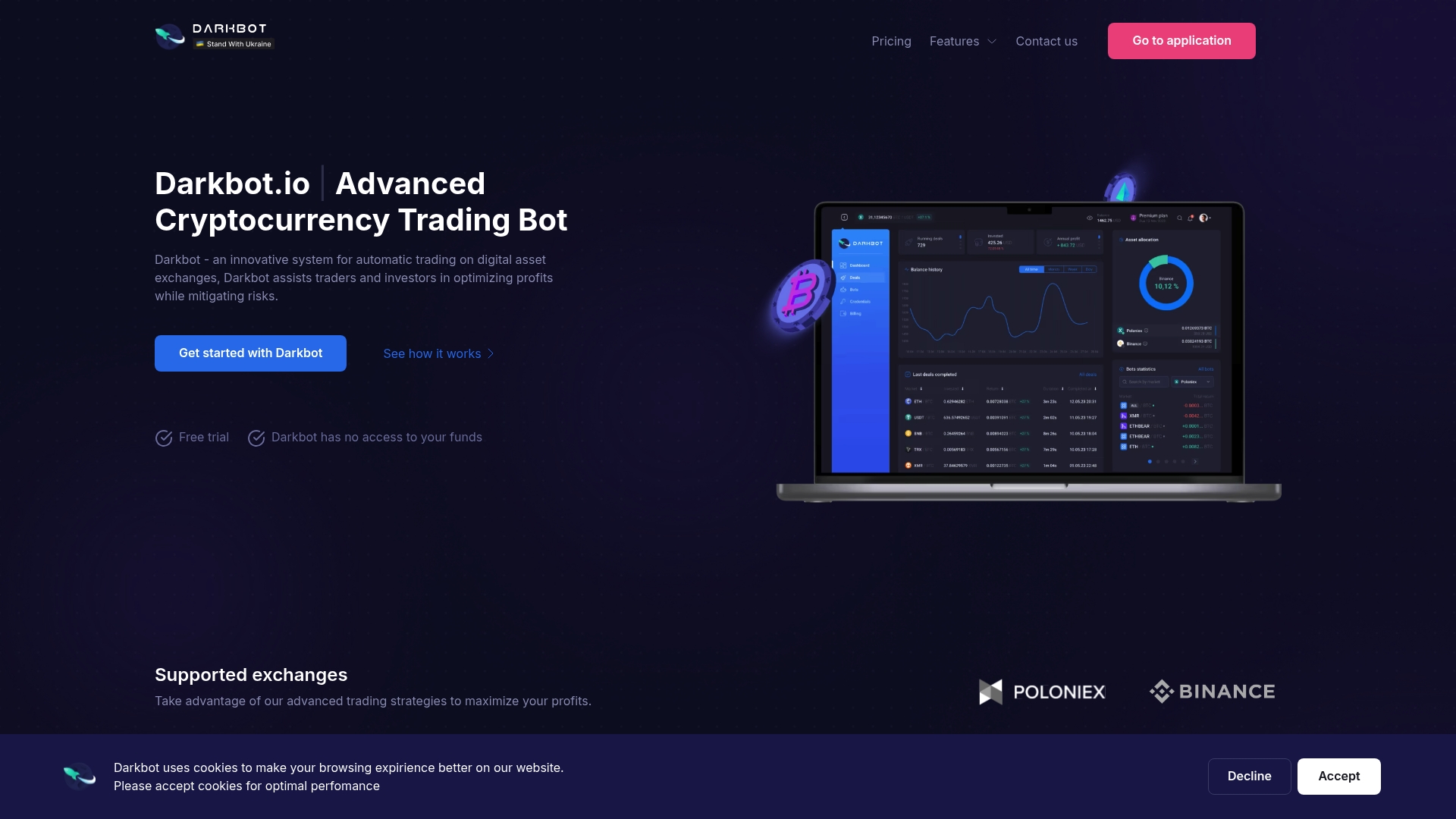
Backtesting and paper trading let you test a rebalancing rule before it touches capital. If you want to review how strategy settings interact with results, read our note on trading strategy optimization.
FAQ
Is VAR the same as VARA?
No. VAR is the token associated with Variational. VARA can mean the Dubai Virtual Assets Regulatory Authority, a regulator, or the separate Vara Network asset. Check the full name and contract or listing details before you buy anything.
How much of a portfolio should VAR be?
There is no universal figure. A common approach is to set a maximum weight in advance, small enough that a total loss would sit within your stated drawdown tolerance, and to trim when the weight passes that cap. A licensed financial adviser can help set the number for your situation.
How often should I rebalance a portfolio that includes VAR?
Vanguard reports that advisers commonly review annually and rebalance when a holding deviates 5% to 10% from target, for traditional portfolios. Crypto weights move faster, so many traders use a combined rule: check on a schedule and act only when a weight leaves its band, after accounting for fees and taxes.
How do I see my crypto portfolio’s performance?
Use the tool where the assets sit. US Coinbase customers can use the beta performance feature, wallet holders can use an on-chain portfolio page such as Matcha’s, and multi-platform holders can use a tracker like TradingView. Pick one cost-basis method and keep it consistent.
Sources
- Virtual Assets Regulatory Authority Rulebook
- Whales Market: What is Variational ($VAR)?
- Alea Research: Only Hyperliquid Traded More
- Variational dashboard
- Messari: Variational Pre-Market Valuation
- Coinbase Help: My investment performance
- Matcha Help: Portfolio page
- TradingView Support: Portfolios
- Vanguard: Portfolio diversification
- Vanguard: Rebalancing your portfolio
- DFSB Standard 5: Investment Operations
Recommended

Start trading on Darkbot with ease
Come and explore our crypto trading platform by connecting your free account!
Free plan available • No credit card required