After-Hours Crypto Trading: What It Means in 2026

In cryptocurrency markets, after-hours trading is not a special session. It is every hour of every day. Unlike stocks or traditional futures, crypto spot markets run continuously on decentralized blockchain networks with no scheduled open or close. The phrase “after hours” carries real meaning in equities, where NYSE trading stops at 4:00 PM ET and extended sessions run under thinner conditions. In crypto, the equivalent concept is simply the periods outside major financial hub business hours, when liquidity thins and spreads widen even though the market technically stays open.
Key distinctions for 2026:
- Spot crypto markets operate 24/7/365 with no central authority to suspend trading.
- Regulated derivatives like CME Bitcoin futures historically followed a 23/5 schedule, but CME Group launched 24/7 trading for cryptocurrency futures and options as of may 2026, logging notable weekend liquidity with over 7,200 contracts traded worth approximately $50 million during the inaugural weekend of 24/7 trading.
- The CFTC explicitly endorsed 24/7 trading as appropriate for blockchain-native crypto markets while cautioning that the same model may not suit traditional derivatives.
- “After-hours” in crypto practice means low-liquidity windows, not market closures.
How crypto trading hours actually differ from traditional markets
The structural gap between crypto and traditional markets comes down to infrastructure. Spot crypto markets settle trades directly on blockchain networks, which run without interruption. No clearing house sets a daily window. No exchange committee votes to open the session.
| Market | Annual trading hours | Weekends | Holidays |
|---|---|---|---|
| Cryptocurrency (spot) | — | Always open | Never closes |
| Forex | — | Closed | Christmas, New Year |
| US Stocks (NYSE) | — | Closed | — |
| CME Crypto Futures (pre-2026) | — | Closed | US holidays |
| CME Crypto Futures (2026+) | — | Now open | Maintenance window only |
The CME shift matters because it closes the gap between regulated derivatives and spot markets. Previously, a trader holding a CME Bitcoin futures position had no hedge mechanism over the weekend while spot prices moved freely. That asymmetry created real risk. The new 24/7 model retains only a Saturday maintenance window from 2:00 AM to 4:00 AM CT as a scheduled interruption.
When does liquidity actually peak in a 24/7 crypto market?
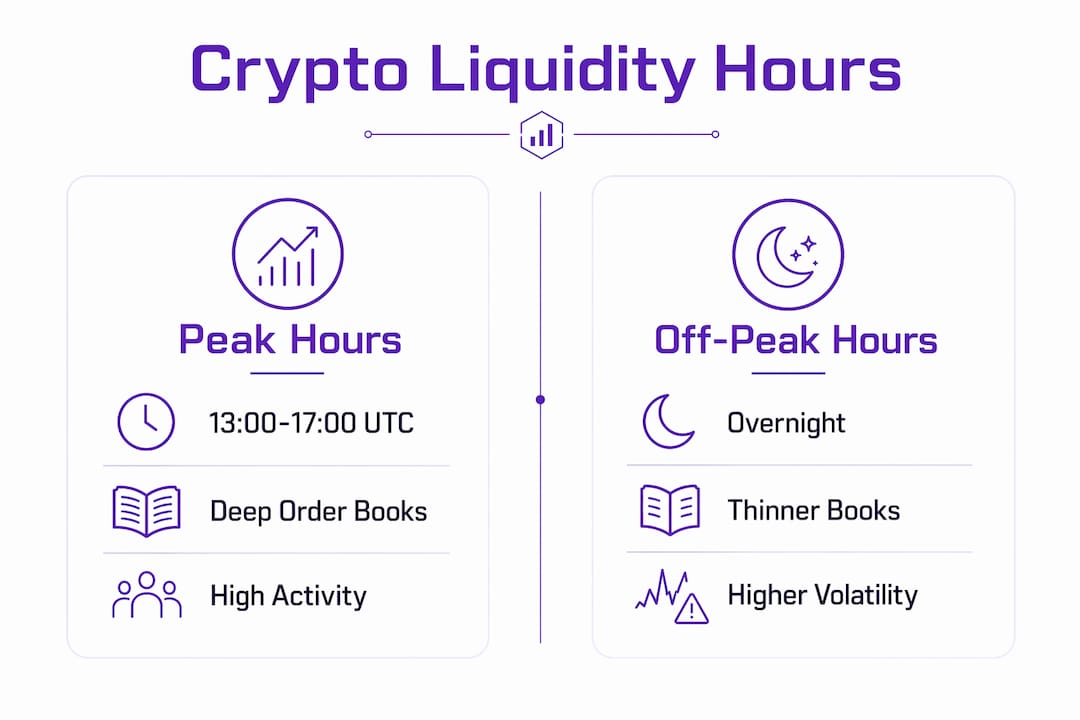
Market access and market depth are not the same thing. Liquidity in crypto clusters around three regional sessions: Asia (00:00–08:00 UTC), Europe (08:00–17:00 UTC), and the US (13:00–22:00 UTC). The US-Europe overlap from 13:00 to 17:00 UTC is where conditions tighten most.
Regional liquidity windows at a glance:
- US-Europe overlap (13:00–17:00 UTC): Highest liquidity, tightest spreads, strongest price discovery. NYSE/NASDAQ open, CPI releases at 13:30 UTC, CME futures activity.
- US session (17:00–22:00 UTC): High liquidity, tight spreads. FOMC decisions at 19:00 UTC on meeting days, CME settlement.
- European morning (08:00–13:00 UTC): Moderate to high liquidity. ECB decisions, London institutional flow.
- Asian session (00:00–08:00 UTC): Low to moderate liquidity, wider spreads. Chinese macro data, Bank of Japan decisions.
- Weekend and off-peak (Saturday–Sunday, 22:00–06:00 UTC weekdays): Lowest liquidity, widest spreads, retail-dominated.
Academic analysis of 1,940 cryptocurrency trading pairs across 38 global exchanges confirms that trading activity and volatility peak between 16:00 and 17:00 UTC, corresponding to late afternoon in London and late morning in New York. This is the window where liquidity concentration around major financial hubs creates the most efficient conditions for execution.
Pro Tip: If you trade Bitcoin or major altcoins, the 13:00–17:00 UTC window gives you the deepest order books and the lowest execution cost. Treat everything outside that window as a different risk environment, not just a quieter version of the same one.
What are the real risks of trading during low-liquidity hours?
Off-peak crypto trading carries a specific set of structural risks that go beyond simple price uncertainty. Weekend trading volume can be substantially lower compared to weekdays, thinning order books such that smaller orders may impact prices more sharply.
Core risks during after-hours or low-liquidity windows:
- Wider bid-ask spreads: A BTC/USD spread that is relatively tight during US trading hours can widen noticeably during low-liquidity periods like a Saturday afternoon.
- Slippage: Thinner books mean your fill price diverges from your expected price, especially on larger orders.
- Flash crashes: Cascading stop-losses in thin markets can trigger dramatic moves that deeper books would absorb.
- Market manipulation: The CFTC specifically warned that extended hours create greater opportunities for manipulation in less-observed, off-peak periods.
- Maintenance interruptions: Even 24/7 venues have scheduled breaks. CME’s Saturday 2:00–4:00 AM CT window is one example. Automated systems that ignore maintenance windows can generate failed orders or unmanaged positions.
- Psychological overexposure: A market that never closes creates pressure to monitor continuously, which leads to fatigue, impulsive decisions, and overtrading.
Pro Tip: Apply your risk management framework consistently across all hours, not just peak sessions. A stop-loss that works at 15:00 UTC needs to be equally active at 03:00 UTC, because the market does not pause while you sleep.
How professional traders manage a market that never closes
The defining discipline of professional crypto trading is not trading more. It is trading selectively. Professionals identify two or three windows that align with their strategy and liquidity requirements, then treat the rest of the day as monitoring time rather than execution time.
Practical tactics used by systematic traders:
- Time-filter rules in automated systems: Bots restrict live order execution to high-liquidity windows like the US-Europe overlap and shift to monitoring mode during off-peak hours to reduce slippage.
- Continuous stop-loss and take-profit coverage: Every open position carries protective orders at all times. The 24/7 nature of crypto means a gap past a stop-loss, common in equities over weekends, is largely eliminated.
- Maintenance-aware execution logic: Automated systems check exchange status before submitting orders. A bot that fires into a maintenance window creates a failed trade with no position feedback.
- Session-based performance review: Rather than reviewing trades in real time, professionals batch their analysis to specific windows, reducing reactive decision-making.
- Defined rest periods: A well-rested trader executing two quality setups per day consistently outperforms one monitoring screens for sixteen hours. This is not a soft suggestion; it is a structural edge.
Darkbot’s AI-powered automation is built around exactly this kind of rule-driven execution. The platform applies time-based filters, monitors exchange status, and maintains protective order coverage without requiring continuous manual oversight.
What is the regulatory status of after-hours crypto trading in the US?

Crypto spot trading is legal for US residents at any hour on registered exchanges. There is no federal rule restricting when you can buy or sell Bitcoin or Ethereum on a licensed platform. The regulatory complexity sits at the derivatives layer.
The CFTC oversees crypto futures and options. Its may 2026 advisory drew a clear line: 24/7 trading is appropriate for blockchain-native crypto markets because the underlying asset never stops trading. The same agency approved perpetual futures contracts for crypto-native platforms on the same day it issued that advisory, signaling a deliberate policy direction. Traditional derivatives markets covering agricultural products or interest rates received a different message: expanded hours may not suit their customer bases or hedging structures.
For US traders, the practical implication is that regulated crypto derivatives are now accessible around the clock through CME Globex, while spot trading on licensed centralized exchanges has always been available at any hour.
How does off-peak trading affect price volatility and manipulation risk?
Price volatility in crypto follows liquidity. When order books thin out during overnight or weekend hours, the same dollar volume of buying or selling produces larger price moves. This is not a bug in the system; it is a direct consequence of reduced market depth.
The manipulation risk is structural. With fewer participants active, a coordinated actor needs less capital to move prices, trigger stop-losses, or create artificial momentum. The CFTC’s advisory named this explicitly, noting that reduced liquidity during extended hours creates “greater opportunities for market manipulation.” Exchanges are expected to implement compliance measures specifically designed for these windows, including enhanced surveillance during off-peak periods.
Which platforms support 24/7 crypto trading?
Most major centralized exchanges run spot markets continuously. Binance, Coinbase, and Kraken accept spot orders at all hours, with only brief announced maintenance windows causing temporary interruptions. Decentralized exchanges settle trades directly on-chain and have no operator-controlled downtime at all.
On the regulated derivatives side, CME Globex now offers 24/7 cryptocurrency futures and options, including Bitcoin Volatility futures. Bitnomial’s perpetual futures trade 24/7 with a weekly maintenance window on Fridays from 5:00 to 7:00 PM CT. Spot ETFs remain tied to NYSE hours, closing at 4:00 PM ET on weekdays.
How does 24/7 access affect retail traders differently than institutions?
Institutions generally benefit more from the CME’s move to 24/7 regulated derivatives. They can now hedge spot exposure over weekends using regulated futures, something previously impossible. During the inaugural weekend of 24/7 trading on CME, over 7,200 contracts were traded with a notional value of approximately $50 million by a mix of retail and institutional participants, but the infrastructure requirements, clearing relationships, and risk management systems involved favor institutional actors.
Retail traders gain the theoretical benefit of continuous access but face a practical disadvantage: they typically lack the automated systems needed to manage positions safely during off-peak hours. A retail trader who leaves an unprotected position open overnight is exposed to the same flash-crash risk that a systematic bot handles through continuous stop-loss monitoring.
Practical tools for monitoring and executing trades during extended hours
Managing a 24/7 market without burning out requires a structured toolkit. The goal is coverage without constant attention.
- Automated bots with time filters: Set execution windows to match your target liquidity session. Outside those windows, the bot monitors but does not trade.
- Exchange status feeds: Binance, Coinbase, and Kraken each publish real-time status pages and support alert subscriptions. Check these before entering positions near known maintenance windows.
- Persistent stop-loss and take-profit orders: Server-side order management keeps protective orders active even when your connection drops.
- Portfolio dashboards with alerts: Real-time analytics that flag abnormal price moves or spread widening let you respond to off-hours events without staring at charts.
- Session-based trade logs: Reviewing performance by trading session rather than by calendar day reveals which windows actually produce your edge.
Darkbot’s portfolio management tools combine real-time analytics, automated rebalancing, and configurable execution rules, giving traders a structured way to stay covered across all hours without manual intervention at every step.
Key Takeaways
Crypto markets never close, but liquidity does thin dramatically outside major financial hub hours, and that distinction drives every meaningful decision about when and how to trade.
| Point | Details |
|---|---|
| No true “after hours” in spot crypto | Spot markets run 24/7/365 on blockchain networks; low-liquidity windows are the functional equivalent. |
| CME now trades 24/7 | As of may 2026, regulated crypto futures run continuously, with over 7,200 contracts traded and approximately $50 million in notional value recorded on their inaugural weekend. |
| Peak liquidity window | The US-Europe overlap (13:00–17:00 UTC) offers the tightest spreads and deepest order books for execution. |
| Off-peak volume drops sharply | Weekend trading volume falls 40–60% versus weekdays, widening spreads and increasing slippage risk. |
| Automation requires maintenance awareness | Bots must check exchange status before executing; maintenance windows like CME’s Saturday 2:00–4:00 AM CT break can cause silent trade failures. |
Recommended

Start trading on Darkbot with ease
Come and explore our crypto trading platform by connecting your free account!
Free plan available • No credit card required