Optimize crypto strategies: advanced automation for profits

TL;DR:
- Effective crypto trading depends on robust systems that incorporate clean data, reliable automation, and clear strategies to withstand market shifts. Using ensemble machine learning models, implementing strict risk controls, and continuous monitoring improve long-term resilience and performance. Simplifying strategies and prioritizing risk management ultimately enhance survival and consistent compounding in volatile markets.
Volatility, false signals, and strategy overfitting have quietly derailed the accounts of traders who thought they had everything figured out. You nail a backtest, deploy your strategy, and watch it hemorrhage capital the moment market conditions shift even slightly. The real problem is not a lack of intelligence or effort. It is a lack of systems. In 2026, advanced automation combined with rigorous risk controls gives you a structural edge over manual trading, and this guide walks you through exactly how to build, deploy, and protect a strategy that holds up when markets get ugly.
Key Takeaways
| Point | Details |
|---|---|
| Ensemble ML outperforms | Models like XGBoost and hybrid approaches beat deep learning and complex optimization in real crypto markets. |
| Automation demands discipline | Signal generation is not enough—automated risk controls and monitoring are vital to survive volatility. |
| Simplicity wins long term | Overly optimized strategies often fail; robust, simple methods with aggressive risk management usually outperform. |
| Verify, adapt, repeat | Constant backtesting, live monitoring, and adjusting for new regimes keeps strategies profitable and safe. |
What you need to optimize crypto strategies
Before touching a single line of code or connecting an exchange API, you need the right foundation. Successful automated crypto trading depends on three core inputs: clean market data, a reliable automation platform with proper backtesting, and a clearly defined strategy type.
Essential requirements at a glance:
- Market data access: Real-time and historical tick-level data for the assets you plan to trade
- Automation platform: A system that handles signal generation, order execution, monitoring, and risk controls in a coordinated loop
- Strategy selection: Choose from momentum, mean reversion, funding arbitrage, or statistical arbitrage based on current market regime
- Capital allocation: Enough to absorb normal drawdown without triggering psychological panic selling
The table below breaks down what each component typically involves in practice:
| Component | Software/Tool type | Typical capital commitment | Complexity level |
|---|---|---|---|
| Market data | Exchange API or data vendor | Low (often free tier) | Low |
| Signal generation | ML model or rule-based indicator | Low to medium | Medium to high |
| Order execution | Automation platform | Medium | Medium |
| Risk controls | Built-in bot logic | Varies | Medium |
| Backtesting engine | Historical simulator | Low | Medium to high |
When it comes to signal generation, the evidence strongly favors ensemble machine learning approaches. Ensemble methods like XGBoost and Gradient Boosting outperform deep learning architectures like LSTM for crypto price prediction, achieving R² scores near 0.98 and low error rates across 30 different cryptocurrencies. This matters because deep learning models demand massive datasets and tuning time, while ensemble approaches are more interpretable and stable out of sample.
Building smarter crypto strategies often means layering ensemble ML models with reinforcement learning decision engines, a hybrid approach that consistently outperforms single-method setups in volatile conditions. The fintech crypto automation ecosystem has matured to support these architectures without requiring a PhD. Consult an AI trading bots guide if you want a vendor-neutral overview of what today’s automation infrastructure looks like.
Pro Tip: Do not start by building the most sophisticated model possible. Research consistently shows that simple, well-validated momentum models outperform heavily tuned strategies out of sample. Start with a robust, interpretable model and only add complexity when data justifies it.
Step-by-step: Designing high-performing crypto strategies
With your toolkit assembled, here is the sequence that turns research into a live, automated strategy:
- Research and hypothesis formation. Define the market inefficiency you are targeting. Is it trending behavior after high-volume breaks? Mean reversion after exchange-specific liquidation events? Be specific. Vague hypotheses produce untestable strategies.
- Feature engineering. Build your inputs from raw price, volume, funding rates, and on-chain data. For ensemble models, interaction features between multiple timeframes often provide the most predictive power.
- Model selection and training. Start with Gradient Boosted Regression Trees (GBRT) or XGBoost. These handle non-linear relationships better than linear models and are far less prone to overfitting than neural networks on crypto-sized datasets.
- Backtesting with walk-forward validation. Never test on the same data you trained on. Walk-forward validation splits your data into rolling training and test windows, simulating real deployment conditions.
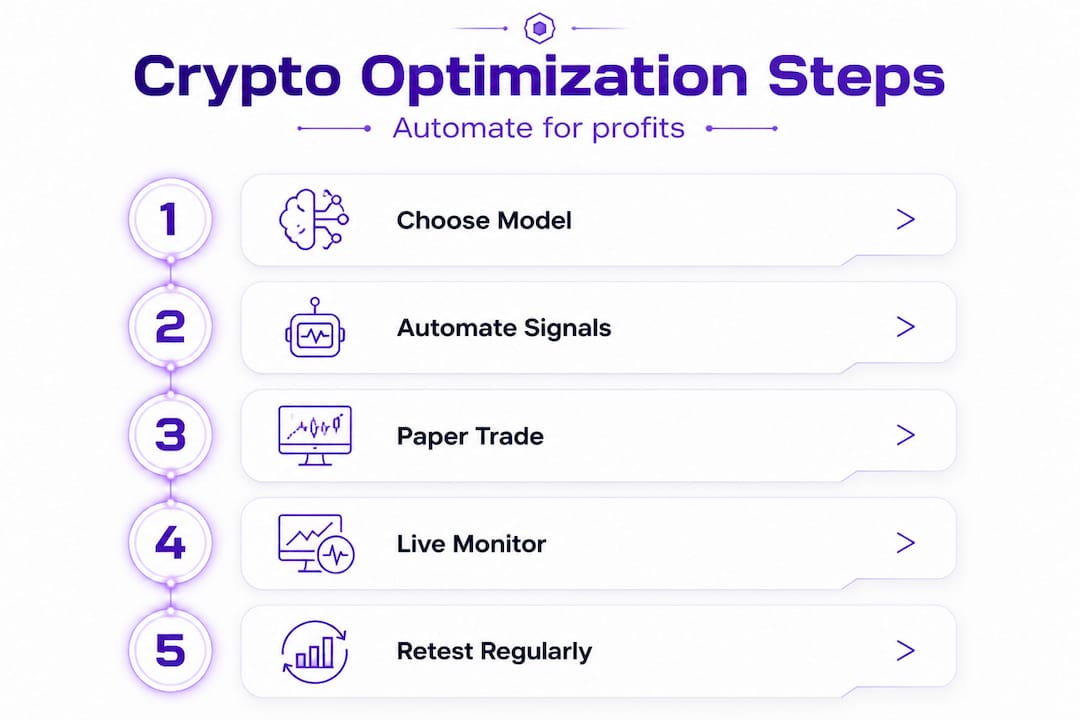
- Execution automation. Connect your signal model to an order management layer. Start by automating signal generation only, then expand to order execution once you have verified signal accuracy in paper trading.
- Monitoring and iteration. Set up real-time dashboards tracking Sharpe ratio, drawdown, slippage, and win rate. Treat live performance as another data source for model refinement.
Comparison of strategy modeling approaches:
| Approach | Performance | Interpretability | Out-of-sample robustness |
|---|---|---|---|
| Ensemble ML (XGBoost, GBRT) | High | Medium | High |
| Deep learning (LSTM, Transformer) | Variable | Low | Low to medium |
| Hybrid ML/RL | Very high | Medium | Very high |
| Simple rule-based | Medium | High | Medium to high |
The performance data backs this up. Empirical benchmarks from peer-reviewed research show Soft Actor-Critic (SAC) achieving 152% excess returns with a Sharpe ratio of 2.81 on ETH/USDT, Rainbow DQN producing 287% returns in trending markets, and hybrid ML/RL setups reducing drawdown by 63% during the LUNA crisis and by 23.8% during the March 2020 crash. These are not cherry-picked results from a marketing deck. They are benchmarked against buy-and-hold across multiple crisis periods.
“Hybrid ML/RL setups consistently reduce drawdown during black swan events while preserving trend-following upside, outperforming pure deep learning and pure rule-based systems across every tested regime.”
For strategy type selection, crypto automation explained in detail covers which approaches work in trending versus choppy markets. Funding arbitrage on perpetual futures is especially attractive in sideways markets where directional strategies underperform. The 1Token Quant Indices track real-money quant strategy performance monthly, which is a reliable benchmark for measuring your results against the broader systematic trading community.
For deeper context on how machine learning fits into the crypto investment lifecycle, the ML in crypto investing guide walks through implementation without assuming a quant background.
Pro Tip: Start with one core strategy and automate it in incremental stages. Automate signal generation first, then paper trade execution, then go live with small sizing. Rushing all stages to production simultaneously is where most automation projects break down.
Risk management: Automation, diversification, and edge cases
A brilliant signal model with poor risk management will blow up. Execution quality and position control, more than signal accuracy, determine whether you compound capital or crater it.
Essential automation-friendly risk controls:
- Volatility-adjusted position sizing: Scale your position size inversely to recent volatility. The standard 2% rule limits any single trade to 2% of total account equity, adjusted down further in high-volatility regimes.
- ATR-based dynamic stops: Average True Range (ATR) stops scale with actual market movement, preventing you from getting stopped out by normal fluctuation while still protecting against real trend breaks.
- Regime filtering: Automatically detect trending versus choppy market conditions and only activate strategies suited to the current regime.
- Max drawdown triggers: Set automated halt rules at 20%, 30%, and 40% portfolio drawdown thresholds, forcing a review before further capital is at risk.
- Liquidity limits: Cap position size at a percentage of the asset’s average daily volume, typically a maximum of one day’s volume, to avoid massive slippage on exits.
- Correlation management: Track rolling correlations across your open positions. In crashes, crypto correlations often converge toward 1.0, making “diversified” portfolios behave like concentrated single-asset bets.
Regime filtering alone adds 1.54% to net profit and cuts drawdowns by 1.55% over a six-year backtested period, filtering out only 4.3% of total trades. That is an exceptional efficiency trade-off. You sacrifice a tiny fraction of trade volume to meaningfully improve the long-term equity curve.

The overfitting trap is equally dangerous. A backtest showing a Sharpe of 3.19 during validation collapsed to 0.46 on out-of-sample data in documented research, while a simple momentum approach returned 69% versus only 29% for the heavily optimized version. Complexity does not protect you. Robust, simple controls do.
For a broader look at how automation handles risk systematically, smart risk automation and risk management fundamentals both cover practical implementation frameworks that translate directly to bot configuration. External resources like advanced risk strategies provide a vendor-neutral perspective on AI-powered risk layers.
Pro Tip: Build automated circuit breakers into your bot logic for flash crashes. Simple adaptive grid logic that widens stop spacing during abnormal volatility spikes can keep you in a position through a temporary shock rather than locking in a loss at the worst possible moment.
Verifying and improving: Backtesting, monitoring, and surviving real markets
Deploying a strategy is not the end of the process. It is the beginning of a continuous verification loop that keeps your edge alive as market conditions evolve.
Robust backtesting checklist:
- Walk-forward validation: Roll your training and test windows forward in time, never using future data to fit past parameters.
- Multi-regime testing: Your strategy must be tested across trending, choppy, and crisis periods. A strategy that only worked during a 2020 or 2021 bull run is not validated.
- Stress testing under abnormal liquidity: Simulate the conditions where exchange order book depth dropped 80% to 95% during the LUNA collapse and other liquidity crises. If your strategy cannot survive those conditions in simulation, it will not survive them live.
- Slippage and fee inclusion: Gross returns in backtests look far better than net returns after realistic slippage and fees. Always include them.
- Monte Carlo simulation: Run thousands of randomized trade sequence simulations to understand the probability of your worst-case drawdown scenario, not just the average case.
Warning signs that your automation is underperforming:
- Live Sharpe ratio is more than 30% below backtested Sharpe within the first three months
- Win rate drops sharply after a volatility regime change
- Slippage on live execution consistently exceeds backtest assumptions
- Drawdown recovery time is lengthening across successive drawdown episodes
- Model feature importance has shifted significantly from original training distribution
Monitoring is not optional once you are live. Set up automated alerts for each of the warning signs above, and treat any trigger as a mandatory review event rather than background noise. An audit trail of every live trade, with timestamps, fills, and slippage data, is essential for diagnosing where the strategy deviates from simulation.
For context on how AI in volatile markets maintains resilience through regime shifts, the principles overlap directly with monitoring frameworks. A comprehensive trading bot auditing process should be part of your quarterly operations review.
Pro Tip: Schedule a formal out-of-sample retest every 90 days. Markets shift regime roughly every one to three quarters, and parameters that were optimal six months ago may now be fitting historical noise rather than exploitable structure.
The uncomfortable truth about optimizing crypto strategies
Here is something most automation guides will not tell you: the traders who consistently outperform are not the ones with the most sophisticated models. They are the ones with the most ruthless risk discipline and the fastest regime recognition.
We see this pattern repeatedly. A trader builds an intricate multi-factor model with 40 features, optimized Sharpe of 3.2, beautiful equity curve. Then a narrative shift happens, liquidity dries up in their target assets, and the model goes quiet for six weeks before starting to slowly bleed. The problem was not the model. It was the absence of a decision rule for what to do when the model stopped working.
The data is blunt on this. Risk management outperforms prediction for long-term survival. Over-optimization fails out of sample. Maximalism in any form, whether single-asset concentration or single-strategy reliance, creates hidden fragility. Diversification captures more opportunities but demands far more rigorous correlation monitoring to actually work.
The practical implication is uncomfortable: you probably need to simplify your strategy, not optimize it further. Remove features that barely improve predictive power but significantly increase parameter count. Set hard rules for when your strategy gets paused, not just reduced. Treat losing streaks as signals for regime review, not psychological challenges to push through.
Smarter automated trading is ultimately about building systems that fail gracefully, adapt quickly, and survive long enough to compound. A strategy that returns 30% annually with controlled drawdowns will outperform a 90% return strategy that blows up every three years without exception. Compounding requires survival first.
Next steps: Automate and optimize with confidence
The frameworks in this guide only create results when they are implemented through reliable automation infrastructure. Building your own execution layer from scratch is possible, but it introduces engineering risk that most traders underestimate.
Darkbot.io provides the automation foundation that lets you focus on strategy and risk logic rather than infrastructure plumbing. From multi-exchange API integration and strategy customization to portfolio optimization tools and real-time analytics, the platform supports the full strategy lifecycle covered in this guide. Whether you are running an ensemble ML signal model, implementing regime filters, or managing drawdown triggers across multiple bots simultaneously, Darkbot’s flexible tier structure accommodates everything from first-time automation to professional-grade systematic trading. Your next logical step is connecting your strategy to infrastructure that executes it reliably, 24 hours a day, without manual supervision.
Frequently asked questions
How do ensemble methods like XGBoost improve crypto predictions?
Ensemble methods such as XGBoost combine multiple models to capture diverse patterns and reduce overfitting, often outperforming deep learning for crypto price prediction, with R² scores near 0.98 across 30 cryptocurrencies.
What is regime filtering and why is it crucial for crypto automation?
Regime filtering detects periods when a strategy is likely to underperform and pauses or switches it automatically. Filtering just 4.3% of trades via regime detection added 1.54% to net profit and cut drawdowns by 1.55% over six years in documented backtests.
How can I prevent overfitting in my crypto trading backtests?
Use walk-forward validation and always test on out-of-sample data. Research shows a Sharpe ratio drop from 3.19 to 0.46 between validation and real test sets when strategies are over-tuned.
Which automation features are most important for advanced crypto risk management?
The highest-impact features are volatility-adjusted position sizing, ATR-based dynamic stops, regime filters, and automated drawdown halts. These controls together form a layered defense that keeps you in the game through normal market stress.
Should I focus on diversification or stick to what I know in 2025?
Both approaches have merit, but the data suggests that risk management outperforms prediction for long-term survival, making strong risk controls more important than the diversification versus concentration choice itself.
Recommended
- Trading Strategy Optimization: Boosting Crypto Profits
- Optimize automated crypto trading: 152%+ returns safely
- Crypto Trading Strategy Optimization for Profitable Automation
- Crypto Trading Strategy Optimization Steps for Profits
- Optimizing Automated Trading Strategies for Long-Term Profitability
- How to Automate Trade Execution for Proven Results - My Framer Site

Start trading on Darkbot with ease
Come and explore our crypto trading platform by connecting your free account!
Free plan available • No credit card required