What is robot trading? A guide to automated crypto profits
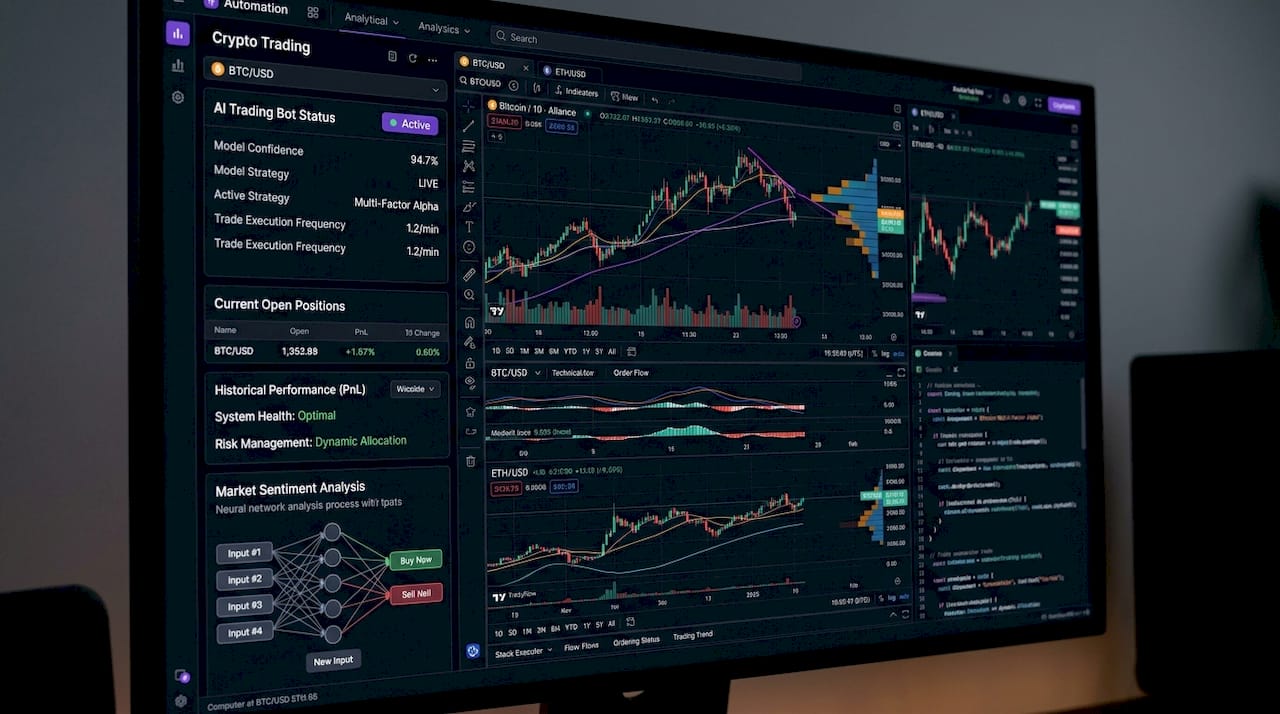
The idea that a bot can print profits while you sleep has pulled in thousands of crypto traders. But here’s the reality: 65 to 80% of crypto volume is already automated, mostly by institutions with sophisticated strategies built over years. Retail traders who jump into bots without understanding the mechanics often amplify losses rather than gains. This guide breaks down exactly what robot trading is, how it works, where it genuinely helps, and the security and strategy fundamentals that separate profitable automation from expensive mistakes.
Key Takeaways
| Point | Details |
|---|---|
| Robot trading defined | Automated bots execute trades based on predefined strategies, not human emotions. |
| Automation’s true value | Efficiency and speed are advantages, but profitability depends on proven manual strategies. |
| Risk and security essentials | API security and rigorous backtesting are critical to success and safety. |
| Choose the right timing | Only automate after you’ve consistently succeeded with manual trading. |
| Realistic expectations | Bots amplify your strategy—profitable or not—so proper preparation is vital. |
Defining robot trading: Automation in action
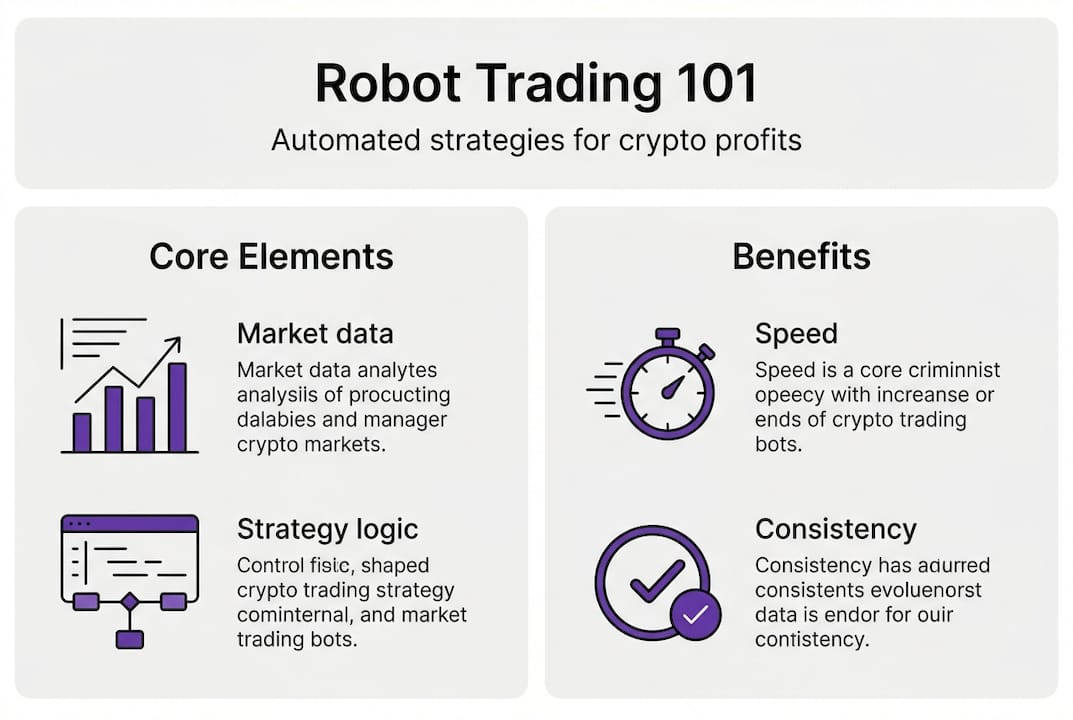
Robot trading, at its core, means using software to buy and sell crypto automatically. No manual clicks, no emotional decisions, no missed signals at 3 a.m. Algorithmic trading in crypto refers to automated programs that execute orders on exchanges based on predefined rules, market data, and strategy logic. You set the conditions; the bot acts.

Every trading bot relies on four core components: market data input (price feeds, order book depth, volume), a strategy or algorithm (the logic that decides when to trade), order execution (the actual placement of buy/sell orders), and exchange APIs (the connection between the bot and the exchange). Understanding these basics is the first step toward robot trading basics that actually work.
There are several common bot types, each built for a different purpose:
| Bot type | Primary purpose | Complexity |
|---|---|---|
| Signal bot | Trades based on technical indicators | Low to medium |
| Arbitrage bot | Exploits price gaps across exchanges | Medium to high |
| Market-making bot | Places buy/sell orders to profit from spread | High |
| HFT bot | Executes thousands of trades per second | Very high |
The advantages of automation are real when the strategy behind it is solid:
- Speed: Bots react in milliseconds, far faster than any human.
- 24/7 operation: Crypto markets never close; bots never sleep.
- Emotion-free execution: No panic selling, no greed-driven holds.
- Consistency: The same rules apply every single time.
- Scalability: One bot can monitor dozens of pairs simultaneously.
These benefits are why institutions dominate automated volume. But the same tools are now accessible to individual traders, provided they approach them correctly.
How do trading bots work? From strategy to automation
Knowing what a bot is and knowing how to deploy one safely are two very different things. The bot automation workflow follows a clear sequence, and skipping any step is where most traders run into trouble.
Here’s how the process works from start to live execution:
- Choose a strategy. Momentum, mean reversion, arbitrage, grid trading — pick one you understand and have tested manually.
- Select an exchange. Make sure your chosen bot platform supports it via API.
- Connect via API keys. Generate trade-only keys with withdrawal permissions disabled.
- Define your parameters. Set entry/exit rules, position sizes, stop-loss levels, and any filters.
- Backtest your strategy. Run it against historical data to see how it would have performed.
- Paper trade. Simulate live trading with no real money to validate real-time behavior.
- Go live with small capital. Start conservatively and scale only after consistent results.
The critical insight most guides skip: automate only after manual profitability. Bots amplify whatever edge or flaw already exists in your strategy. If you are not profitable trading by hand, a bot will not fix that. It will just lose money faster.
Pro Tip: Always paper trade a new bot for at least two to four weeks before committing real funds. Market conditions shift, and what looks perfect in backtesting can behave very differently in live conditions.
Advanced platforms now incorporate AI and machine learning to refine strategy optimization over time, adjusting parameters as market regimes change. This adds a layer of adaptability that static rule-based bots lack, but it still requires a sound foundational strategy to work from.
Robot trading pros, cons, and common pitfalls
Automation is a tool, not a guarantee. Understanding both sides of the equation is what keeps traders from making costly assumptions.
| Advantage | Challenge |
|---|---|
| Trades 24/7 without fatigue | Cannot adapt to unexpected market events |
| Executes faster than any human | Amplifies bad strategies at scale |
| Removes emotional decision-making | Requires ongoing monitoring and maintenance |
| Enables backtesting and iteration | API exposure creates security vulnerabilities |
| Scales across multiple assets | Regulatory landscape is still evolving |
The stat that should reset expectations: 70 to 90% of retail traders lose money using bots. Automation does not create an edge. It scales one.
“Automation doesn’t guarantee profit. It amplifies whatever strategy you feed it, good or bad.”
The most common mistakes traders make when starting out with bots:
- Using untested or copied strategies without understanding the logic
- Ignoring API security and leaving withdrawal permissions enabled
- Overestimating bot intelligence — bots follow rules, they do not think
- Skipping paper trading and going straight to real capital
- Failing to monitor bots during high-volatility events
Two specific technical risks deserve attention. Overfitting happens when a strategy is tuned so precisely to past data that it fails in live markets. Market regime changes — like a sudden shift from a bull to a bear trend — can make a previously profitable strategy lose consistently. Exploring the automation pros and pitfalls in depth before committing capital is time well spent. For those just getting started with exchange accounts, reviewing crypto account setup guidance is a practical first step.
Key risk management: API security, testing, and safe integration
Even a perfect strategy can result in losses if your bot setup is not secure. Security is not optional. It is the foundation everything else rests on.
The minimum standard for any bot deployment: use trade-only API keys with withdrawal permissions disabled, and whitelist only the IP addresses your bot runs from. These two steps alone block the most common attack vectors. API key security is one of the most overlooked areas in retail bot trading, and the consequences of getting it wrong are irreversible.
Here is a practical security checklist every bot trader should follow:
- Generate trade-only API keys. Never enable withdrawal permissions on a bot-connected key.
- Enable IP whitelisting. Restrict API access to your bot’s specific server or IP.
- Use strong, unique passwords for exchange accounts and bot platforms.
- Audit API permissions regularly. Revoke old or unused keys immediately.
- Store keys securely. Never hardcode API keys in scripts or share them in public repositories.
- Enable two-factor authentication on all exchange and platform accounts.
Pro Tip: Many exchanges offer sandbox or testnet environments. Use them to test your bot’s behavior under real market conditions without any capital at risk before going live.
Poor setup creates risk before a single trade is placed. API trading bot risks include unauthorized access, key leakage, and misconfigured permissions that expose your funds. Following API integration best practices from day one prevents the majority of these issues.
Who should automate? When bots truly help traders
Not every trader is ready for automation, and recognizing where you stand is more valuable than any bot feature list.
Traders who benefit most from automation share a few common traits. They have a systematic, rule-based approach they already apply manually. They trade multiple assets or time zones that make 24/7 coverage impossible by hand. They want to remove emotional interference from a strategy that already works. And they have the technical comfort level to manage API connections and monitor performance.
Here is when automation genuinely makes sense:
- You have a proven manual strategy with a documented track record
- You need round-the-clock market coverage across multiple pairs
- Your strategy involves high-frequency signals that are impossible to execute manually
- You want to manage a diversified portfolio without constant attention
- You are ready to invest time in setup, testing, and ongoing oversight
On the other hand, automation is the wrong move if you are not yet consistently profitable trading by hand. Automate only after manual profitability is not just advice; it is the single most important filter for whether a bot will help or hurt you. Bots do not create strategy. They execute it.
Red-flag situations to avoid: trading unfamiliar markets with a bot, deploying automation without a clear exit or stop-loss logic, or using a bot on an exchange you have not traded manually. If you are exploring digital currency considerations for the first time, build your manual skills first. The beginner automation workflow is a useful reference for structuring that progression.
A trader’s perspective: Why mastering the basics outweighs any bot
Here is the uncomfortable truth most automation content avoids: the bot is rarely the problem. The strategy is.
We see it constantly. Traders spend weeks comparing platforms, reading bot reviews, and optimizing parameters for a strategy they have never proven manually. Then they wonder why the bot loses. The answer is simple: bots amplify both edge and error. If the strategy has no edge, the bot just finds that out faster and at greater cost.
The traders who succeed with automation are almost always the ones who were already winning without it. They automated because they wanted to scale, not because they hoped the bot would solve a strategy problem. That distinction matters enormously.
Constant learning, rigorous backtesting, and honest performance review matter more than which platform or algorithm you choose. The best profitable automation strategies are built on months of manual observation, not copied from a forum post. Treat automation as a scaling tool, not a shortcut, and the results will reflect that mindset.
Ready to try automated crypto trading solutions?
If you have built a solid manual strategy and you are ready to scale it with automation, the next step is choosing a platform built for serious traders.
Darkbot offers AI-powered automated trading with seamless exchange integration, secure API management, and strategy customization designed for both developing and experienced traders. From hands-free crypto portfolio management to multi-bot deployment and real-time analytics, the platform is built to scale what already works. Explore flexible plans, including a free tier to get started, and see how structured automation can bring consistency and efficiency to your trading operation.
Frequently asked questions
Are trading bots profitable for beginners?
Generally, no. Trading bots amplify existing strategies, and since most beginners lack a proven edge, bots tend to accelerate losses rather than generate profits.
Do I need coding skills to use a crypto trading bot?
Not always. Many platforms offer no-code interfaces, but understanding trading logic and strategy is essential regardless of your technical background.
What is the biggest risk with crypto trading bots?
Poor API security and untested strategies are the top risks. Bots amplify both edge and error, so a security breach or flawed strategy can cause significant losses quickly.
How do I start with robot trading safely?
First become consistently profitable trading manually, then backtest your strategy, use trade-only API keys, and paper trade before committing any real capital.
Can robot trading help manage a diversified portfolio?
Yes. Bots are well suited for balancing trades across multiple crypto assets simultaneously, provided the underlying strategy and platform are reliable.
Recommended

Start trading on Darkbot with ease
Come and explore our crypto trading platform by connecting your free account!
Free plan available • No credit card required