Day trading crypto: proven strategies and automation guide
TL;DR:
- Most crypto day traders lose money due to emotional decisions, overtrading, and high fees.
- Automating trading with disciplined oversight improves consistency and reduces human errors.
- Success relies on strategic session timing, multi-venue execution, and ongoing performance optimization.
Most people assume that trading cryptocurrency is a fast track to profits. The reality is far more sobering. 70 to 90% of day traders lose money, and the crypto market’s unique structure makes those odds even harder to beat. Emotional decisions, runaway fees, and a market that never sleeps conspire against the unprepared trader. But here’s where things get interesting: automation is fundamentally changing what’s possible, shifting the advantage toward disciplined traders who understand both the mechanics and the tools at their disposal.
Key Takeaways
| Point | Details |
|---|---|
| Market structure matters | Crypto trades 24/7 with unique liquidity risks and fragmentation that impact profitability. |
| Automation isn’t magic | Bots can boost efficiency, but oversight and disciplined strategies are essential for success. |
| Focus on liquid pairs | Trading top crypto pairs like BTC/USD and ETH/USD yields better execution and less slippage. |
| Risk controls are crucial | Multi-venue trading, monitoring, and volatility-aware models help you withstand flash crashes and outages. |
| Continuous optimization wins | Profitable traders iterate their strategies, balance automation with manual checks, and respond to new market conditions. |
Understanding the structure of crypto markets
With these pitfalls in mind, let’s break down the market mechanics that make crypto day trading uniquely challenging.
Crypto markets operate 24 hours a day, 7 days a week, 365 days a year. There are no closing bells, no weekend pauses, and no regulatory circuit breakers to slow a freefall. This is structurally different from equities or forex, where session closes force natural resets. For a day trader, this means opportunity is always present, but so is risk.
Liquidity is not evenly distributed across the clock. According to crypto market microstructure research, the market experiences significant liquidity troughs between 02:00 and 06:00 UTC on weekends, when order books thin out and spreads widen. Trading during these windows means your orders face higher slippage, and a single large trade can move price more than you expect.
“The crypto market’s fragmented structure across dozens of exchanges means the same asset can trade at different prices simultaneously, creating both opportunity and execution risk for active traders.”
Market fragmentation is another layer of complexity. Unlike a centralized stock exchange, crypto trades across Binance, Coinbase, Kraken, OKX, and hundreds of smaller venues simultaneously. This fragmentation creates arbitrage opportunities, but it also means your execution quality depends heavily on which venue you’re using and when.
Here’s a quick look at how market conditions shift across sessions:
| Session | Liquidity level | BTC spread (typical) | Flash crash risk |
|---|---|---|---|
| Europe/US overlap (13:00-17:00 UTC) | High | 0.01% to 0.03% | Low |
| US session (14:00-22:00 UTC) | High | 0.01% to 0.04% | Low |
| Asia session (00:00-08:00 UTC) | Medium | 0.03% to 0.08% | Medium |
| Weekend early morning (02:00-06:00 UTC) | Low | 0.08% to 0.20% | High |
The absence of circuit breakers is worth emphasizing. Traditional markets halt trading when prices drop too fast. Crypto does not. Flash crashes, where prices drop 10% or more within minutes before recovering, happen regularly. Understanding this when building your trading strategies guide is not optional. It’s survival.
Reviewing strategy examples from experienced traders consistently shows that the most successful ones account for session-based liquidity shifts rather than treating all market hours as equal.
The major risks and why most day traders lose
Now that we understand the market framework, it’s clear why so many traders struggle to succeed.
The statistics are blunt. Between 70 and 90% of day traders lose money, and the causes are consistent: emotional trading, overtrading, and fees that silently erode any edge. These aren’t rookie mistakes exclusive to beginners. Experienced traders fall into the same traps under pressure.
Here are the four biggest reasons active crypto traders lose money:
-
Emotional decision making. Fear and greed override logic in real time. A trader who planned to exit at a 2% loss suddenly holds through a 15% drawdown, hoping for recovery. This is not a discipline failure. It’s human neurology working against you.
-
Overtrading. More trades mean more fees. On a platform charging 0.1% per trade, a trader making 20 round trips per day is paying 4% of their capital daily just in fees, before accounting for slippage. At that rate, you need an extraordinary win rate just to break even.
-
Slippage and execution costs. During volatile periods, the price you see and the price you get diverge. On thin order books, a market order can fill at 0.5% to 1% worse than expected. These costs compound fast in active strategies.
-
No systematic edge. Many traders enter positions based on intuition or social media sentiment rather than a repeatable, tested framework. Without a defined edge, trading is closer to gambling than investing.
Pro Tip: Before running any strategy live, calculate your total cost per trade including fees, slippage, and funding rates. If your expected profit per trade doesn’t comfortably exceed this number, the strategy will bleed you dry over time.
Automation addresses some of these risks but not all of them. Bots eliminate emotional execution and can process far more data than a human. But they require oversight, and high-frequency edges often vanish after accounting for real-world costs. Reviewing essential strategies before deploying a bot helps ensure you’re building on a foundation that has a realistic chance of surviving transaction costs.

How automation and bots change the game
Given these risks, many traders are turning to automation, but it’s important to know how these tools fit into your workflow.
Bots outperform humans in three specific areas: consistency, speed, and emotionless execution. A bot doesn’t panic during a flash crash. It doesn’t revenge trade after a loss. It executes the rules you set, every single time, without fatigue. For strategies that depend on precise entry and exit timing, this is a significant structural advantage.
The range of automated strategies available today is wide. Simple grid bots buy and sell at fixed price intervals, profiting from range-bound markets. More sophisticated systems use multifactor signal models, combining momentum indicators, volume analysis, and order book depth to route orders intelligently. Understanding the types of trading bots available is the first step to matching the right tool to your market thesis.
Here’s a direct comparison of trading approaches:
| Approach | Speed | Emotional control | Cost efficiency | Oversight needed |
|---|---|---|---|---|
| Manual trading | Slow | Poor | Low | Constant |
| Semi-automated (alerts + manual execution) | Medium | Moderate | Medium | Frequent |
| Fully automated bot | Fast | Excellent | High | Periodic |
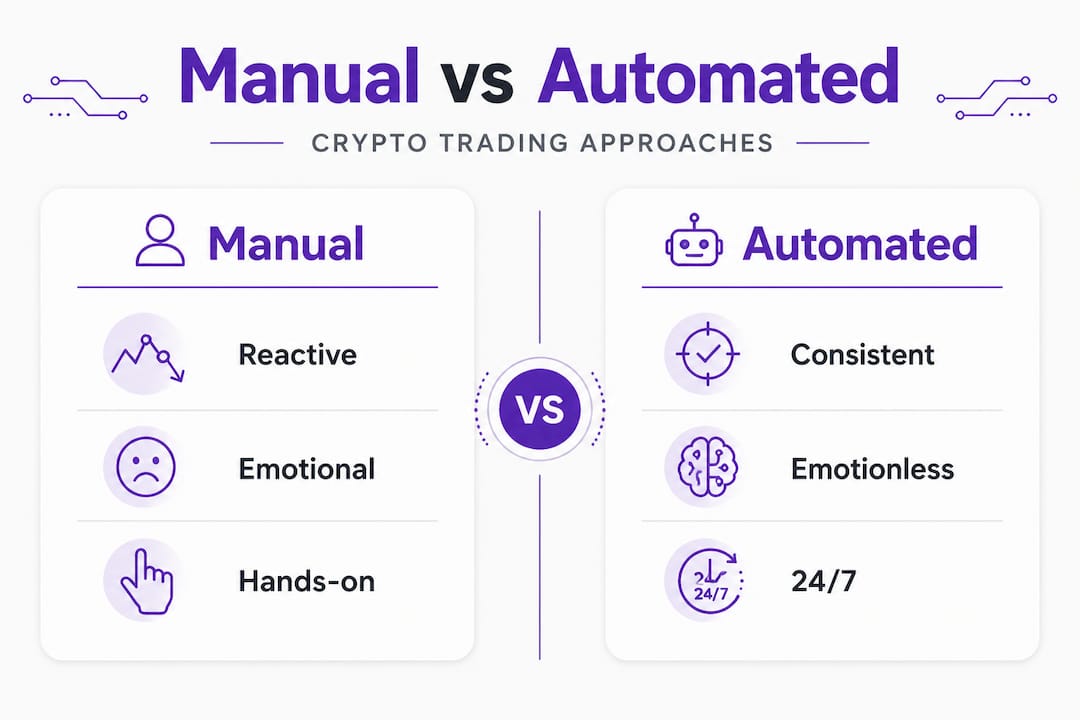
The table makes automation look like an obvious winner, and in many cases it is. But bots require oversight, and high-frequency edges often disappear once real costs are factored in. A bot running a strategy that worked perfectly in backtesting can fail in live markets due to slippage, exchange downtime, or sudden regime changes in volatility.
The right approach to automating your trading is not to set it and forget it. It’s to set it, monitor it, and adjust it as market conditions evolve. The automation advantages are real, but they require an operator who understands what the bot is doing and why.
Key capabilities to look for in any automated trading system:
- Multi-exchange connectivity via API keys for diversified execution
- Strategy customization with adjustable parameters for different market regimes
- Real-time risk controls including stop losses, position sizing limits, and volatility filters
- Portfolio rebalancing to maintain target allocations without constant manual intervention
- Transparent analytics so you can track performance and identify when a strategy is degrading
Practical strategies for automated day trading success
With a foundation in automation, let’s look at specific, battle-tested strategies you can implement right away.
The single most important filter for automated day trading is pair selection. Prioritizing liquid pairs like BTC and ETH dramatically reduces slippage and improves fill quality. Smaller altcoins may look attractive on paper due to larger price swings, but the execution costs and manipulation risk in thin markets often destroy any theoretical edge.
Session timing matters more than most traders realize. The Europe and US overlap window, roughly 13:00 to 17:00 UTC on weekdays, consistently offers the deepest liquidity and most reliable momentum setups. Mean reversion strategies tend to perform better during quieter Asian sessions, while trend-following approaches align better with the high-volume Europe and US windows. Using geometric grid spacing rather than linear grids also helps bots adapt to volatility expansions without over-trading in low-volatility periods.
Here’s a practical workflow for setting up an automated day trading bot:
- Select your pair and session window. Start with BTC/USD or ETH/USD during the Europe/US overlap for maximum liquidity.
- Define your strategy type. Choose between grid, momentum, mean reversion, or pairs trading based on current market regime.
- Set risk parameters first. Define maximum position size, daily loss limit, and slippage tolerance before touching entry logic.
- Backtest on realistic data. Use at least 6 months of tick data and include realistic fee assumptions.
- Paper trade for two weeks. Run the bot in simulation mode to catch logic errors without risking capital.
- Deploy with reduced size. Start at 25% of your intended position size and scale up only after confirming live performance matches expectations.
- Schedule regular reviews. Check performance weekly and recalibrate parameters if the strategy’s win rate or average profit per trade degrades.
Pro Tip: Always run your bot across at least two exchanges simultaneously. If one exchange experiences an outage or a liquidity spike, your strategy continues operating on the other venue. Multi-venue execution with heartbeat monitoring and volatility-scaled slippage models is the standard approach among serious algorithmic traders for managing flash crash and outage risk.
The optimization process behind a well-tuned bot is iterative, not a one-time setup. Markets shift, correlations break down, and volatility regimes change. Traders who treat their bots as living systems that require ongoing attention consistently outperform those who treat automation as a fire-and-forget solution.
Understanding the automation benefits goes beyond just removing emotions. It includes the compounding advantage of executing more setups per day at consistent quality, the ability to monitor multiple pairs simultaneously, and the discipline of never deviating from a tested framework. Combining this with solid strategy optimization creates a feedback loop that improves performance over time.
What most traders miss about crypto day trading
Most traders spend 80% of their energy searching for the next hot strategy and 20% on execution and risk control. The traders who actually build durable performance do the opposite.
Here’s the uncomfortable truth: the strategy itself is rarely the limiting factor. A simple moving average crossover with proper risk controls and consistent execution will outperform a sophisticated machine learning model that’s poorly monitored and over-leveraged. The edge in crypto day trading is not primarily about finding alpha. It’s about operational discipline.
Multi-venue hedging, real-time monitoring, and stable infrastructure are what separate traders who survive market dislocations from those who blow up. A flash crash on a single exchange is a catastrophic event if all your capital is there. It’s a minor inconvenience if you’re diversified across venues with automated failover logic.
Automation is not a magic bullet. It’s a discipline. The traders who benefit most from bots are those who already understand what they’re trying to accomplish and use automation to execute that vision with more precision and less emotional interference. Traders who deploy bots hoping the technology will figure out profitability for them almost always end up disappointed.
Human oversight remains the critical variable. Even the most sophisticated bot can’t recognize when market conditions have fundamentally changed, when an exchange is manipulating its order book, or when a macro event is about to invalidate every technical signal in the model. Reviewing your automation discipline regularly, asking whether your current setup still reflects your market thesis, is what keeps a bot profitable over months rather than just days.
The traders who thrive long-term treat automation as a partnership. They bring the judgment, the risk framework, and the ongoing oversight. The bot brings the consistency, speed, and emotionless execution. Neither works well without the other.
Take your crypto day trading to the next level
If you’ve made it this far, you understand that successful crypto day trading requires more than a good strategy. It requires the right infrastructure, disciplined risk management, and tools that can execute your vision consistently across market conditions.
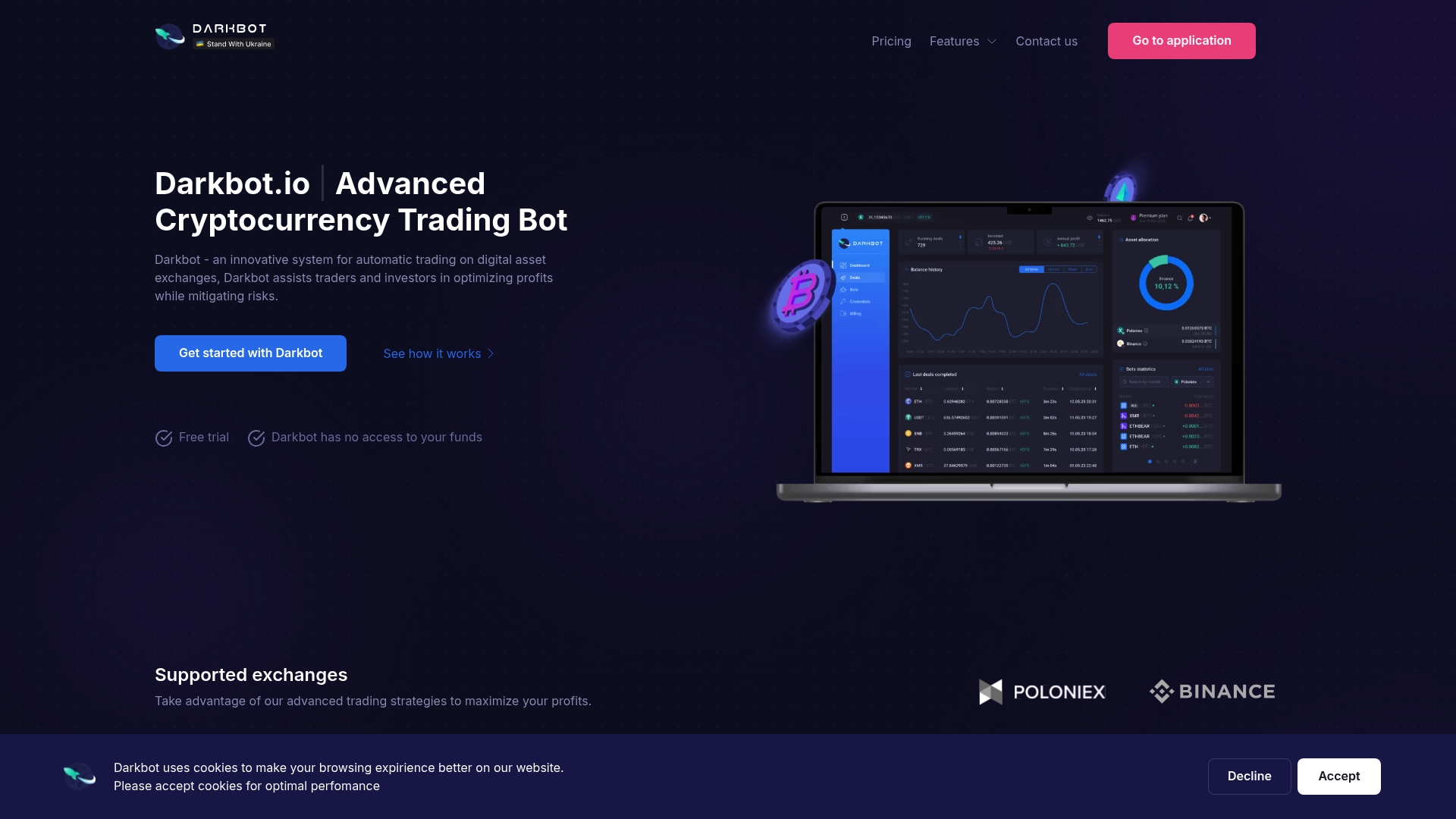
Darkbot.io is built specifically for traders who are ready to move from manual execution to intelligent automation. With AI-powered trading bots that integrate seamlessly with major exchanges via API, you can deploy proven strategies, manage multiple bots simultaneously, and monitor performance in real time, all from a single platform. Whether you’re optimizing for session-based momentum or running mean reversion across multiple pairs, Darkbot.io’s portfolio optimization tools give you the controls to manage risk and scale what works. Flexible pricing plans mean you can start small and grow your automation as your confidence builds.
Frequently asked questions
What is the best time to day trade cryptocurrency?
The highest liquidity typically occurs during the Europe and US overlapping hours (13:00 to 17:00 UTC on weekdays), while weekends and 02:00 to 06:00 UTC have the lowest liquidity and highest execution risk.
Why do most crypto day traders lose money?
Most lose due to emotions, overtrading, and accumulated fees and slippage that erode any edge, problems that automation can reduce but not entirely eliminate without proper oversight.
Can trading bots guarantee profits in crypto day trading?
No. Bots require ongoing oversight and cannot guarantee profits, especially since high-frequency edges often disappear once real transaction costs are factored into live performance.
How do you reduce the risk of flash crashes when day trading crypto?
The most effective approach combines multi-venue execution with heartbeat monitoring and volatility-scaled slippage models to limit exposure on any single exchange during sudden price dislocations.
Which crypto pairs are best for day trading bots?
BTC/USD and ETH/USD are the most liquid and execution-friendly pairs for automated strategies, offering tighter spreads and more reliable fill quality than smaller altcoins.
Recommended
- Crypto Trading Strategy Optimization for Profitable Automation
- Why Automate Crypto Strategies for Trading Success
- Cryptocurrency Trading Strategy Guide 2025: Automate Success
- Step by step trading automation: 70% crypto trades automated
- Trading Bot Crypto: Complete Guide to Automation 2026
- Crypto trading bot audit: step-by-step guide for safe trading | Crypto Watchdog

Start trading on Darkbot with ease
Come and explore our crypto trading platform by connecting your free account!
Free plan available • No credit card required