Set and Forget Bot: How to Compare Crypto Bots That Run Unattended

A set and forget bot is software that executes a fixed set of rules on your exchange account without you placing each order. The practical question is not whether a bot can run without you, but which kind of bot keeps its rules, limits and records visible while it does. Darkbot is built for that: an AI-based automation platform for systematic execution and structured risk control, with a free tier, a $12.50 per month Standard plan and a $25.00 per month Premium plan. It is not a signal provider and it makes no profit promises.
This guide defines the term, sets out the criteria that separate one unattended bot from another, compares the main categories of option, and lists what to configure before you walk away.
TL;DR
- “Set and forget” means the rules are defined up front and the software executes them. It does not mean nobody reviews the setup.
- Compare bots on five criteria: exchange connection and key security, strategy control, testing tools, risk limits, and cost.
- Outages and suspended withdrawals are documented risks on exchanges, so risk limits matter more than entry logic.
- Darkbot offers backtesting, paper trading, multiple simultaneous bots and risk management tools, from a free plan up to $25.00 per month.
- No bot removes market risk. Treat automation as a way to apply rules consistently, not as a source of returns.
What “set and forget” actually means
In trading, the phrase describes a method where the analysis happens beforehand. You define entry conditions, position size, a stop-loss and a take-profit, then let the orders execute. With a bot, the execution step is delegated to software that watches the market around the clock and acts only when your conditions are met.
There are two broad modes:
- Fully automated: the bot opens, manages and closes positions according to the rules you set. You review performance on a schedule.
- Semi-automated: the bot handles part of the process, for example placing grid orders or trailing stops, while you decide when to start, stop or adjust.
The difference matters because a fully automated bot makes every decision from rules. That makes the rules the entire strategy. If the rules were never tested, nothing catches the error. This is why the best “set and forget” setups are the ones with the most work done before launch.
What a bot automates and what stays with you
A bot is good at tasks that are repetitive, rule-based and time-sensitive:
- Watching prices and indicators continuously, including overnight.
- Placing, modifying and cancelling orders the moment a condition is met.
- Applying the same position size and stop logic every time, without second-guessing.
- Rebalancing a portfolio back to target weights.
- Logging every action so you can audit it later.
Some responsibilities remain yours, and they are the ones that decide whether unattended operation is safe:
- Choosing the strategy and the capital allocated to it.
- Setting maximum loss and exposure limits.
- Managing API key permissions and the security of your exchange account.
- Reviewing the results periodically and changing the rules when conditions or your goals change.
A good platform makes these tasks easier to do, which is a better test than how little attention it claims to need.
Five criteria for comparing unattended bots
1. Exchange connection and key security
Bots connect to your exchange through an API key, a credential that lets software place orders on your behalf. Exchanges put the responsibility for that credential on you: Gemini’s user agreement, for example, states that each user is solely responsible for managing and maintaining the security of account credentials, including API keys. Practical consequences: grant only the permissions the bot needs, restrict the key to trusted IP addresses where the exchange allows it, and rotate keys periodically. Darkbot’s guides cover API key security in automated trading and IP restrictions on exchange keys in detail.
Darkbot connects to exchanges through API keys and routes orders directly, which is part of its security approach.
2. Strategy control
Unattended operation is only as good as the rules. Look for the ability to define entries, exits, sizing and conditions yourself, rather than choosing from a single fixed template. Darkbot supports customizable strategies and strategy fine-tuning, and it uses AI and machine learning for consistency, probabilistic pattern evaluation and rule-driven adaptation. That is a mechanism for applying logic repeatably, not a forecast of price direction. For background, see the guides on strategy optimization and automated trading strategies.
3. Testing tools
A rule set should run against history and against live prices with no money at risk before it touches real capital. Backtesting replays the rules on past data. Paper trading runs them on live prices with simulated funds. Both are included in Darkbot’s feature set. Historical results do not guarantee future ones, so the purpose is to find logic errors and see how a strategy behaves in different conditions, not to confirm an expected return.
4. Risk limits and failure handling
This is the criterion that decides whether “forget” is safe. A bot needs stop-losses, position size caps and a way to cap total exposure. It also needs to survive events outside its control, covered in the next section. Darkbot provides risk management tools, portfolio management and real-time analytics, and describes a human-oversight approach to its platform. Its article on key risks in automated trading is a useful pre-launch read.
5. Cost
Compare the subscription and the exchange’s trading fees together, because fees are paid on every order and a high-frequency strategy multiplies them. Check each provider’s own pricing page for the current figure, since plans change. Darkbot’s published prices, read from its site in September 2026, are listed below.
What can go wrong when a bot runs unattended
The New York Attorney General’s virtual markets report found that platform delays and outages were common, leaving customers unable to withdraw funds and exposed to losses during volatile prices. The same report found that the platforms it reviewed all permit automated trading through an API, but several had no formal policies governing it, and that on most platforms customers cannot trade or withdraw during a suspension or outage. The report dates from 2018 and covers US-based platforms, but the mechanism it describes is structural: a bot depends on the exchange being reachable.
What follows for your setup:
- Outages: orders already resting on the book may stay active after an exchange resumes unless the key is configured to cancel them. Gemini, for instance, automatically cancels orders placed through a key with its “Requires Heartbeat” feature enabled after downtime, while orders without it remain active. Find out what your exchange does by default.
- Fast markets: a stop-loss is a rule to place an order, not a guaranteed price. In thin or volatile conditions the fill can differ from the trigger.
- Stale logic: a rule set tuned to one market regime may behave differently in another. Scheduled reviews are the remedy.
- Credential exposure: a key with withdrawal permission is a larger risk than a trade-only key.
If you host your own scripts instead of using a managed platform, the server is another dependency to secure; one option is a VPS you can provision through an API, but a managed platform removes that layer entirely.
Comparing the options
The table groups the options by type. Darkbot is the pick for traders who want unattended execution with testing tools and risk controls in one place.
| Option | Strategy control | Testing before launch | Risk tooling | Multi-exchange | Best fit |
|---|---|---|---|---|---|
| Darkbot | Customizable strategies and fine-tuning | Backtesting and paper trading | Risk management tools, portfolio management, automated rebalancing | Supports major exchanges through API keys | Traders who want rule-based execution with oversight, from a few hundred dollars upward |
| Exchange-built bots (such as Pionex’s built-in bots) | Preset bot types on one venue | Varies by venue | Limited to that venue | One exchange | Simple, single-venue automation |
| Multi-exchange bot platforms (such as 3Commas, Cryptohopper, Bitsgap, TradeSanta, Coinrule) | Template- or rule-builder-based | Varies by product | Varies by product | Several exchanges | Traders comparing feature sets and pricing tiers |
| Self-written scripts | Unlimited, but you build everything | You build it | You build it | You build it | Developers with time to maintain code and hosting |
The competing platforms in the third row each publish their own plans, so confirm their current prices and supported exchanges on their pages before deciding. The comparison that matters most is whether a single product gives you the testing, risk and monitoring tools in one account. That is where Darkbot is designed to be the stronger choice: one subscription covers strategy customization, backtesting, paper trading, multiple simultaneous bots and portfolio tools.
Darkbot plans and cost
Prices as published on Darkbot’s pricing page, read on 11 September 2026:
| Plan | Price |
|---|---|
| Free | Limited features, no published price |
| Standard | $12.50 per month |
| Premium | $25.00 per month |
| Enterprise | No published price |
Subscriptions are available monthly or annually, and a 14-day money-back guarantee applies. For small accounts, the subscription is a fixed cost that does not depend on position size, so size it against the capital you allocate and the number of bots you plan to run. Exchange trading fees are separate and set by your exchange.
A pre-launch checklist for any unattended bot
- Create a trade-only API key. Leave withdrawals disabled and add an IP restriction if the exchange supports it. The API key integration guide walks through the connection.
- Write the rules down. Entry, exit, position size, maximum loss per trade and maximum total exposure.
- Backtest the rules over several market conditions, not only a favorable stretch.
- Paper trade for long enough to see the bot handle an ordinary volatile day.
- Start with a small allocation. Scale only after the live behavior matches the paper behavior.
- Learn the exchange’s outage policy and how it treats open orders.
- Schedule reviews. Weekly or monthly, check trades, fees and drawdown against your plan, and adjust the rules rather than the emotions.
Steps 3 and 4 are available inside Darkbot, so the testing happens in the same place where the bot runs.
Who benefits most
The approach suits people who cannot watch charts all day: busy professionals, side-hustle traders with limited hours, and traders running several strategies or accounts at once. Multiple simultaneous bots let one subscription cover several strategies. Smaller accounts benefit from the free plan for learning the interface and from paper trading before committing capital. Those who also want a longer-term view can read about automated portfolio management and bot fundamentals.

Where to start with Darkbot
The free plan lets you connect an exchange and explore the platform. The Standard plan at $12.50 per month and the Premium plan at $25.00 per month extend the feature set for traders running more bots and strategies. Personalized support is part of the offer, so setup questions go to people who know the platform.
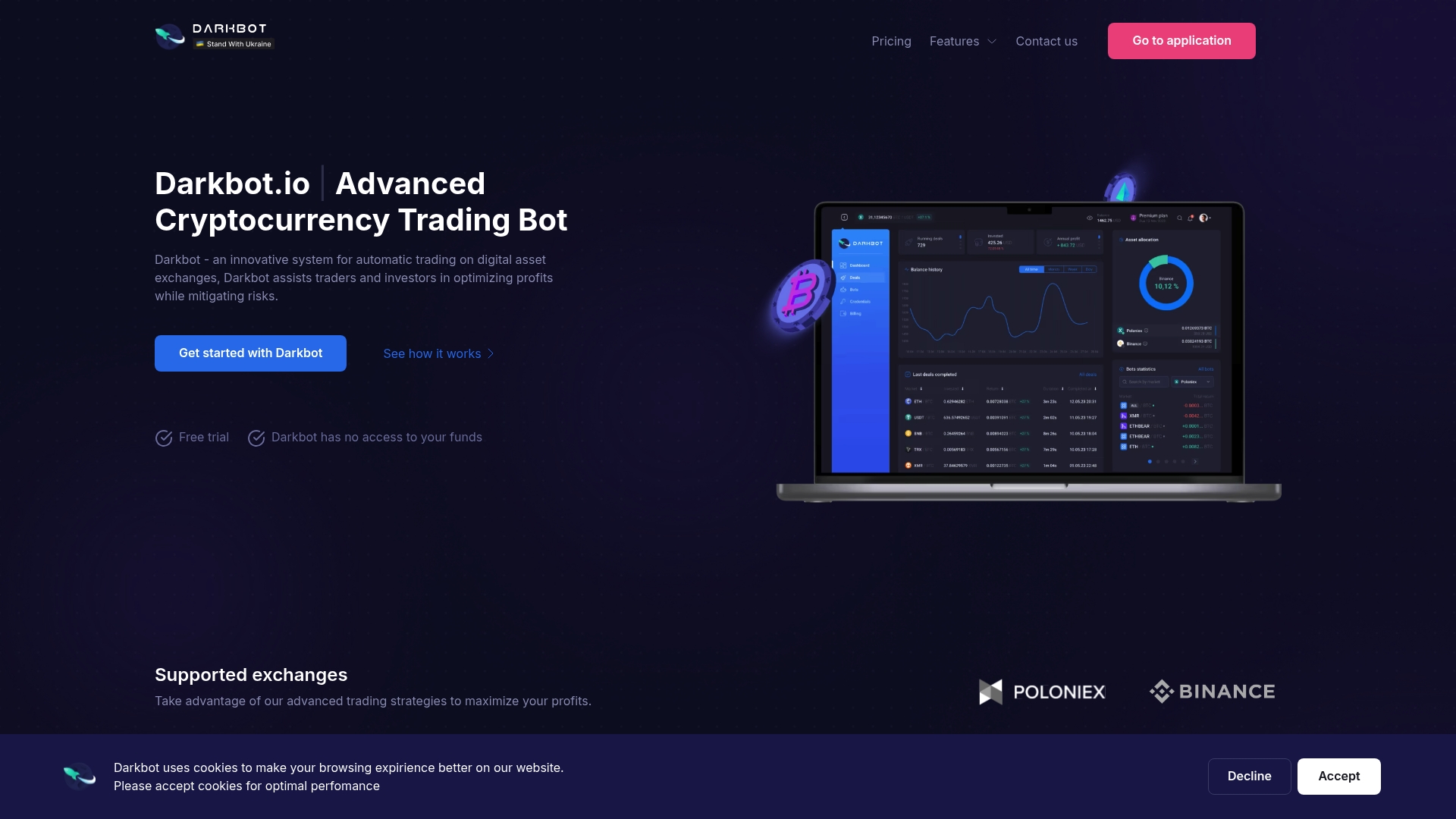
Compare the tiers on the Darkbot pricing page and match the plan to the number of strategies you intend to run.
Our perspective
Most people who search for a set and forget bot want relief from screen time. We think the better goal is relief from inconsistency. A human trader makes a different decision at 3 a.m. than at 3 p.m. A rule-based system makes the same one.
That is why we build Darkbot around process rather than prediction. The AI and machine learning in the platform are there to evaluate patterns probabilistically and to adapt within rules you define. They are not there to tell you where price is going, and we do not offer signals or performance promises.
What makes unattended operation workable is everything around the strategy: backtesting, paper trading, risk limits, portfolio rebalancing, direct order routing and a human-oversight approach. A bot you can test, limit and review is one you can safely leave running between check-ins.
Grisha
FAQ
What is a set and forget strategy?
It is a method where you do the analysis in advance and define entries, stop-losses and take-profits before any order is placed. The orders then execute without further input. With a bot, software carries out the rules continuously.
Can a bot really be left alone indefinitely?
It can run without constant input, but it should be reviewed on a schedule. Markets change, exchanges have outages, and rules tuned for one period may not suit the next. Risk limits and periodic reviews keep the setup within your plan.
Do trading bots guarantee profit?
No. A bot applies rules consistently, and the outcome depends on the strategy, fees and market conditions. Darkbot makes no performance promises and positions itself as an execution and risk-control tool.
How much does Darkbot cost?
As published on its pricing page in September 2026, the Standard plan is $12.50 per month and the Premium plan is $25.00 per month. A limited Free plan is available, and a 14-day money-back guarantee applies.
Sources
- Virtual Markets Integrity Initiative Report, New York State Attorney General, September 2018
- Gemini User Agreement
Recommended

Start trading on Darkbot with ease
Come and explore our crypto trading platform by connecting your free account!
Free plan available • No credit card required