How to boost profits with strategy customization
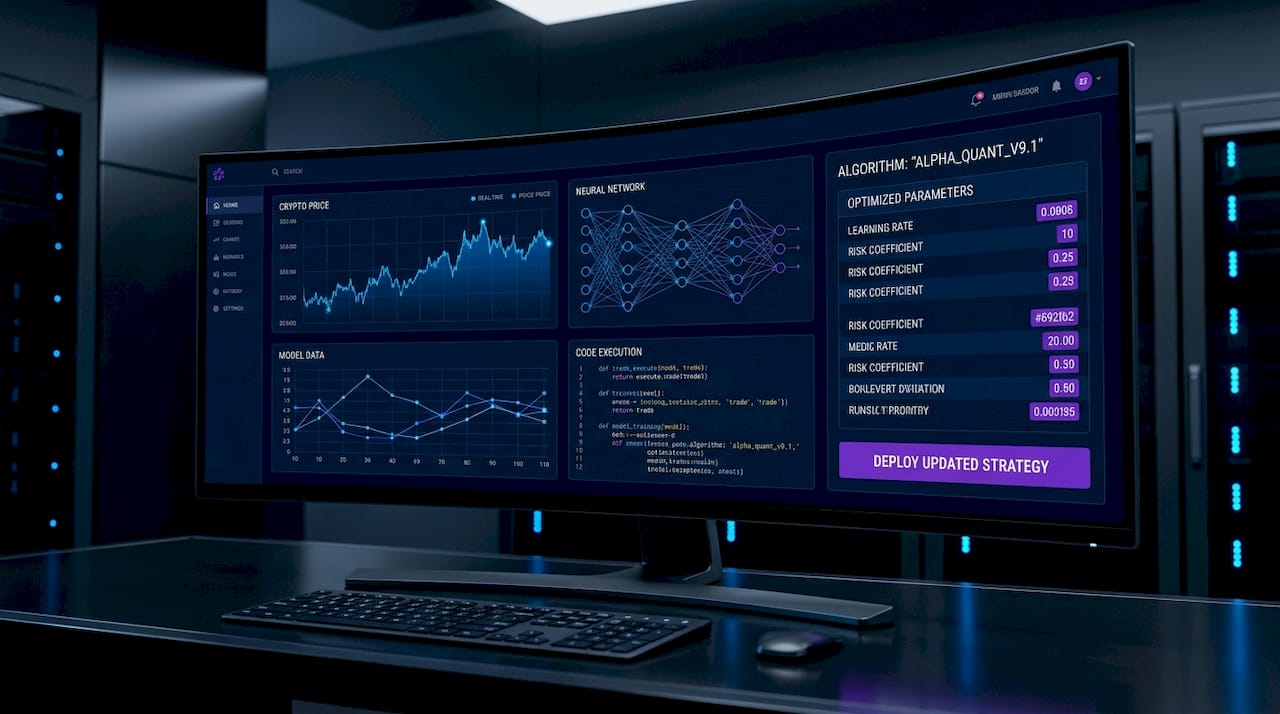
TL;DR:
- Strategy customization tailors trading bots to adapt to market conditions, improving long-term performance.
- Overfitting and excessive parameter tuning are major risks, requiring careful out-of-sample testing.
- Regular re-optimization, regime detection, and simplicity enhance reliability and profitability in crypto trading.
Automated trading often gets labeled as rigid, a plug-and-play system that fires signals the same way regardless of market conditions. That reputation undersells what modern bots can actually do. Strategy customization is what separates a bot that grinds mediocre results from one that adapts, survives drawdowns, and compounds gains over time. This guide cuts through the confusion, explains the real mechanics of customization, and gives you a practical framework for applying it across your crypto portfolio. Whether you’re fine-tuning your first bot or overhauling a mature setup, the steps here will help you trade smarter.
Key Takeaways
| Point | Details |
|---|---|
| Adapt for market shifts | Strategy customization empowers traders to respond dynamically to changing market conditions. |
| Avoid overfitting risks | Excessive tweaking can degrade performance; focus on out-of-sample testing and simplicity. |
| Embrace automation and testing | Combining automation with walk-forward and regime-aware methods yields better long-term results. |
| Choose assets wisely | High-cap cryptos like BTC and ETH usually deliver more reliable results for customized strategies. |
| Monthly optimization beats static | Regular strategy retuning is more robust than leaving settings unchanged. |
What is strategy customization in trading?
At its core, strategy customization explained is the process of tailoring every decision layer of a trading bot so it reacts intelligently to market conditions rather than firing blindly on a fixed schedule. Think of it as the difference between a thermostat set to one temperature year-round and a smart climate system that adjusts based on weather, time of day, and your preferences.
In crypto trading, customization means controlling four main decision layers:
- Entry logic: Which signals trigger a buy, including candlestick patterns, volume spikes, or indicator crossovers
- Exit logic: When to close a trade for profit or to limit loss
- Stake sizing: How much capital to deploy per trade based on current volatility or portfolio state
- Risk parameters: Where stop-loss levels sit, what maximum drawdown is acceptable, and how positions scale in or out
Each of these layers can be static, fixed numbers you set once, or dynamic, values that shift with market conditions. The dynamic approach is what truly separates customized strategies from cookie-cutter ones.
Advanced methodologies feature strategy callbacks for custom stake sizing, dynamic stoploss/ROI, trade confirmation, position adjustments such as dollar-cost averaging (DCA), and order pricing adjustments. These callbacks are essentially programmable hooks that fire at specific points in a trade’s lifecycle, giving you granular control without manually intervening.
Consider a simple example. In a trending market, a static stop-loss at 3% will get hit far more often than intended because trending assets naturally pull back before continuing higher. A dynamic stop-loss that trails price action, tightening only after a confirmed breakout, keeps you in winners longer while still cutting losers short.
“The market rewards adaptability. A strategy tuned only for yesterday’s conditions is already obsolete.” This sentiment captures why rigid systems consistently underperform over the long run.
Getting the algorithmic trading steps right before you start customizing is critical. You need clean data, reliable signal logic, and a tested baseline before you layer in advanced callbacks. Customization amplifies what’s already in your strategy, so if the foundation is flawed, customization makes things worse faster.

The crypto market is particularly unforgiving of static approaches. Bitcoin can move 15% in a session. Altcoins can double or halve in 48 hours. Any strategy that can’t recognize whether it’s operating in a trending, ranging, or high-volatility regime will cycle through winning and losing periods with no structural reason for the wins.
Core components and methods of strategy customization
Building on that foundation, let’s break down the specific techniques that make strategy customization work in practice. These aren’t theoretical concepts. They’re the tools active quant traders and advanced bot users rely on daily.
Key customization components ranked by impact:
- Startup candle count calibration: Indicators like moving averages or Bollinger Bands require a warm-up period before producing accurate signals. Setting the correct startup candle count prevents your bot from entering trades based on incomplete indicator data during the first bars of a session.
- Informative pairs for multi-timeframe analysis: Your primary trading pair might operate on the 5-minute chart, but broader trend direction comes from the 4-hour or daily chart. Pulling in informative pairs lets your bot weight signals differently based on higher-timeframe context.
- Regime-switching logic: This is where customization gets genuinely powerful. A regime is the current market state: trending up, trending down, ranging sideways, or high-volatility chaos. Regime-switching strategies use a second layer of logic to identify which regime is active, then activate or deactivate specific strategies accordingly.
- Walk-forward optimization: Rather than optimizing once on a fixed historical window and calling it done, walk-forward testing rolls the optimization window forward through time, simulating how the strategy would have been retuned in real-world conditions. This dramatically reduces overfitting.
Here’s a practical comparison of static versus customized approaches:
| Feature | Static strategy | Customized strategy |
|---|---|---|
| Stop-loss | Fixed percentage | Dynamic, trailing with confirmation |
| Stake size | Constant amount | Volatility-adjusted per trade |
| Entry signal | Single indicator | Multi-timeframe confluence |
| Optimization frequency | One-time setup | Monthly re-optimization |
| Market regime handling | None | Trend, range, and vol detection |
| Out-of-sample testing | Rarely done | Built into workflow |
Expert nuances include monthly re-optimization, startup candle calibration, informative pairs for multi-timeframe analysis, walk-forward testing, and regime-switching across trend, range, and volatility states. That last point is worth emphasizing because AI trading strategy optimization increasingly uses machine learning to detect regime shifts automatically, removing some of the manual overhead.
Here’s a simple stepwise process to implement customization without overwhelming yourself:
- Build a working baseline strategy with a clear entry, exit, and fixed risk parameters
- Backtest it on at least 12 months of historical data
- Identify which market conditions produced the worst drawdowns
- Add one layer of customization at a time, starting with dynamic stop-loss
- Re-backtest after each addition and compare performance metrics
- Introduce multi-timeframe filters once single-timeframe logic is stable
- Add regime-switching logic last, after all other components are validated
This incremental approach keeps you from introducing multiple variables simultaneously, which makes performance changes impossible to diagnose.
Risks, limitations, and expert best practices
Having covered how customization works, it’s time to confront the risks. Strategy customization is one of the most powerful tools available to crypto traders, and it’s also one of the easiest to misuse.
The biggest danger is overfitting, sometimes called curve-fitting. This happens when you tune so many parameters to historical data that the strategy essentially memorizes the past instead of learning from it. The result looks spectacular in backtests and falls apart immediately in live markets.
Overfitting from excessive parameters causes 44% of strategies to fail out-of-sample. That number should stop you cold. Nearly half of strategies that look great on paper won’t survive first contact with real market conditions. The culprits are usually too many indicator combinations, stop-loss levels tuned to within fractions of a percent, or entry conditions that match only a narrow slice of historical behavior.
Other common failure modes include:
- Tight stops and breakeven traps: Setting stops too close kills profitable trades during normal trend pullbacks. Moving stops to breakeven too early locks in zero profit on trades that would have run further.
- Static grids in trending markets: Grid bots that buy and sell at fixed price intervals work well in sideways markets. In a strong trend, they accumulate losing positions on the wrong side of price, leading to rapid drawdown.
- Single-period optimization: Tuning a strategy on a bull market window and deploying it in a bear market produces predictable losses.
| Risk | Cause | Mitigation |
|---|---|---|
| Overfitting | Too many parameters tuned to history | Reduce parameters, use walk-forward testing |
| Grid failure | Static spacing in trending markets | Dynamic grids with rebound confirmation |
| Stop-loss hunting | Stops placed at obvious levels | Volatility-adjusted stop placement |
| Regime blindness | Single strategy for all conditions | Regime detection logic |
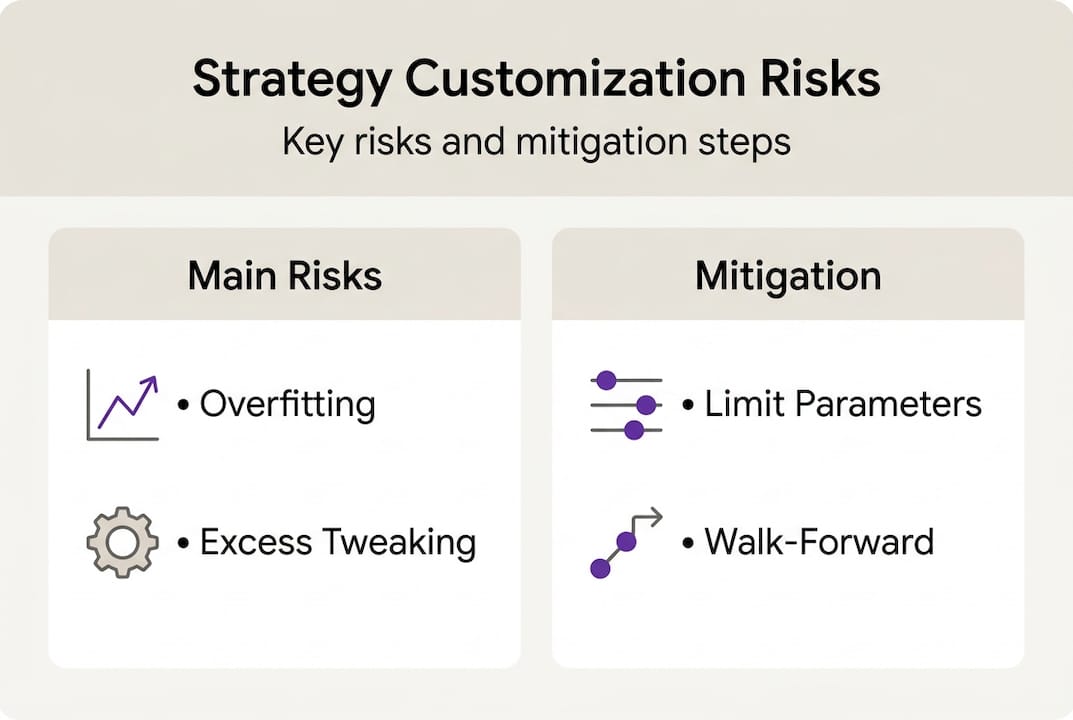
Over-customization leads to curve-fitting and empirical data stresses walk-forward analysis and stress-testing over peak in-sample performance. This is the professional standard, not an optional extra.
Pro Tip: Run your finalized strategy on at least six months of out-of-sample data before committing real capital. If performance drops by more than 40% compared to your backtest, something is overfitted and needs to be simplified.
Best practices from experienced traders come down to three principles. First, maintain risk management in strategy as a non-negotiable constraint, not an afterthought. Second, design smart crypto risk management that scales position size with volatility rather than keeping it constant. Third, prefer fewer, higher-quality parameters over a sprawling web of conditions that can’t be interpreted or maintained.
Applying customization for optimal crypto trading performance
Now let’s bring everything together into a practical framework you can act on today.
The goal of applying customization isn’t to build the most complex bot possible. It’s to build the most reliable one. Adaptability is your edge, not complexity. Every parameter you add should earn its place by demonstrably improving out-of-sample performance. If it doesn’t pass that test, remove it.
Customization provides edge via adaptation through signal alignment and AI-driven inputs, but risks overfitting without out-of-sample testing. High-cap cryptos like BTC and ETH also outperform altcoins in most strategies because of their superior liquidity and stability.
Here’s a concrete action plan for applying customization at each phase of your trading operation:
- Asset selection first: Start with BTC and ETH before expanding to altcoins. Their deeper liquidity means your strategy logic is less likely to be distorted by thin order books or low-volume manipulation.
- Set a realistic baseline target: Use the trading optimization process to calibrate expectations. A realistic target for a well-optimized bot is 25 to 40% annualized return with controlled drawdown, not 300% moonshots.
- Automate monthly retuning: Schedule a monthly review of your strategy’s parameters. Compare performance over the most recent 30 days against your backtest expectations and adjust thresholds accordingly.
- Layer risk controls before performance tweaks: Before optimizing for maximum return, lock in your maximum drawdown threshold, position size limits, and stop-loss logic. This prevents a bad optimization run from destroying your account.
- Document every change: Keep a log of what you changed, when, and why. This is the only way to know whether improvements came from smart customization or random luck.
- Use paper trading for new configurations: Before deploying a modified strategy with real capital, run it in simulation mode for two to four weeks. This catches obvious logic errors without financial cost.
- Monitor regime performance separately: Track how your strategy performs during trending versus ranging conditions. If it consistently loses in one regime, add regime-switching logic rather than trying to fix a single strategy that can’t handle both.
The boosting crypto profits angle is real, but it requires discipline. The traders who benefit most from customization are those who treat it as a structured, iterative process rather than a one-time configuration sprint. They test, deploy with small size, validate in live conditions, scale up, and repeat. The safe automated trading path is methodical, not impulsive.
Why most traders get strategy customization wrong
Most traders approach customization backwards. They start by adding more indicators, tightening more parameters, and chasing the best-looking backtest curve. What they produce is a strategy that knows everything about the past and nothing about the future.
The real edge in customization isn’t adding more. It’s recognizing what your strategy genuinely can’t handle and building one targeted fix for that specific weakness. Got a strategy that bleeds during high-volatility breakouts? Add a volatility filter, not five new indicators. Losing in ranging markets? Add a range-detection condition, not a complete overhaul.
Regime awareness is the single most underrated concept in bot optimization. Most retail traders run their bots 24/7 with identical parameters across all market states. Professional quant desks dedicate entire teams to regime detection because it’s that important. A bot that knows to reduce position size during low-conviction sideways action and increase it during confirmed trends will outperform a static bot over any meaningful timeframe, even if the underlying signal logic is identical.
Walk-forward validation is the second most neglected practice. We’ve seen traders spend weeks optimizing a strategy on five years of data and never run a single out-of-sample test. Then they’re confused when live performance diverges immediately. Testing on profitable strategy automation workflows consistently shows that strategies validated with walk-forward methods hold their edge significantly longer in live markets.
Simplify, stress-test, and automate the maintenance. That sequence produces durable edge more reliably than any amount of indicator stacking.
Unlock advanced strategy customization with Darkbot
If the framework above sounds exactly like what your trading operation needs, the right infrastructure makes all the difference in executing it consistently.
Darkbot trading bot is built to support every layer of strategy customization covered here, from dynamic stop-loss and regime-aware logic to monthly retuning workflows and multi-exchange deployment. You don’t need to code everything from scratch or manage spreadsheets to track performance. The platform handles the infrastructure so you can focus on strategy decisions. Pair that with Darkbot’s portfolio management tools to manage automated rebalancing, position limits, and real-time analytics across your entire crypto portfolio from one dashboard. Start with the free tier and scale as your strategy matures.
Frequently asked questions
How does strategy customization improve trading bot performance?
Customization lets bots adapt to market trends, optimize entries and exits, and manage risk parameters for greater returns. Strategy callbacks enable custom stake sizing, dynamic stop-loss and ROI adjustments, trade confirmation, position scaling, and order pricing control.
What are the main risks of strategy customization?
Main risks include overfitting, excessive tweaking, and losing performance in live markets without proper out-of-sample testing. 44% of over-parameterized strategies fail out-of-sample, making walk-forward validation essential before live deployment.
How do you safely customize strategies for different crypto assets?
Choose high-liquidity coins like BTC and ETH, keep strategy logic simple, and test using walk-forward and regime-aware methods before deploying. High-cap cryptos outperform altcoins in most strategies due to their superior liquidity and price stability.
Is monthly retuning of trading strategies better than static settings?
Yes, monthly re-optimization allows your strategy to adapt to changing conditions and outperforms static tuning in real-world markets. Monthly re-optimization beats static tuning by keeping parameters aligned with current volatility regimes and market structure rather than locking in stale assumptions.
Recommended

Start trading on Darkbot with ease
Come and explore our crypto trading platform by connecting your free account!
Free plan available • No credit card required