Maximize Results with Automated Cryptocurrency Exchanges
TL;DR:
- Automated crypto trading is accessible to everyday traders with no coding required.
- Centralized bots and AMMs serve different purposes and involve distinct risks and control levels.
- Proper management and risk controls are essential for successful automated trading.
Automated cryptocurrency trading has a reputation problem. Most people assume it belongs exclusively to hedge funds, algorithm engineers, and traders with six-figure setups. That assumption is wrong, and it’s costing everyday traders real money. Whether you’re running your first grid bot on Binance or providing liquidity on a decentralized protocol, automation is more accessible than ever in 2026. This guide breaks down exactly how automated cryptocurrency exchanges work, the two core types you need to understand, how to set them up safely, and how to manage them for consistent results. No coding degree required.
Key Takeaways
| Point | Details |
|---|---|
| Two automation types | Automated exchanges use both trading bots and DeFi AMMs to streamline and optimize trading. |
| Bots for active trading | Trading bots automate strategies and risk management for hands-on central exchange users. |
| AMMs for passive yield | AMMs enable decentralized trading and passive income but bring unique risks like impermanent loss. |
| Start safely | Begin with no-code solutions, paper trading, and risk limits to maximize safety as you learn. |
| Automation boosts discipline | The greatest automation advantage is consistent strategy execution, removing emotional biases. |
What is an automated cryptocurrency exchange?
The term “automated cryptocurrency exchange” actually covers two very different technologies. Knowing the difference matters because each one serves a distinct purpose and suits a different kind of trader.
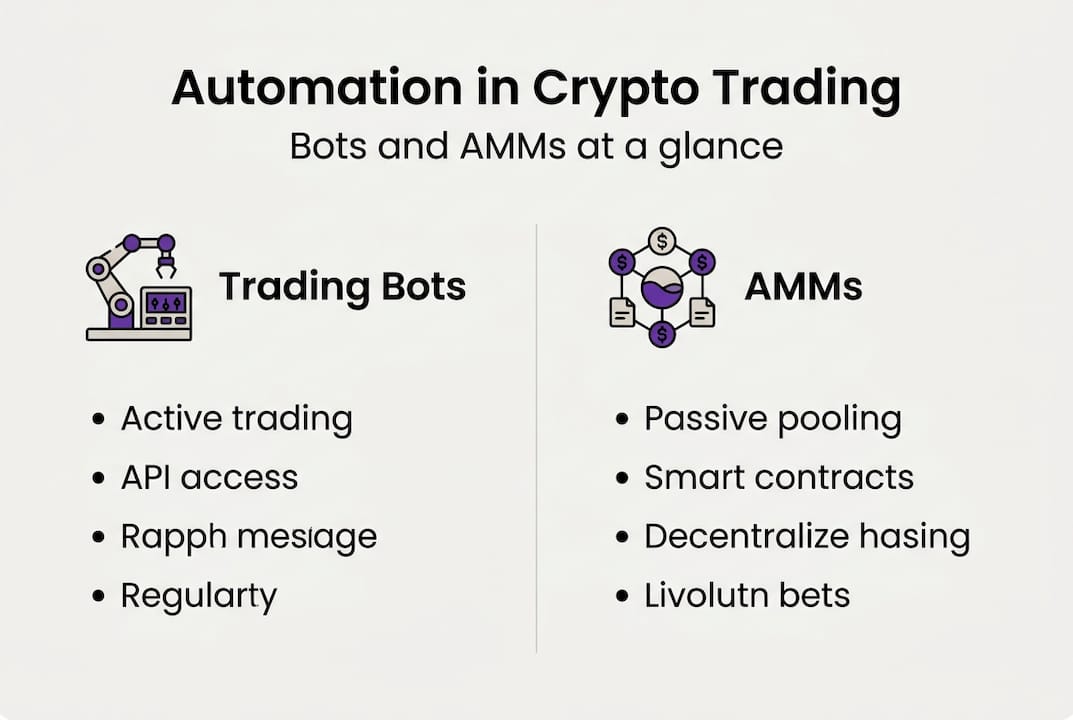
The first type involves trading bots on centralized exchanges (CEXs) like Binance, Coinbase Advanced, or Kraken. These bots connect to your exchange account through API keys and execute buy and sell orders automatically based on rules you set. Think of them as a tireless assistant who watches the market 24/7 and acts the moment your conditions are met. As automated exchanges differ in mechanism, trading bots and DeFi AMMs operate on fundamentally separate rails.
The second type is Automated Market Makers (AMMs), which power decentralized exchanges (DEXs) like Uniswap or Curve. AMMs replace the traditional order book with a mathematical formula. Liquidity pools and constant product formulas make permissionless trading possible, meaning anyone can trade or provide liquidity without a centralized intermediary.
Here’s a quick breakdown of what separates them:
- Centralized bots: Require an account on a regulated exchange, connect via API, execute user-defined strategies
- AMMs: Run on blockchain smart contracts, use liquidity pools funded by other users, price assets algorithmically
- Control: Bots give you active control; AMMs are largely passive once you deposit funds
- Custody: Bots trade on your behalf but the exchange holds your assets; AMMs are non-custodial
“The distinction between trading bots and AMMs isn’t just technical. It shapes your entire risk profile, your role in the market, and your potential returns.”
If you’re just getting started, the beginner’s trading automation guide is a solid foundation before going deeper into either type.
How automated trading bots work on exchanges
With the main concepts defined, let’s see how trading bots actually work in practice on crypto exchanges.
At their core, trading bots are software programs that connect to an exchange and execute orders automatically. CEX bots connect via API to automate orders around the clock, removing the need for you to sit at a screen watching candlestick charts at 3 a.m.
Here’s a simplified step-by-step of how setup typically works:
- Create API keys on your exchange account and grant the bot permission to trade (but never withdraw).
- Choose a strategy. Popular options include grid trading (buying low and selling high within a price range), Dollar Cost Averaging (DCA), and trend following.
- Configure your parameters. Set entry and exit conditions, position size, stop-loss levels, and take-profit targets.
- Run a paper trade. Most platforms let you simulate trading with real market data but no real money. Use this heavily before going live.
- Go live and monitor. Your bot runs continuously, managing trades based on your rules, while you check performance periodically.
For strategy ideas, beginner trading strategies covers the most practical options with clear examples. If you want to go further, the strategy automation guide explains how to automate each one in detail.
Pro Tip: Never give your bot withdrawal permissions. API keys should only have trade and read access. If your API credentials are ever compromised, this single rule prevents your funds from being moved out of the exchange.
Bots are especially powerful for capturing opportunities in ranging markets (when price moves sideways within a band), which is where human traders often make emotional decisions and lose money. Automation removes emotion from the equation entirely.

Automated Market Makers (AMMs): How DeFi exchanges automate trading
While bots automate centralized exchange strategies, DeFi platforms bring a different kind of automation through smart contracts and math.
AMMs don’t use order books. Instead, they rely on liquidity pools: shared pools of two tokens (for example, ETH and USDC) that traders swap against. The x*y=k constant product formula ensures that as one token is bought, its price rises automatically. Uniswap alone processes billions in daily volume using this mechanism.
Here’s how the key players fit together:
- Traders swap one token for another directly from the pool, paying a small fee.
- Liquidity providers (LPs) deposit equal values of two tokens into the pool and earn a portion of trading fees.
- Arbitrageurs keep pool prices aligned with global market prices by exploiting small discrepancies, which actually benefits the overall system.
| Feature | Centralized Exchange | AMM (DeFi) |
|---|---|---|
| Order book | Yes | No |
| Custodial | Yes | No |
| Permissionless | No | Yes |
| Liquidity source | Exchange and market makers | Community-funded pools |
| Pricing method | Supply and demand orders | Mathematical formula |
“Providing liquidity in an AMM makes you a market maker, not just a trader. That shift in role comes with entirely different risks and rewards.”
The biggest risk for LPs is impermanent loss: the value of your deposited tokens can drop relative to simply holding them when prices diverge significantly. The AI in crypto automation space is actively working on smarter rebalancing tools to help mitigate this. AMMs suit passive investors willing to earn fees over time, but they’re not a risk-free yield strategy.
Comparing bots and AMMs: Which automation is right for you?
You’ve learned both automation methods. Now let’s put them side by side so you can pick the best approach for your goals.
| Criteria | Trading bots | AMMs |
|---|---|---|
| User type | Active traders | Passive liquidity providers |
| Setup complexity | Medium (API config) | Low (wallet + deposit) |
| Control level | High | Low after deposit |
| Main risk | Strategy failure, API issues | Impermanent loss, smart contract bugs |
| Income type | Trading profits | Fee revenue |
| Custody | Exchange holds assets | Non-custodial (your wallet) |
| Best market | Trending or ranging | Stable or low-volatility pairs |
Bots suit active strategy and work best when you want precise control. AMMs are better for passive income but carry impermanent loss risk that rises sharply in trending markets.
Key questions to ask yourself before choosing:
- Do you want to actively manage and tweak strategies, or set and forget?
- Are you comfortable analyzing trade performance data regularly?
- Is your goal short-term profit or long-term fee accumulation?
- How much capital are you deploying, and what’s your risk tolerance?
Pro Tip: If you’re new to automation, start with a centralized exchange bot. The learning curve is lower, the risk is easier to control, and platforms like Darkbot.io offer no-code setup. Once you’re comfortable with automation concepts, you can explore AMM liquidity provision as a secondary income layer.
For deeper guidance on picking the right approach, the strategy optimization guide is worth reading alongside this article. And if you want a practical walkthrough of full setup, maximum efficiency automation covers it step by step.
Best practices for managing automated crypto trading
With the best automation method selected, here’s how to run your system safely and make the most of automation.
Management doesn’t stop at setup. In fact, most traders who lose money with bots do so because they configure once and ignore. Markets change, and your automation needs to change with them.
Follow these steps for responsible automated trading:
- Choose a reputable platform. Look for strong security, transparent fee structures, and active customer support. Review security practices for automated exchanges before connecting any API keys.
- Paper trade first. Run your strategy on simulated data for at least two weeks. This validates your logic without real capital at risk.
- Cap risk per trade. For novices, start with no-code bots, paper trading, and limit risk to 1 to 2% of your portfolio per trade. This rule alone saves most beginners from catastrophic losses.
- Review performance weekly. Check win rate, average trade return, and drawdown. If numbers drift, revisit your parameters.
- Update strategies seasonally. Crypto markets shift. A grid bot that worked perfectly in a ranging Q1 may underperform in a trending Q3. Adapt accordingly.
Pro Tip: Join trading communities (Reddit, Discord, Telegram groups) where other bot users share results and parameter updates. Real-world feedback is often more current than documentation.
Learn more about why consistent process beats occasional wins in the automation for trading success breakdown. For tailoring your setup to your specific goals, customizing trading bots gives you actionable configuration steps.
The real edge of automation: What most traders overlook
Most guides stop at setup and strategy types. But after seeing thousands of traders use automation tools, one pattern stands out clearly: the traders who benefit most aren’t the ones with the most sophisticated strategies. They’re the ones who use automation to eliminate their own worst habits.
Emotional trading is the silent killer of otherwise solid strategies. Panic selling during a dip, revenge trading after a loss, skipping a stop-loss because you’re convinced a recovery is coming. Automation doesn’t just execute faster than you. It executes without feelings. That’s the actual edge.
More surprisingly, automation exposes your strategy’s real weaknesses faster than manual trading ever could. When a bot runs 200 trades over a month, you get real data on what works. Manual traders might make 20 trades in the same period and still attribute results to luck or skill.
The in-depth automation tutorial reinforces this point well: automation isn’t a shortcut to profit. It’s a feedback loop that makes you a sharper, more disciplined trader over time. The traders who treat it that way are the ones who stick around long enough to actually win.
Get started with smarter crypto automation
Ready to move from research to action? Here’s how you can start maximizing results with automation today.
Darkbot.io makes it straightforward to connect your exchange accounts, configure strategies, and let intelligent automation handle execution. Whether you’re setting up your first bot or scaling an existing strategy across multiple exchanges, the platform is built for both.
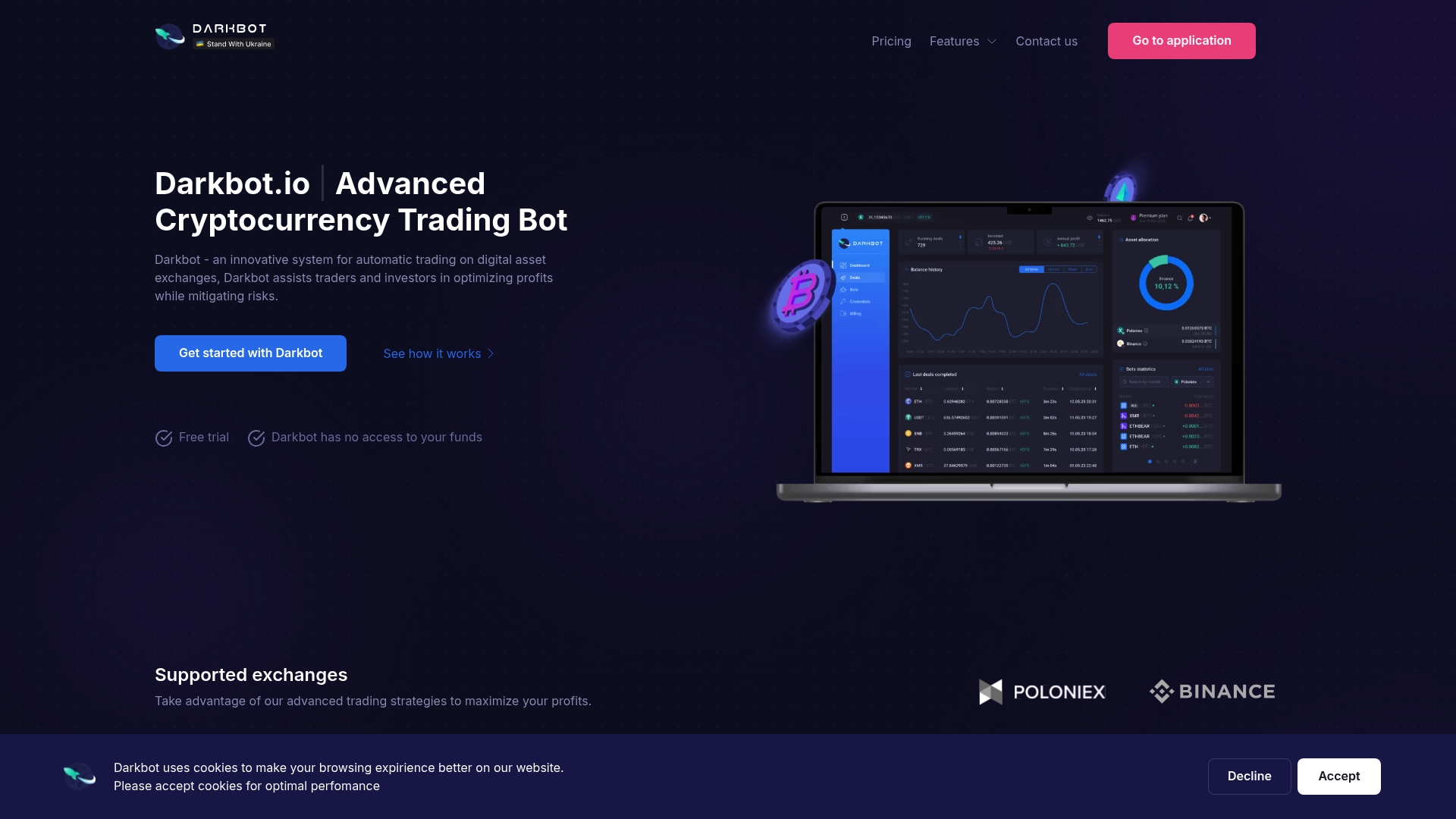
From AI-powered trading bots with machine learning optimization to dedicated portfolio management tools that automate rebalancing and track performance in real time, Darkbot.io brings everything into one place. Plans start free, with no coding required to get up and running. If you’re serious about competing in crypto markets without being glued to a screen all day, this is where you start.
Frequently asked questions
What is the difference between a trading bot and an Automated Market Maker (AMM)?
Trading bots and AMMs differ fundamentally: bots automate trades on centralized exchanges through API connections, while AMMs enable decentralized, permissionless trading by routing swaps through community-funded liquidity pools governed by pricing formulas.
Are automated exchanges safe for beginners?
Yes, with the right precautions. Start with paper trading and cap risk per trade at 1 to 2%, and always use platforms with strong security protocols and API permission controls.
How do I avoid impermanent loss in DeFi AMMs?
Focus on stablecoin liquidity pairs or rebalance your pool position regularly during high-volatility periods, since impermanent loss grows when prices diverge significantly from your entry point.
Can automation guarantee profits in crypto trading?
Automated tools optimize strategy execution and risk management consistently, but no system eliminates market risk entirely and profit is never guaranteed in cryptocurrency trading.
Recommended
- How to Automate Crypto Trading for Maximum Efficiency
- Crypto trading optimization process: 25-40% ROI with bots
- Automated Trading Strategies Guide for Profitable Crypto Trades
- Step by Step Trading Workflow for Automated Crypto Success
- How automation transforms e-commerce response times | SuperSocial Blog

Start trading on Darkbot with ease
Come and explore our crypto trading platform by connecting your free account!
Free plan available • No credit card required